


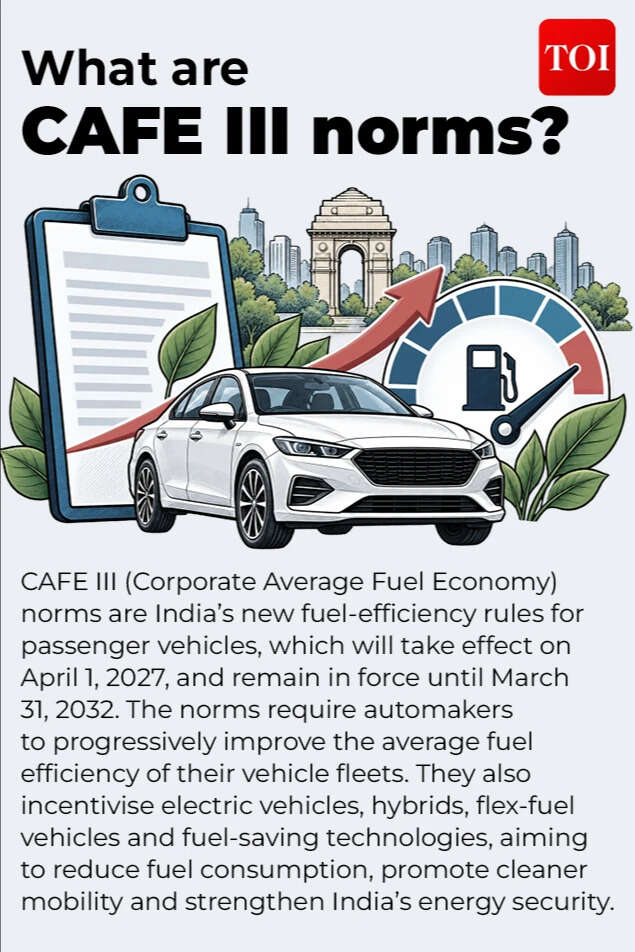
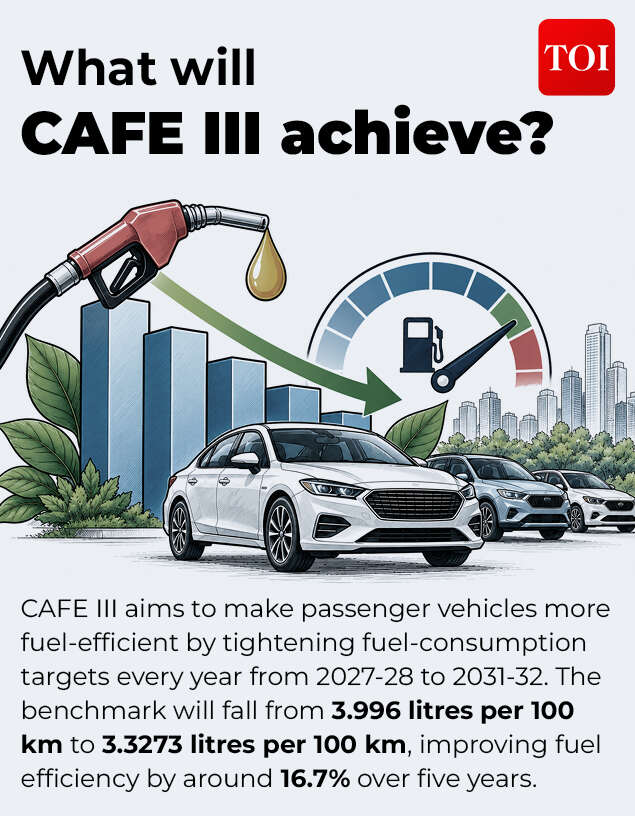
What if your next car saves you more at the fuel station but costs more in the showroom?That is the next big question as Indian consumers are asking themselves while the government prepares to roll out its new Corporate Average Fuel Economy (CAFE III) norms from April 1, 2027.Over the next five years, carmakers will have to make their passenger vehicle fleets progressively more fuel-efficient, potentially bringing more efficient petrol cars, hybrids, electric vehicles (EVs) and alternative-fuel models to the market.Notified by the ministry of power, the new rules will remain in force until March 31, 2032. They tighten fuel-consumption targets while offering incentives for cleaner technologies and ethanol-blended fuels. The fleet-average benchmark will fall from 3.996 litres per 100 km in 2027-28 to 3.3273 litres per 100 km in 2031-32, an improvement of around 16.7%.But what does that mean for your wallet? Will your next car go further on every litre, or will the technology needed to improve efficiency add to its price?The answer will depend on how automakers respond, and which car you choose.
Will your next car be cheaper to run?
Under the new norms, automakers will have to meet fuel-efficiency targets based on the average performance of their entire passenger vehicle fleet, rather than each model individually. This will require carmakers to factor in the efficiency of their overall line-up when deciding which vehicles to develop, manufacture and sell.Jyoti Prakash Gadia, managing director of Resurgent India Limited, said the framework tightens efficiency requirements. It also adds new fleet-weighting rules and incentives for clean technology.“The primary modification made by CAFE III is to bring about increasingly stringent fuel economy pathway in conjunction with new fleet weighting and clean technology incentive provisions,” Gadia told TOI.He added that the framework strengthens the earlier fleet-averaging system. This, he said, was in response to rising car ownership and changes in automotive technology.Pankaj Sharma, founder and managing director of K2 Infragen Limited, said the stricter standards were necessary as the growing number of vehicles increased energy consumption. Improving transport efficiency would also help India reduce pollution and dependence on oil.For buyers, this could mean more fuel-efficient models on offer as carmakers work to meet their targets. Better engines, hybrid systems and electrification can cut energy use. Actual savings, though, will depend on the vehicle, driving conditions, fuel or electricity prices and how far you drive each year.The norms do not guarantee lower running costs for every owner. They set requirements for manufacturers’ fleets. They do not fix a fuel-efficiency figure or a saving for any single model.
Will car prices rise under CAFE III?
The cost of complying will depend on how each carmaker chooses to improve its fleet. More efficient engines, electrification and engineering changes could raise the price of some models. Competition and higher volumes may limit that rise over time.Gadia said the impact will differ from one manufacturer to another. He expects buyers to have a range of choices, including efficient petrol cars, hybrids, EVs and alternative-fuel vehicles.“Efficient Engines, Comprehensive Electrification, and Engineering might raise the cost of certain models but this would be limited due to competitive pressure and expected economies of scale from increasing volumes,” he said.Sharma also said the impact on prices would vary between brands and technologies. While more efficient engines and other innovations could increase costs, competition and economies of scale could help contain the rise.The rules could also push carmakers to review their line-ups, especially models that drag down their fleet average. Still, CAFE III does not force them to give up petrol engines or follow one technology path.For buyers, the difference between the purchase price and the total cost of owning a car will matter more. A costlier car can work out cheaper over several years if savings on fuel or electricity cover the extra price. The result will depend on the price gap, yearly usage, maintenance and energy costs.Gadia said buyers should remember that the purchase price is only one part of the calculation. The cost of running the car over its lifetime counts too.
Salient features of the CAFE III norms
EVs, hybrids and flex-fuel cars get a boost
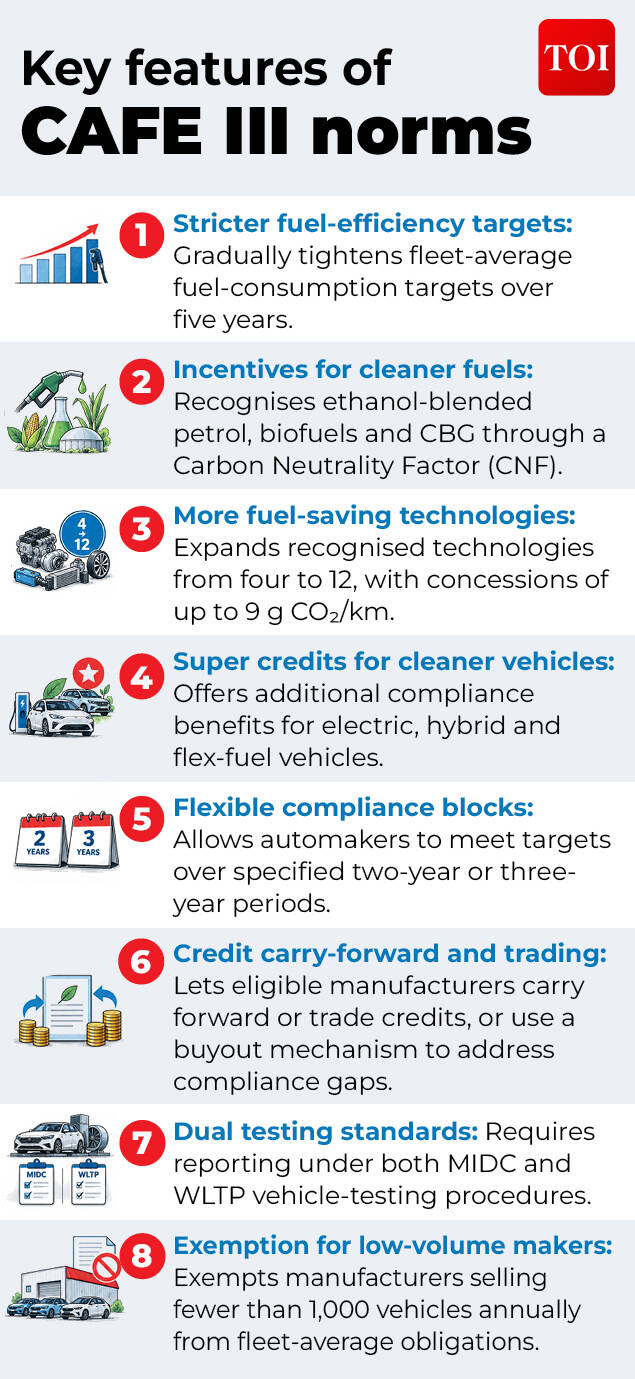
CAFE III does not push carmakers towards a single route. Instead, it gives them incentives and room to choose different technologies.Battery electric vehicles (BEVs), range-extended electric vehicles (REEVs), plug-in hybrids (PHEVs), strong hybrids (SHEVs) and flex-fuel ethanol vehicles get volume derogation factors, commonly called super credits.These factors give such vehicles extra weight when a company’s fleet average is calculated, giving carmakers a reason to sell more of them.Under the notified framework:
- BEVs and REEVs get a factor of 3.0.
- PHEVs get 2.5, as do strong hybrids that run on flex-fuel ethanol.
- Strong hybrids get 1.6.
- Flex-fuel ethanol vehicles get 1.1
These incentives could eventually shape manufacturers’ future investment and product plans. But how many new models actually arrive will also depend on consumer demand, vehicle costs, charging infrastructure and fuel availability.“Absolutely, the regulations make EVs, hybrids and alternative fuel vehicles more attractive as these cars are seen as helping overall fleet efficiency in the interest of sustainability,” Gadia said.He cautioned that not every carmaker will take the same path. “But it doesn’t imply that all car manufacturers will use only one trajectory and phase out regular engines,” he added.Sharma said the incentives would encourage manufacturers to produce more electric, hybrid and alternative-fuel vehicles, but affordability, demand and manufacturing capacity would continue to influence their decisions.He also highlighted the importance of infrastructure in determining which vehicles consumers can conveniently use.“The role of infrastructure will be important for choosing convenient vehicles. It is hardly possible to call a good car convenient if there are no places where one could recharge or refuel it,” Sharma told TOI.For infrastructure providers, the shift towards cleaner vehicles also underlines the importance of dependable electricity supplies and transport connections. The availability of vehicles and the infrastructure required to operate them will need to develop together.Carmakers will therefore keep weighing market demand, financial viability, manufacturing capacity and infrastructure before choosing their technologies.
Ethanol and alternative fuels enter the compliance equation
CAFE III introduces a Carbon Neutrality Factor (CNF). It gives credit to certain renewable and low-carbon fuels when a fleet’s compliance is calculated.CNF treatment applies, under set conditions, to petrol vehicles running on ethanol blends, flex-fuel ethanol vehicles and compressed natural gas (CNG) vehicles. The rules set the following factors on tailpipe carbon dioxide emissions:
- Ethanol-blended petrol vehicles: 8%
- Flex-fuel ethanol vehicles: 22.3%
- CNG vehicles: 5% or the notified compressed biogas blending percentage, whichever is higher
- Diesel vehicles: depends on the applicable biofuel blending percentage
This gives carmakers one more way to meet their fleet targets, alongside better efficiency and electrification.Dr CK Jain, president of the General Ethanol Manufacturers Association (GEMA), said recognising ethanol was significant because India’s clean-mobility transition need not rely on electrification alone.“Ethanol offers a domestically produced, renewable fuel pathway that can complement vehicle electrification, reduce dependence on imported crude oil and create sustained demand for agricultural feedstocks,” Jain said.GEMA said the recognition of ethanol could encourage investments in flex-fuel and electrified flex-fuel technologies. Greater adoption could also strengthen the domestic ethanol value chain, supporting farmers and rural industries through sustained demand for agricultural feedstocks.The association said the need for cleaner transport went beyond reducing emissions. India also needs to strengthen energy security and create sustainable demand for domestically produced fuels.A framework that supports multiple decarbonisation pathways could allow automakers to innovate while helping India build on its existing ethanol ecosystem. However, the policy incentives will need to translate into greater availability of compatible vehicles, wider adoption of flex-fuel technology and higher ethanol consumption.For buyers, the real impact will depend on whether carmakers launch more compatible vehicles. It will also depend on whether suitable fuel and servicing are easy to find.
Aim behind CAFE III norms
Twelve fuel-saving technologies eligible for incentives
The list of recognised fuel-saving technologies grows from four to 12. This lets carmakers improve efficiency without changing the powertrain alone.The 12 technologies are:
- Start-stop systems
- Tyre-pressure monitoring
- Regenerative braking
- Six-speed or higher transmissions
- Efficient alternators
- Motor-generators
- Exterior LED lighting
- Advanced glass and glazing
- Electric water pumps
- High-efficiency air-conditioning
- Solar-reflective paint
- Pulse-width-modulated radiator fans
For each eligible technology in a vehicle, a manufacturer can claim a cut of 1g of CO₂ per km, up to a cap of 9g CO₂ per km. The Ministry of Road Transport and Highways will develop the certification methods.Verification rules differ across the compliance period. In the first block, carmakers can claim savings through self-declaration. In the second block, claims must be backed by validated test results.This lets carmakers combine several small improvements across their models. Some of these cut energy use without asking buyers to switch fully to EVs.
New weight-based targets and compliance flexibility
CAFE III also changes how a vehicle’s weight affects its fuel-consumption target. The reference weight rises from 1,082 kg to 1,229 kg, an increase of about 13.6%.The revised target line is meant to be more weight-sensitive. Lighter vehicles get relatively softer targets, while heavier ones must meet tougher efficiency requirements.The applicable standard is worked out with a formula based on the average unladen mass of vehicles made or imported for sale in India. The constants in the formula change over the five years as the benchmarks tighten.Carmakers also get some flexibility in how they comply:
- Those that beat their target can earn credits and carry them forward within the compliance block.
- Those that fall short can use eligible credits, swap credits with other manufacturers, or buy credits through the Bureau of Energy Efficiency’s buyout mechanism.
- The buyout price will rise from Rs 2,500 per g CO₂/km in 2027-28 to Rs 4,500 in 2031-32.
- Credit trading will happen in a set annual window, and compliance will be checked at the end of each block.
Manufacturers selling fewer than 1,000 eligible vehicles in a reporting period are exempt from the fleet-average obligations.
Things car buyers should keep in mind
What should buyers consider from April 2027?
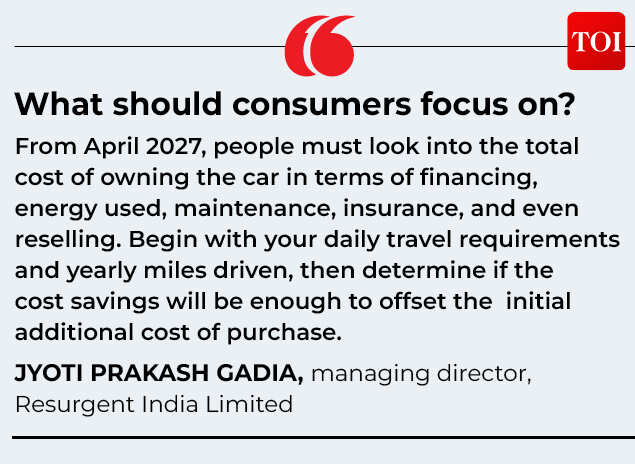
The standards will apply to new passenger vehicles made or imported for sale in India from April 1, 2027. That does not mean every car bought after that date will be cheaper to run.Gadia advised buyers to look at their travel needs and yearly mileage first. Only then can they judge whether the likely energy savings justify a higher upfront price.“From April 2027, people must look into the total cost of owning the car in terms of financing, energy used, maintenance, insurance, and even reselling,” he said.Sharma similarly advised consumers to consider their travel requirements, budgets and available infrastructure before making a purchase. For EV buyers, this includes assessing the possibility of charging at home, the reliability of public charging facilities, battery guarantees and after-sales service.Those considering hybrids or alternative-fuel vehicles should check fuel availability and the reach of maintenance networks. Sharma also stressed that safety remains important because fleet-level efficiency standards do not mean all individual models perform equally.Gadia also advised EV buyers to check access to reliable charging and the battery warranty. Across all categories, safety, reliability, insurance, maintenance and resale value will still matter.The economics will differ from buyer to buyer. Someone who drives long distances every year has more room to recover a higher purchase price through lower energy bills. Someone who drives little may not. So buyers should compare their expected savings with the upfront premium, rather than assume a more efficient car is always cheaper overall.
Share your thoughts in the comments
Be respectful · TOI community guidelines
CAFE III aims to push the passenger vehicle industry towards steadily better fleet efficiency while letting carmakers choose from several technologies. Its effect on buyers will depend on how carmakers respond, how fast cleaner technologies arrive and how much of the efficiency gain shows up as lower real-world energy use.The takeaway for car buyers is to look beyond the showroom price. The new rules may bring more efficient cars to the market, but whether your next car is cheaper to run will depend on the model, the technology, the cost of energy and how you use the vehicle.