

Brazilian football legend Cafu believes that his nation’s friendly against India next month could leave a mark beyond the final whistle. For young Indian footballers, he feels, seeing Brazil’s iconic yellow shirt up close could be inspiration enough to dream bigger.
The 2002 World Cup-winning Brazil captain acknowledged the gulf in rankings between the two teams but said Indian players would benefit from the experience when the sides meet at the Vivekananda Yuba Bharati Krirangan (Salt Lake Stadium) in Kolkata on October 3.
“If you go by the rankings, there is a significant difference between Brazil and India, but football has modernised. Today, everyone plays on equal terms. You saw this in the World Cup, where national teams like Curaçao and Cape Verde played on equal terms with all the big national teams,” Cafu said during a visit to the Pillai University on Friday.
“We hope that Brazil and India can play a great game. It will benefit the Indian people (fans) and the Indian national team, which will face a team that is a five-time world champion,” Cafu said, adding: “Now that FIFA has expanded the World Cup, opening up space for other countries, it will be important for India as well…”
A World Cup winner in 1994 and captain of Brazil’s fifth title-winning side in 2002, Cafu has visited India before and has seen enough to know that the game needs to reach deeper into the country. For him, that starts with children.
“(India should) encourage children to play football, advertise the sport, and study the great footballing schools. Look at Japan, South Korea, and China. They brought in Brazilian coaches and Brazilian players, and began to popularise football. This helped these countries to grow, and India can do this too,” Cafu said.
ALSO READ | India vs Brazil tickets — When and how to buy tickets for the historic Indian football match?
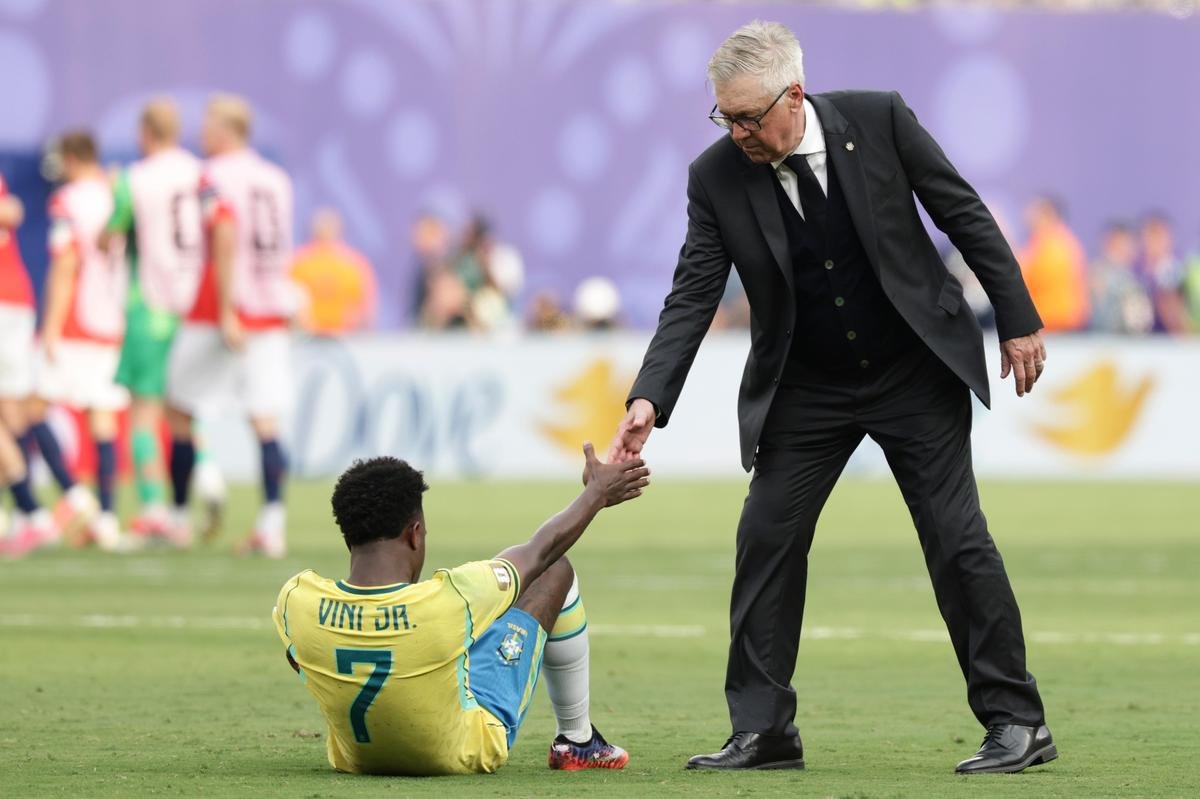
Brazil, meanwhile, has its own catching up to do. Its latest World Cup campaign ended in the Round of 16, extending a wait that has increasingly begun to weigh on a football nation accustomed to winning.
“We see that every change is necessary in football. Brazil has been going through a difficult period when it comes to the national team, because it has been more than 24 years that we have been without winning a World Cup title,” he said.
“You cannot compare it to the era when we played in practically three consecutive World Cup finals. It is a new generation with new players, and we have to root hard so that this new era and these new players can achieve what we achieved – reaching a World Cup final,” Cafu said with a wry smile.
“The World Cup is not an exact science. The best do not always win, and the champion is not always the best team. It is a sequence of factors that makes you win a World Cup. I am very hopeful that Brazil can win the World Cup in 2030 and end this 28-year drought…”
Brazil’s latest World Cup campaign ended in the Round of 16, extending a wait that has increasingly begun to weigh on a football nation accustomed to winning.
| Photo Credit:
AP

Brazil’s latest World Cup campaign ended in the Round of 16, extending a wait that has increasingly begun to weigh on a football nation accustomed to winning.
| Photo Credit:
AP
There is a familiar debate in Brazilian football over young players leaving for Europe before they have fully developed at home. Some believe it has diluted the tactical and cultural identity of the national team. Cafu sees it differently.
“When I played my third consecutive World Cup final, I was playing in Italy. All national teams, except for the 1994 team, had the majority of their players playing outside the country, playing in other teams that were not Brazilian clubs. Of course, if you look at the very beginning in 1994, the majority of the players played in Brazil, but this is also an evolution that occurred in football,” Cafu said.
“Today, young Brazilian players are leaving earlier for other countries, and because of that, perhaps they do not develop an identity with the Brazilian national team, an identity with the Brazilian people. Perhaps what is missing most for our Brazilian national team is a bit more Brazilianness in these players — feeling the weight of what it means to play for a Brazilian club, going to the Brazilian national team, and only then going abroad to another country…”
Cafu knows something about changing the way a position is played. As a right-back, he turned what was once primarily a defensive role into a relentless two-way job, covering enormous distances and repeatedly appearing in attack.
“In our era, the fullback was a fullback; the wing-back covered the midfield, covered the defence, went to the byline, crossed, and came back consecutively. As a fullback, I once ran 22 kilometers in a single match, such was the intensity with which we played,” he said with a smile.
“Today, I see that most fullbacks are having a bit more difficulty because most coaches are playing with two open wingers, which restricts the fullback’s overlapping runs and prevents them from reaching the byline. But we were stubborn fullbacks. We did not listen much to what the coach said, and we just loved to play. That is why we attacked and defended with the same intensity…”
And when the conversation finally turned to the eternal comparison — Messi or his old Brazil team-mate Ronaldo — Cafu did not need long to think. Asked who he would rate higher between the two, he smiled. “Ronaldo…”
Published on Sep 04, 2026