

[ad_1]
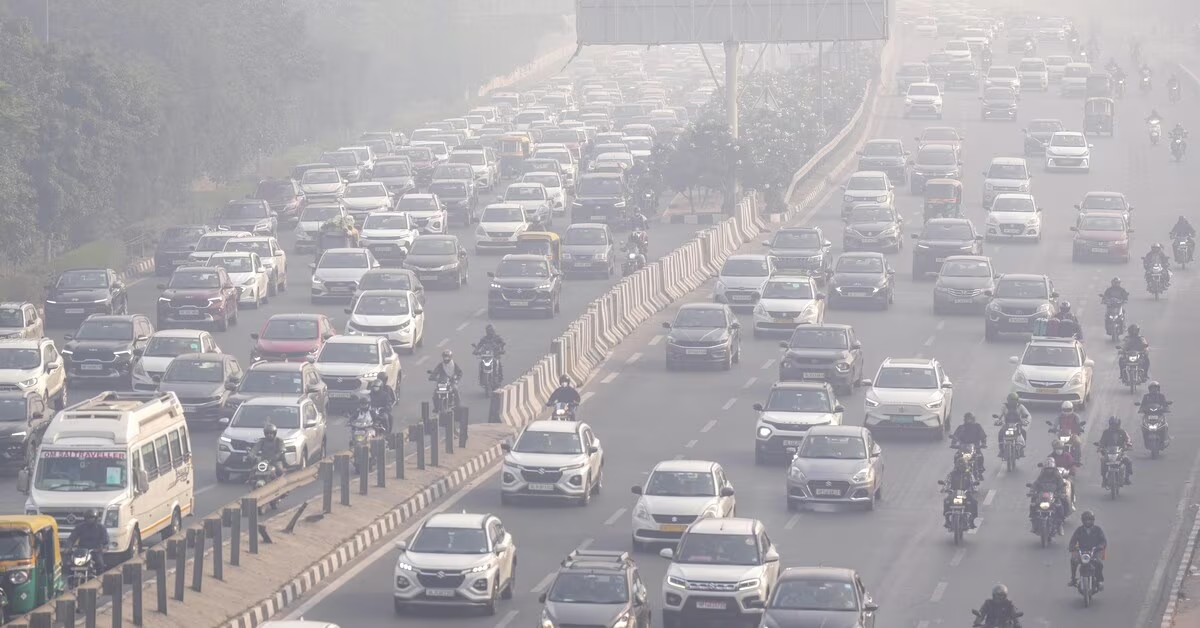
The Commission for Air Quality Management (CAQM) on Wednesday announced phased restrictions on the registration of light goods vehicles (LGVs) running on Compressed Natural Gas (CNG), petrol and diesel in Delhi-NCR as part of efforts to reduce air pollution.
Under the new directive, no new CNG, diesel or petrol Light Goods Vehicle (LGV) weighing below 3,500 kg (N1 category) will be allowed to register in Delhi from January 1, 2027. The restrictions will extend to the NCR districts of Gurugram, Faridabad, Sonipat, Ghaziabad and Gautam Buddha Nagar from July 1, 2027. N1 refers to a motor vehicle used for carrying goods and having a gross vehicle weight not exceeding 3,500 kg.
During a meeting chaired by CAQM chairperson Rajesh Verma on Wednesday, the commission approved mandating the registration of cleaner modes of LGVs in Delhi-NCR in a phased manner. The move comes in view of the significant contribution of the vehicular sector to PM2.5 emissions in Delhi-NCR and the disproportionately high particulate emissions from LGVs.
Phased restrictions on N2 LGVs
CAQM also announced phased restrictions on the registration of N2 LGVs, which refer to vehicles with a maximum weight between 3,500 kg and 7,500 kg.
Only electric N2 LGVs will be allowed to be registered in Delhi from January 1, 2028. The restriction will come into force in Gurugram, Faridabad, Sonipat, Ghaziabad and Gautam Buddha Nagar from July 1, 2028, and in the rest of NCR from January 1, 2029.
The move comes after Delhi’s new Electric Vehicle Policy, notified on July 30, 2026, mandated that only electric N1 category goods vehicles would be allowed for fresh registrations in the national capital from January 1, 2027. The CAQM directive expands the transition plan to other key NCR districts, with the aim of reducing emissions from commercial vehicles and improving air quality across the region.
Tighter norms for stone crushing units
The commission also announced tighter norms for stone crushing units in NCR. CAQM seeks to strengthen control of fugitive dust emissions by incorporating the dust mitigation measures prescribed under the Central Pollution Control Board’s (CPCB) Environmental Guidelines for Stone Crushing Units, 2023, into the consent to operate (CTO) conditions of stone crushing units.
Technology-enabled continuous remote monitoring, including video surveillance, PM2.5/PM10 sensors and wheel washing, has also been provided for effective enforcement.
Meanwhile, financial assistance was approved for four R&D projects recommended by the Project Evaluation and Appraisal Committee (PEAC) under the Call for Proposals 2025-26. The projects cover road dust exposure, mechanical road sweeping technologies, particulate matter profiling and source apportionment in high-rise buildings, and forecasting of rice residue burning. The total approved financial assistance is ₹32,556,393 for two years.
[ad_2]
Source link