

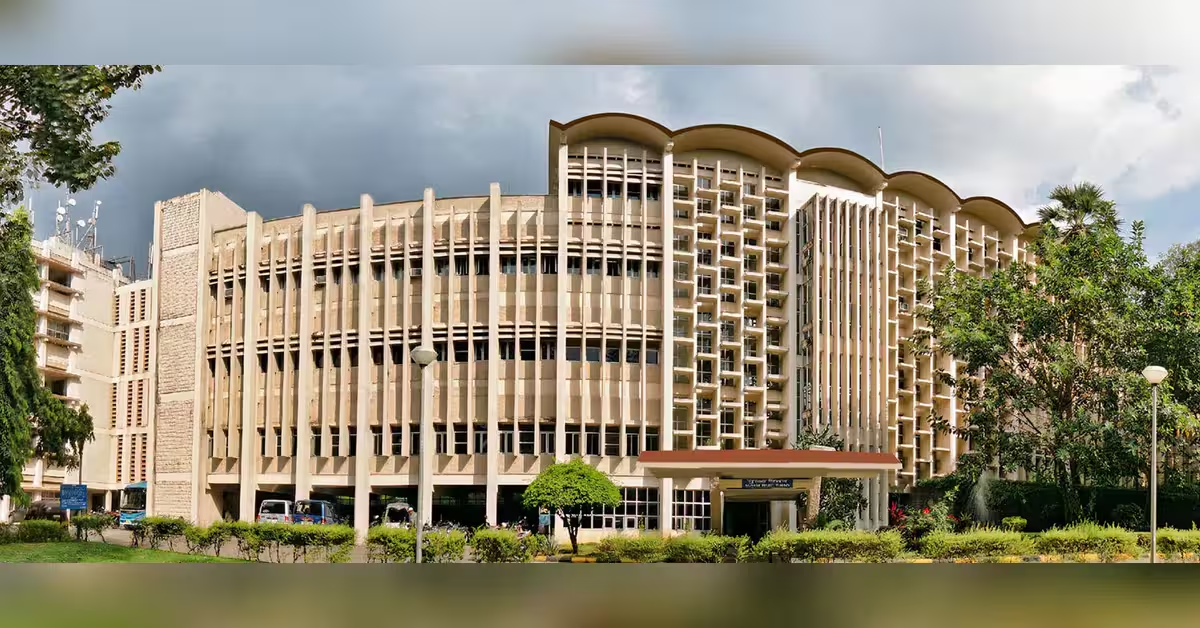
The death of a second-year BTech student at IIT Bombay has renewed concerns over academic pressure, caste and social exclusion on campuses.
The incident has also brought attention to the National Task Force on student mental health and suicides. Set up by the Supreme Court in March 2025, the NTF is due to submit its final report by November. Its interim report flags several campus fault lines.
Thousands of students dropped out
The NTF, using data cited in parliamentary questions, found that more than 13,600 students from disadvantaged communities dropped out of premier institutions between 2018 and 2023. During this period, 4,596 OBC, 2,424 SC and 2,622 ST students left central universities. At IITs, the numbers were 2,066 OBC, 1,068 SC and 408 ST students. At IIMs, 163 OBC, 188 SC and 91 ST students dropped out.
Social gap on campuses
The NTF also highlighted a gap between the social composition of students and faculty in higher education. It said that around 60 per cent of students come from SC, ST or OBC communities, while 56 per cent of faculty members belong to socially advantaged groups.
The gap is more visible in Institutes of National Importance (INIs), which include IITs and NITs. The report said only 7.57 per cent of faculty in these institutions were from the SC community and 1.91 per cent from the ST community. About 67.71 per cent were from “privileged backgrounds”.
The disparity was even sharper in state private universities, where SC and ST faculty accounted for 3.59 per cent and 1.68 per cent, respectively, while nearly 67 per cent belonged to “privileged” backgrounds.
According to the report, this social mismatch can contribute to “low academic integration”. It cited research linking such conditions with depression, dropouts and suicide.
The report also said discrimination and harassment can lead to alienation, lower confidence and a fractured sense of belonging, and said that counselling alone would not address these problems unless institutions also tackle discriminatory practices.
Academic competition adds to student stress
The NTF’s discussions with IIT faculty pointed to what it called a “relentless culture of academic competition” at leading institutions.
The report said academic success is often measured through grades, ranks and placement packages. This can make students “reduce their entire personality into numbers”.
The task force found that relationship problems were an important source of stress at some engineering colleges and central universities. At IITs, however, students also faced pressure arising from “unrealistic expectations of being IITians and myths of guaranteed success”.
Caste and reservation also emerge as fault lines
The report said some IIT faculty members believed that students enter the institutions without clear academic goals and may end up pursuing courses they did not originally want.
Faculty members told the panel that “intense competition was linked to reservation politics”.
The pressure around grades was another concern. The NTF noted that amid CGPA cut-offs, “many approach faculty aggressively, demanding higher marks or grade revisions” based on its discussions with IIT faculty.
The report’s field findings also pointed to anti-reservation views, caste jokes, micro-aggressions and differential academic attention as forms of discrimination faced by students from disadvantaged communities. It recommended mandatory diversity sensitisation programmes and measures to reduce caste-based bias.
‘Vibe check’ and social exclusion
The NTF cited reports suggesting that the dominant “campus culture”, while “not explicitly casteist, can involve a so-called vibe check”. According to the report, students from disadvantaged sections often fail this informal test, which can leave them feeling excluded and isolated.
The report cited an earlier study of IIT students in which students from socially disadvantaged backgrounds described exclusion from campus cultural and social spaces based on factors such as English fluency, city background and perceived social fit.
The NTF’s student surveys, which had higher representation from Tamil Nadu, Gujarat and Karnataka as well as SC, ST and OBC communities, found that 34 per cent of students felt like an “outsider” on campus. About 15 per cent said they had experienced a period of “very distressed” feelings in the previous six months, while 9 per cent reported experiencing “suicidal thoughts” often.
The panel also flagged discrimination faced by disabled students and women students.
Mental health support remains a concern
The NTF noted that IITs have expanded mental health support services over the years. However, it said many institutions still lack “systematic screening mechanisms” and integrated reporting systems involving faculty and hostel staff. As a result, institutions may become aware of a student’s mental health crisis only after it has escalated.
The NTF’s preliminary survey of higher education institutions found that more than 70 per cent reported no full-time mental health service providers. Fewer than 4 per cent had suicide risk management protocols, while 45 per cent had not conducted faculty sensitisation workshops in the previous 18 months.
NTF calls for institutional changes
The NTF’s interim recommendations include filling vacant faculty posts within three months, while key leadership vacancies such as those of vice-chancellors and registrars should be filled within a month.
It has also recommended time-bound and uniform reporting of all student suicides and unnatural deaths, including cases occurring outside campus, in hostels or PG accommodation.
On mental health, the NTF has called for qualified professionals, clear protocols to protect confidentiality, regular anonymous feedback on services and better training in crisis intervention. It has also recommended faculty and administrative training to identify academic, financial, social and discrimination-related stress among students.
The report has also called for clearing pending scholarships and ensuring that students are not prevented from appearing in examinations, attending classes or staying in hostels because of delays in scholarship disbursal.