
[ad_1]
The Union government has moved the Supreme Court against a Punjab and Haryana High Court ruling that declared Section 147A of the Income Tax Act unconstitutional, a decision that has raised questions over the validity of reassessment proceedings conducted by jurisdictional tax officers.
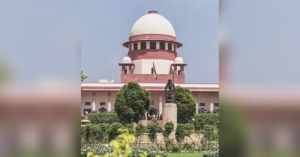
Additional Solicitor General N Venkataraman, appearing for the Centre, on Wednesday sought an urgent hearing of the Centre’s special leave petition (SLP) before Chief Justice of India Surya Kant. The CJI agreed to have the matter listed on an urgent basis.
Seeking an early hearing, Venkataraman told the court that the High Court ruling had created a “huge vacuum” in the law and that the issue was being closely followed by taxpayers.
The challenge concerns the statutory framework governing reassessment proceedings under Sections 148 and 148A of the Income Tax Act, particularly the respective roles of the jurisdictional assessing officer (JAO) and the National Faceless Assessment Centre (NFAC).
The dispute gained prominence after the introduction of the faceless assessment regime. A key question before the courts was whether jurisdictional officers retained the authority to independently issue reassessment notices under Section 148 and pass orders under Section 148A, or whether such functions were required to be routed through the faceless assessment mechanism.
The Punjab and Haryana High Court, in Income Tax Officer, Ward 2(1), Chandigarh v Tej Partap Singh, was among the courts that invalidated reassessment proceedings initiated by jurisdictional officers where the prescribed faceless procedure had not been followed. Some other High Courts, however, adopted a different interpretation of the statutory scheme.
Against this backdrop, Parliament retrospectively introduced Section 147A with effect from April 1, 2021. The provision stipulated that references to the “Assessing Officer” in Sections 148 and 148A would mean an assessing officer other than the National Faceless Assessment Centre.
The amendment effectively sought to preserve the jurisdiction of jurisdictional officers to undertake reassessment-related functions, notwithstanding the earlier judicial rulings concerning the faceless mechanism.
The Punjab and Haryana High Court subsequently examined the constitutional validity of Section 147A and struck it down. The court held that legislation could not retrospectively alter the legal position merely by declaring that a position contrary to earlier judicial findings was valid.
The High Court found that the provision attempted to overcome the effect of judicial decisions holding the earlier reassessment procedure legally defective rather than curing the underlying legal infirmity. It consequently held the retrospective legislative intervention to be impermissible.
The Centre’s challenge before the Supreme Court will now bring the validity and effect of Section 147A into focus, including the extent to which Parliament can retrospectively alter the statutory basis of reassessment proceedings following judicial pronouncements on the issue.
[ad_2]
Source link