

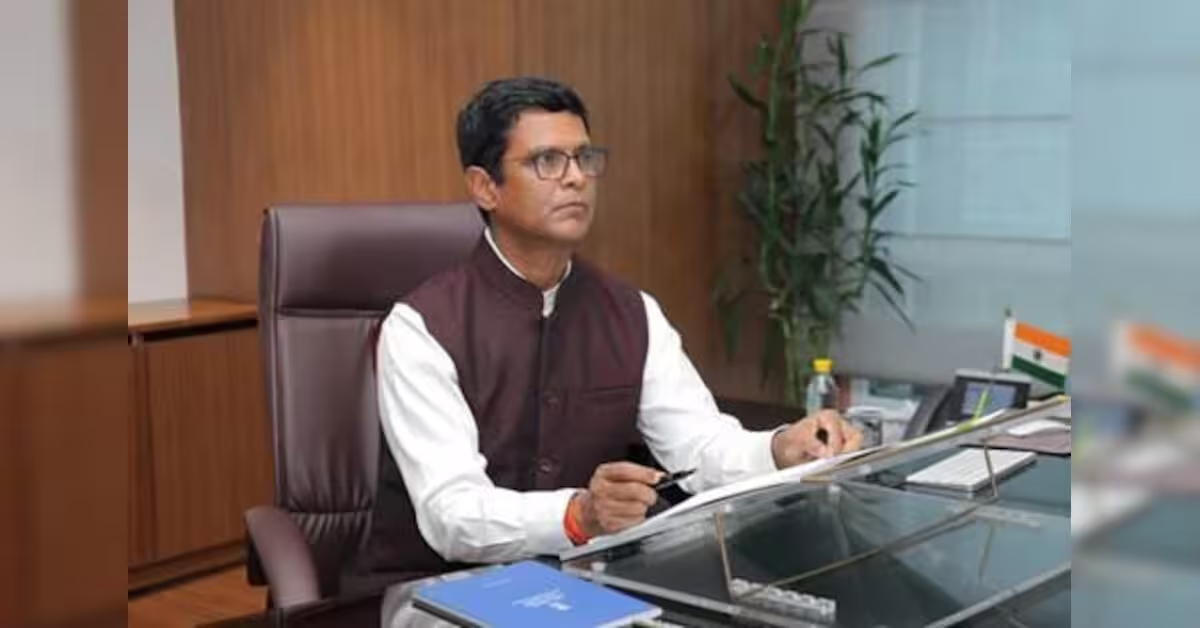
The Ministry of Mines is likely to finalise a policy on stockpiling critical minerals within a month, Mines Secretary Keshav Chandra said on Friday. The policy will lay down protocols for releasing the minerals to users, including the quantities to be released and the eligible recipients.
“We are also looking at creating a stockpile of critical minerals and are making very, very elaborate plans for it,” Chandra said on the sidelines of an Assocham event in New Delhi. It was not feasible to mine every mineral domestically, he said, adding that India needed an alternative mechanism for those that were “not sufficiently available” within the country.
“The protocol for this stockpile is very elaborate. When do you release, what quantities you release, and who all do you release it to? So all these things become very, very important. That’s why stockpiling is slightly different from godowns,” he said.
The proposed stockpile will add to India’s efforts to secure critical minerals essential for advanced manufacturing and reduce dependence on China, which dominates key segments of the global supply chain.
Under the ₹34,300 crore National Critical Mineral Mission, the Centre has been allocating domestic mineral blocks to private and public sector players through auctions. State-backed Khanij Bidesh India Ltd (KABIL) is exploring overseas assets for acquisition, while the mines ministry has announced a ₹1,500-crore scheme to recover critical minerals from recycled products. The Union Budget for 2026-27 also announced dedicated rare earth corridors across Odisha, Kerala, Andhra Pradesh and Tamil Nadu to support the mining, processing and manufacturing of rare earths.
Chandra said no country had all critical minerals within its borders, while strategic requirements made access to these materials essential in varying quantities. India would need to rely on recycling and overseas sourcing to meet its requirements, he said.
Building domestic processing capacity is another priority. Chandra said India needed to ensure that black mass, a material recovered from recycling lithium-ion batteries and containing valuable metals, was processed within the country rather than exported.
He also called for the development of domestic technologies for critical-mineral processing, saying countries with established capabilities were reluctant to share their technologies.
Separately, Chandra urged mining companies to begin production from auctioned mines without prolonged delays, saying failure to operationalise them was hurting the economy.
“There is a tendency to take over the mine and not operationalise it for quite some time. Now it is actually a disservice to the economy,” he said. Prompt operationalisation would benefit the economy and help save foreign exchange spent on mineral imports, he added.
Chandra also called for greater domestic value addition before minerals were exported, urging India to examine practices followed by other mineral-producing countries.
“The entire world has almost moved to that standard. You go to Chile, you go to Latin American countries, South American countries, everywhere it is almost the same policy. We also have to look at the same thing,” he said, referring to the export of minerals after beneficiation.