

[ad_1]
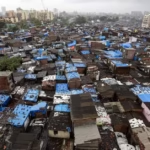
The financial capital is on track to record its driest June in over a decade, with the late onset of the rains straining the city’s water reserves.
Why has BMC cut water supply?
Mumbai is dependent on seven lakes outside the city for its water supply. These lakes are Bhatsa, Upper Vaitarna, Middle Vaitarna, Modak Sagar, Tansa, Vihar and Tulsi. They have a combined useful storage capacity of about 1.45 trillion litres and supply around 4,000 million litres of potable water daily to the city.
The seven reservoirs supplying drinking water to Mumbai were at just 10.01 per cent of their total useful capacity on Wednesday, according to news agency PTI. At 144,918 million litres, the water stock is marginally higher than 141,510 million litres, or 9.78 per cent, available on the same day last year, and substantially above the 77,851 million litres, or 5.38 per cent, recorded in 2024, according to the BMC’s Hydraulic Engineering Department.
As of Wednesday, Bhatsa, the city’s largest source of water located in Thane district, held around 66,627 million litres, accounting for 9.29 per cent of its useful capacity. Modak Sagar contained 37,933 million litres, or 29.42 per cent, and Middle Vaitarna 20,008 million litres, or 10.34 per cent. Vihar and Tulsi lakes, located within Mumbai, were at 42.11 per cent and 23.06 per cent of their capacities, respectively, official data stated.
While the level remains higher than during the corresponding period in the previous two years, the delayed southwest monsoon has slowed replenishment, leaving the city with an estimated 40 days’ worth of water.
How deep is the water crisis?
Usually, the monsoon arrives in Mumbai by June 10. Last year, the city experienced an early onset of monsoon, with rains arriving in May. This year, it has been delayed.
While the IMD has forecast that the monsoon could reach Mumbai in the next few days, emerging El Niño conditions could affect the intensity and distribution of rainfall during the season.
This means the water reservoirs may not receive the sustained inflows needed to replenish depleted stocks in time to maintain normal water supply. If rainfall remains below normal or is unevenly distributed, Mumbai could face prolonged water restrictions, and authorities could extend supply cuts to additional sectors to conserve drinking water.
What measures is the government taking?
After a review meeting on water stock on Tuesday, the BMC announced a 20 per cent cut in water supply to industrial, commercial and sports establishments, effective from June 17. A 10 per cent reduction in water supply had already been in place since May 15. The civic body also announced the suspension of water supply for ongoing construction projects and swimming pools to ensure the current stock lasts longer.
The restrictions are aimed at safeguarding potable water supplies, and strict action will be taken against misuse or wastage of drinking water, the BMC said in a press release.
It also stated that strict penalties will be imposed on anyone found wasting or misusing drinking water.
Moreover, the civic body has directed major establishments, including Central Railway, Western Railway, RCF, HPCL, BPCL, the Navy, MIDC and the Mumbai Port Authority, to reuse treated wastewater from sewage treatment plants for operational and secondary purposes.
[ad_2]
Source link