

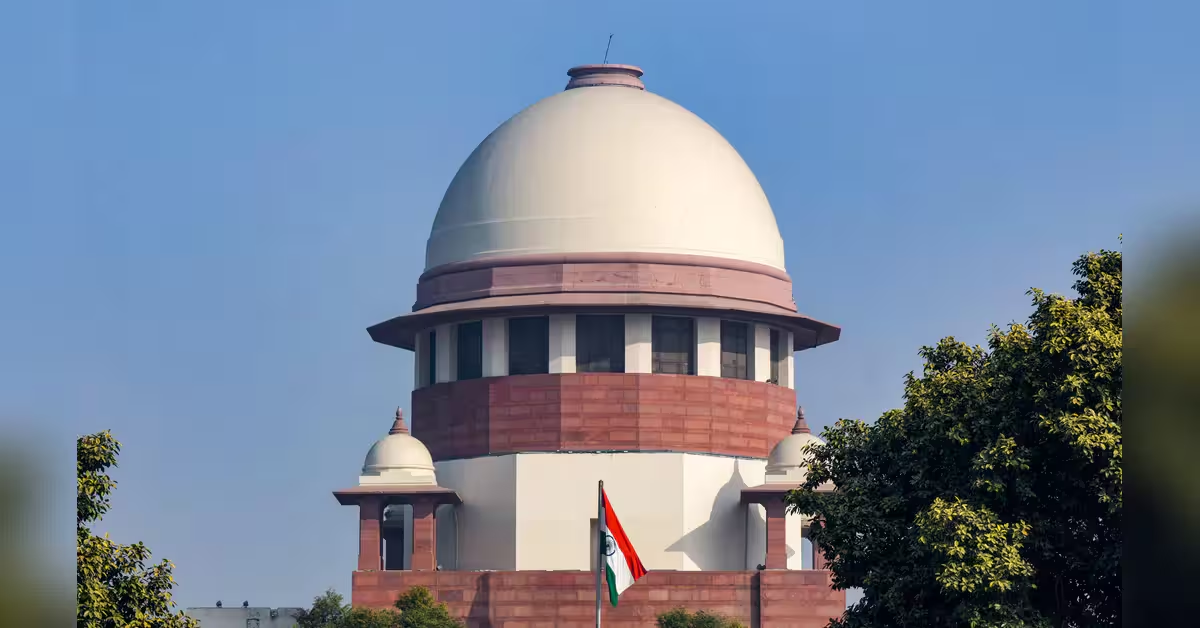
The Supreme Court’s observation on October 5 that “any modified Form 6 has not been approved by us” has brought a narrower legal question into the larger Special Intensive Revision (SIR) litigation: whether the Election Commission of India (ECI) can introduce an additional requirement for voter enrolment through an administrative or digital mechanism when Form 6 is prescribed under statutory rules.
A Bench headed by Chief Justice of India Surya Kant, with Justices Joymalya Bagchi and V Mohana, was hearing Shailendra Mani Tripathi v Union of India, a petition alleging unilateral decisions relating to SIR and changes to the electoral-roll system. The Court issued notice and sought the relevant records. CJI Surya Kant said that once the records were produced, the Court would examine who modified Form 6. The Court did not, however, hold that the ECI had acted illegally or invalidate the SIR at this stage.
The observation assumes importance because the ECI had earlier said that the additional declaration attached to Form 6 for SIR had been upheld by the Supreme Court. The Court’s clarification means that the specific modified Form 6 now under controversy was not judicially approved.
What is the statutory question surrounding Form 6?
Form 6 is the prescribed application for inclusion of a person’s name in the electoral roll. Its legal basis lies in the Registration of Electors Rules, 1960, framed under the Representation of the People Act, 1950.
The controversy arose after the ECI’s online ECINET system introduced an additional SIR declaration requiring a new applicant to state whether the applicant, or a parent or grandparent, appeared in the electoral roll prepared during the previous SIR. Where applicable, the applicant was required to provide details such as the constituency, polling station and serial number. The physical and downloadable Form 6, however, did not contain the additional declaration.
“Article 324 confers wide powers on the ECI to supervise and conduct electoral-roll revisions, but that power cannot be understood as an unrestricted authority to alter a statutory form or introduce a new substantive condition for voter registration without legislative or rule-making authority,” said Saloni Shah, founding partner, Khanwilkar & Shah Associates.
Two Election Commissioners, Sukhbir Singh Sandhu and Vivek Joshi, reportedly objected to the change, taking the position that a statutory form could not be altered without amending the Registration of Electors Rules, 1960. The ECI’s counter-position is that there was no alteration to Form 6 itself; the requirement was an additional SIR declaration or annexure.
That distinction goes to the heart of the case. The question is not whether the ECI can collect information while undertaking an SIR. It is whether an additional requirement that a citizen must satisfy before an online application can proceed effectively changes the legal conditions of enrolment.
Article 324 gives ECI broad powers, but are they unlimited?
The constitutional starting point is Article 324, which vests the ECI with supervision, direction and control over the preparation of electoral rolls and the conduct of elections.
The Supreme Court’s jurisprudence, however, does not treat Article 324 as an independent legislative power.
“Article 324 undoubtedly gives wide powers to the Election Commission. But where the field is already governed by statutory rules, those powers have to operate within that framework,” said Siddharth Batra, Advocate-on-Record, Supreme Court of India.
In Mohinder Singh Gill v Chief Election Commissioner (1978), the Court recognised the Commission’s plenary powers but held that where Parliament has enacted valid electoral law, the Commission must act in conformity with it. Article 324 operates as a reservoir of power in areas left unoccupied by legislation.
The principle was made particularly clear in A C Jose v Sivan Pillai (1984). The Court held that when legislation and rules occupy the field, the ECI cannot override them in the guise of exercising powers under Article 324. Its constitutional power is meant to supplement, not supplant, statutory law. The Court also stressed that Article 324 remains subject to the rule of law and the principles of natural justice.
This doctrine is important for Form 6. If the Registration of Electors Rules prescribe the form and its contents, the ECI’s Article 324 power cannot ordinarily be used to rewrite the statutory framework. Conversely, if the additional declaration is genuinely an ancillary measure in an area not occupied by legislation, the ECI can invoke its constitutional and statutory powers.
The distinction will therefore depend on substance rather than nomenclature. Calling a requirement an “annexure” rather than a “modification” does not necessarily answer whether it changes the legal burden on an applicant.
How do the Bihar and Bengal SIR cases relate to the Form 6 row?
The ECI’s principal justification comes from the Supreme Court’s May 27, 2026, judgment in Association for Democratic Reforms v Election Commission of India, concerning Bihar’s SIR.
The Court upheld the ECI’s power to undertake the SIR under Article 324 read with Section 21(3) of the Representation of the People Act, 1950. Importantly, it held that Form 6 could not necessarily be applied to an intensive revision in its literal sense and recognised a “degree of residual authority” in the Commission to formulate an appropriate documentation framework.
The Bihar judgment dealt with the documentation framework used in that SIR, including Annexure D, which was attached to Form 6 and Form 8 and required declarations concerning matters such as age, ordinary residence and citizenship. The present online declaration concerning linkage with the previous SIR roll was introduced later and was not specifically examined in the Bihar judgment.
West Bengal provides a practical dimension to the Form 6 controversy.
The state’s SIR resulted in the deletion of about 90 lakh voters. More than 22 lakh of them have reportedly filed appeals for restoration, while the total number of appeals concerning inclusion and deletion crossed 38 lakh. The Supreme Court has been monitoring the functioning of the appellate tribunals and the pendency of appeals.
“If an applicant can leave the declaration blank, or answer ‘no’, and still be enrolled in the ordinary course, the requirement is administrative. However, if that answer leads to rejection, a notice, further inquiry, or a shift in the burden of proof, then the requirement is functioning as an eligibility condition,” said advocate Priya Dhankhar, associate partner, SKV Law Offices.
Therefore, the real test is what instructions officers have been given on how to treat the answer. Until those are on record, it is premature to say which side of the line this declaration falls on.
This is relevant to Form 6 because a person whose name has been deleted, or a young person becoming eligible to enrol whose family linkage is not reflected in an earlier SIR roll, may encounter the additional declaration when seeking enrolment.
Who authorised the Form 6 change?
The present proceedings raise another issue beyond the validity of the declaration itself: institutional competence.
The petition alleges that several SIR-related decisions and software changes were taken without the concurrence of the other Election Commissioners. This raises questions about the collective functioning of the multi-member Commission under the Chief Election Commissioner and Other Election Commissioners Act, 2023.
If the Form 6 requirement is found to have been introduced without following the decision-making process required by law, the issue would not merely be whether the procedure had to be followed. It would also concern the procedural validity of the decision-maker’s action.
That makes the Court’s request to examine the records particularly significant. Establishing who authorised the modification may determine whether it was a formal decision of the Commission, an implementation of an existing SIR direction, or an administrative or software intervention.
At an event at NALSAR, Justice Ujjal Bhuyan said: “Any process which leads to wholesale disenfranchisement of Indian citizens making them citizens without voting rights would be violative of Articles 326 (adult suffrage) and 14 (right to equality) of the Constitution, if any process results in disenfranchising millions and millions of Indian citizens making them second class citizens in their own country in the sense of being citizens without voting rights, such a process is intrinsically arbitrary. No amount of whataboutery can justify it. It strikes at the very heart of the Constitution.”
Dr Rishabh Gandhi, former judge and founder of Rishabh Gandhi and Advocates, told Business Standard: “The question is consequently not merely how many persons are excluded, but whether those excluded are legally ineligible and whether the procedure by which that determination is reached is fair, rational and authorised by law.”
What will the Supreme Court have to decide?
The case presents four interlinked questions.
First, does the additional declaration merely facilitate SIR, or does it alter the statutory conditions governing Form 6 applications?
Second, if it alters those conditions, could the ECI do so under Article 324 and Section 21(3), or was an amendment to the Registration of Electors Rules necessary?
Third, does the requirement satisfy the rational-nexus and proportionality framework laid down in the Bihar SIR judgment?
Fourth, was the decision taken through the legally required collective decision-making process of the Commission?
The potential remedy will depend on those findings. If the requirement is found to be ultra vires the statutory framework, the Court may have to consider whether affected applications need reconsideration or whether the digital system must be corrected. If, on the other hand, it is found to be an ancillary SIR measure within the ECI’s residual authority, the challenge to the requirement may fail, even though the Court may separately examine how the decision was authorised.
The significance of the October 5 observation, therefore, lies less in the Form 6 document itself and more in the constitutional boundary it exposes. Article 324 gives the ECI wide powers to administer elections, but the jurisprudence from Mohinder Singh Gill, A C Jose and the 2026 Bihar SIR judgment establishes that constitutional power cannot simply displace statutory law.
The present litigation will test whether the additional Form 6 declaration is a lawful exercise of that residual power or an administrative alteration of a statutory regime requiring formal rule-making.