

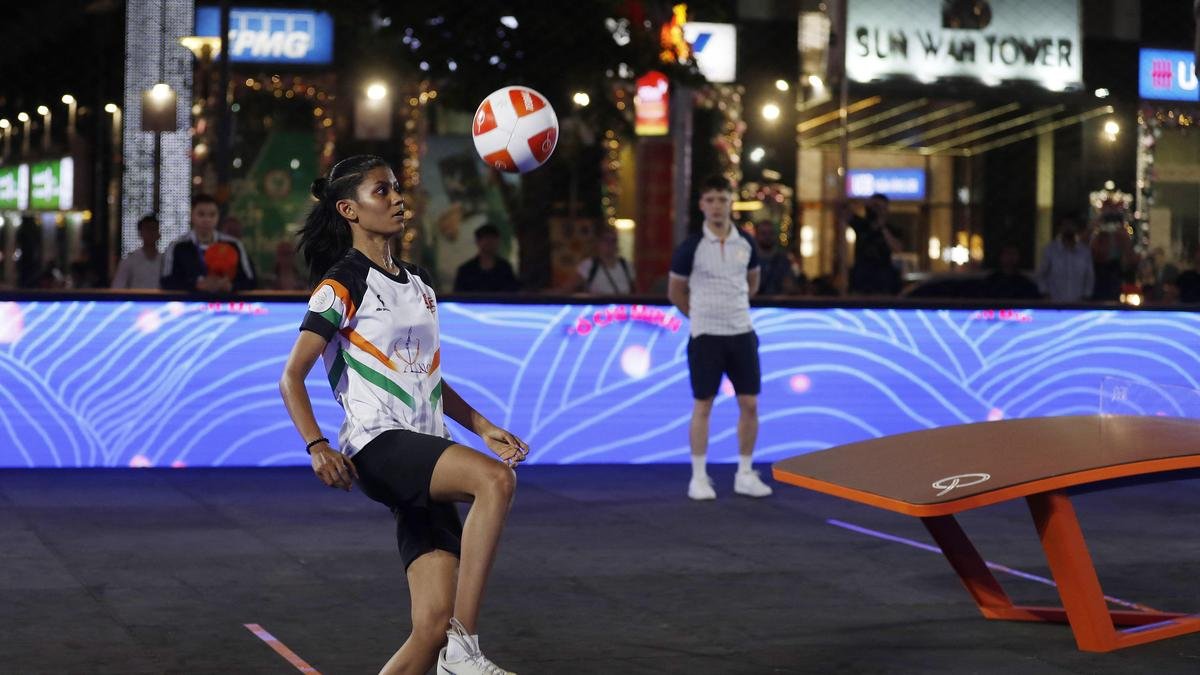
When she finally claimed her semifinal match in the women’s teqball singles competition at the Asian Games on Saturday morning, Indonesia’s Sumaya fell to her knees and performed the sajdah in celebration. On the other side of the table, Quimcy Dsouza was bent over too, her hands on her knees as the result sank in.
Quimcy had won the first game comfortably, 12-7. She had led in the second. In the decider, she was up 7-3 before an extraordinary comeback saw the Indonesian win nine straight points to seal the tie. The 24-year-old from Mumbai had been within touching distance of a place in the final and of assuring India its first medal at Nagoya. Just like that, the chance was gone.
Quimcy might still medal on Sunday, when she competes for bronze in the women’s singles and mixed doubles. But what a difference a medal on Saturday, in the hours before the official opening ceremony of the Games, would have made. On Sunday, as the Games kick off in earnest, the sports cycle will move on to better-known sports and athletes at venues across town.
For nearly an hour at the Nagoya City Higashi Sports Center on Saturday, though, all eyes were on a sport making its Games debut and the Bengaluru-based engineer chasing an unlikely dream.
The stands at the Higashi centre were full of people, many curious about a sport that is a weird but fun cousin of table tennis, football and sepak takraw. They might have started out curious, but there was admiration for the athleticism on display. Dr. Dinshaw Pardiwala, knee specialist to some of India’s greatest sportspersons and Chief Medical Officer of the Indian contingent, was there. “Let’s go, Quimcy!” he yelled in encouragement from the stands.
Ultimately, though, it was not to be. You could see what the loss meant to Quimcy. She took time to compose herself before explaining how she felt.
“I’m feeling so bad I couldn’t make it to the finals but I’m happy that I even made it this far. I came here without a coach, without guidance or support. I just want India to know I gave it my all. I want India to know what teqball is,” she would say later.
Long-time dream
As a child growing up in Mumbai, Quimcy always dreamed she’d wear an India jersey. The daughter of a State-level footballer and hockey player, she initially thought that ambition would be fulfilled on the athletics track.
“I used to watch the Asian Games as a child and think I’d be running for India some day. I didn’t even know about teqball then,” she says.
The sport was still in its infancy in India when it came into Quimcy’s life by accident. She had moved from athletics to football, even representing Maharashtra at the nationals, when she suffered a ligament injury four years ago. As she lay in bed scrolling aimlessly on Instagram, she came across a video of Brazilian football legend Ronaldinho playing on a table.
That’s how the sport got its start.
“It came about as a way for footballers to have a less strenuous workout while still working on their ball handling ability,” says Nihar Shah, technical director of Teqball India.
Quimcy was instantly smitten.
“I knew I had to do this. The logo for teqball is in the shape of a ‘Q’. I thought right then that I was meant to play this game. I found out that there was a club in Mumbai where there was actually a place where there was a table,” she says.
The sport was still being figured out by players in India. Quimcy’s football background helped her pick it up faster, as it has for many of the players at these Asian Games. Sumaya, too, has a sepak takraw background, 12 years of it, which made overhead kicks against Quimcy easy to execute.
But Sumaya had another advantage: Indonesia had invested in teqball since its inclusion in the Asian Games programme.
“For the last two years I’ve been only playing and training teqball morning, afternoon and night,” she told reporters after her win.
That’s not the case for Quimcy. Like every other member of the Indian team here and like the 180-odd athletes registered as teqball players in India, she’s entirely self-funded.
“Everything that we make goes into the sport,” says Quimcy, who currently works as a test engineer at Decathlon in Bengaluru.
She’s largely self-taught too, learning simply through observation.
“Right from the start, when I’d go to international competitions, I’d look at what the other players were doing. I’d look at what new things they had introduced and how they performed. When we came back, we’d look at their videos, and train and adapt it to our style,” she says.
It’s all this that made the chance to compete in Nagoya so meaningful. Being part of an actual Indian team wasn’t just the fulfilment of a childhood dream but also the legitimising of her choice of sport and the struggles of her compatriots who played it.
“Until now we have paid money from own pockets in order to compete. This (Asian Games) is the first time everything was sponsored by IOA and team. That’s why it was so important. I only dreamed about this day. There’s so much joy because I’m not just carrying my dreams but the dreams of all my teammates as well,” she says.
She had nearly managed to make those dreams come true, winning both her group-stage matches against Japan and Cambodia before falling just short against the Indonesian in the semifinal.
But Quimcy isn’t ready to give up on her dreams just yet. She has already beaten Japan’s Yuina Sakamoto, whom she plays for bronze, in the group stage.
“I have two more chances for a medal. The goal still remains to take a medal for India. The fire still burns as much as it was before today’s match,” she says.
Published on Sep 19, 2026