

[ad_1]
NEW DELHI: The protests are over. Dharmendra Pradhan has resigned as Union education minister. A slew of reform measures have been announced. Jantar Mantar is now clear of protesters. So, is the fight against NEET-UG paper leak over? Perhaps not. While the CJP led by Abhijeet Dipke has promised to keep a close eye on developments going forward, the opposition parties have signalled that they will keep the pressure going.As the government and the opposition brace for the second week of the monsoon session from Monday, the stage has been set for the Round 2 of this confrontation.The government, armed with a slew of reform measures in the last few days, is all prepared to counter the opposition offensive. Prime Minister Narendra Modi has himself led this fightback. His video selfie messages to the youth, the latest of which on Sunday evening announced the setting up of a task force for exam reforms, is an indication that the government is reaching out directly to the students to blunt the opposition attacks.
CJP Jantar Mantar Protest Updates
Ahead of the monsoon session, the BJP-led NDA had managed to put the opposition on the backfoot by increasing its numbers in both the Houses of Parliament with some smart political manoeuvres in West Bengal, Maharashtra and Punjab. But as the session started, the students’ protest upset all its calculations and, for the government, the first week was anything but disappointing if not out of control.
How protests changed the political script
While the BJP-led NDA was all geared up to fight the opposition inside Parliament, it could not assess the fact that the youth who effectively took up the opposition space outside Parliament were a bigger challenge. The late realisation perhaps powered the course correction and the government sacrificed a minister in a rare acceptance of pressure.So far so good. But the big question now is: Can the opposition sustain the pressure built up by the students’ protest? When monsoon session resumes on Monday – there could be aggression from both sides. The government, having been forced to take a step back, is likely to come back with a vengeance against a “familiar political rival” that it has on several occasions handled with ease. The opposition, meanwhile, will try to build on the momentum created by the youth protests and hope to pile pressure.
Rahul raises stakes with Amit Shah attack
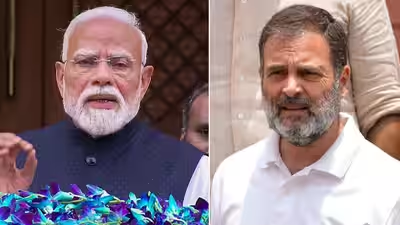
Leader of opposition in Lok Sabha Rahul Gandhi has already set the stage for the Round 2 of the confrontation inside Parliament. Rahul has launched a direct attack on Union home minister Amit Shah, holding him personally responsible for police action and excessive use of force, including allegedly using pellet guns, against student protesters in the national capital.In a letter to Amit Shah, Rahul demanded accountability for what he termed the “barbaric assault” on peacefully protesting students and questioned whether the home minister had approved the use of “lethal force”, including pellet guns, against the youth.The Congress leader alleged that hundreds of students had suffered injuries during the police action and claimed women protesters were assaulted by police personnel.Referring to 19-year-old student Sahil Lochab, whom he had met on Friday, Rahul said the student was likely to lose vision in one eye after allegedly being hit by pellets during the July 20 protest.Rahul also sought to know whether men in plainclothes seen beating students with lathis were police personnel or volunteers and who had authorised their deployment, saying “the country is demanding answers”.The other opposition parties are also keen to capitalise on what is being perceived as the government’s “moment of weakness.” Trinamool Congress Rajya Sabha deputy leader Ghose submitted a notice under Rule 267 seeking suspension of the day’s business in the Upper House on Monday to allow an immediate discussion on what she described as the “use of excessive force on student protestors during NEET examination protests”.Calling it a matter of grave national importance, Ghose said the right to peaceful protest was a constitutional right, but student protesters had allegedly been subjected to “lethal and semi-lethal force” by security agencies.Her notice also referred to reports of pellet gun injuries, “including the possible loss of vision of one student due to use of the pellet gun by the Rapid Action Force”, and sought answers on who authorised the use of such weapons and what protocols were followed.Rahul’s direct attack on Amit Shah is likely to play out in the House tomorrow. The Union home minister, who was believed to be largely working behind the scenes to defuse the situation, may lead the government offensive inside Parliament.For now, BJP leaders have taken up the cudgels on his behalf. Responding to Gandhi’s letter, BJP leader Mrityunjay Tiwari accused the Congress of trying to exploit the issue for political purposes rather than genuinely standing with students.“They did not do anything for the youth until recently. Now, they raised their voice just to incite agitation. They do not really care about the students. However, the Modi government has ensured that no one can commit any wrongdoing when it comes to the students, who are the future of this nation,” Tiwary said.BJP leader P V N Madhav also criticised Rahul, alleging that the Congress leader was frustrated despite the Centre taking steps to address concerns related to students.“Rahul Gandhi has completely turned mad. PM Narendra Modi has shown a magnanimous move by asking our education minister to resign. It’s a great move because everybody thought otherwise, but PM Narendra Modi never thinks the unthinkable. So, he has done what was needed and has shown solidarity with the entire student community to show that he stands with them,” Madhav said.
PM Modi’s reform push takes centre stage
The government will fight back with the Public Examinations (Prevention of Unfair Means) Amendment Bill, 2026, listed for introduction in the Lok Sabha on Monday. The Bill, which was announced by Prime Minister Modi himself in a late-night video selfie, the first from the PM, proposes setting up fast-track courts in every state for paper leak cases and completion of investigations within two months.It also has provisions for enhanced punishment, including imprisonment of up to 10 years and fines up to Rs 50 lakh for individuals involved in paper leaks. Organised crimes related to paper leaks could attract fines of up to Rs 10 crore.
The battle lines for Round 2
Clearly, the government has a lot to showcase in terms of actions. Resignation of Dharmendra Pradhan, PM Modi’s outreach to the students, new Bill with stringent provisions, fast track courts, task force under Nandan Nilekani, action against NTA officials, shifting out of the education secretary – these measures are going to power the government’s defence and offence. Also, the government will try to shift focus back on issues like Delimitation Bill to gain an upper hand over its political rivals.For the opposition, the July 20 police action against protesters is likely to be the rallying cry. The cops perhaps exceeded their brief in handling the protesters, and the opposition will go all out to ensure that the government does not get a breather, at least for now. The other key issue which the opposition would want to focus on to maintain pressure is the row Ram Mandir donation theft. Over to Parliament now for Round 2 of confrontation in monsoon session.
[ad_2]
Source link