

[ad_1]
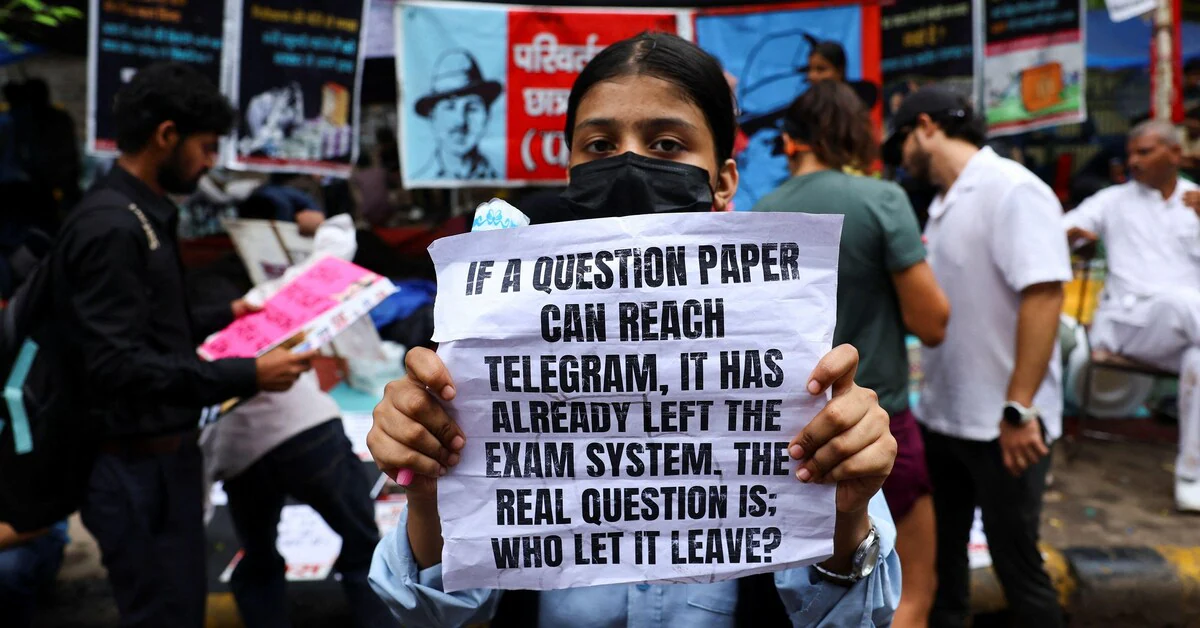
The protests over the irregularities in the National Eligibility-cum-Entrance Test (Neet) and growing calls for reforms in India’s examination system have once again brought students to the forefront of public debate. While allegations of paper leaks and other irregularities sparked the latest wave of protests, they have also exposed deeper anxieties over fairness, transparency and the lack of opportunities for young people.
India has seen several such movements over the past five decades, where protests that began over a single issue went on to shape public policy, influence governments and redefine the political landscape.
As the agitation over Neet continues, here’s a look at some of the landmark protest movements that left a lasting impact on India’s politics and policymaking.
Nav Nirman movement, Gujarat (1973–74)
The Nav Nirman movement began in December 1973 when engineering students in Ahmedabad protested against an increase in hostel mess charges. The agitation soon drew in people affected by rising prices, shortages and allegations of corruption against Chief Minister Chimanbhai Patel’s government.
As protests spread across Gujarat, Patel resigned in February 1974. The Assembly was dissolved the following month and President’s Rule was imposed.
JP movement, Bihar (1974–75)
Inspired by Nav Nirman movement, students in Bihar began protesting against corruption, inflation, unemployment and poor governance. The agitation gained national prominence after socialist leader Jayaprakash Narayan, popularly known as JP, agreed to lead it.
At Patna’s Gandhi Maidan on June 5, 1974, JP called for “Sampoorna Kranti”, or total revolution, seeking wider political and institutional change.
The movement became a major challenge to Prime Minister Indira Gandhi’s government. After the Allahabad High Court set aside Gandhi’s election in June 1975, the Emergency was declared on June 25.
Although the movement could not prevent the Emergency, it united Opposition parties that later formed the Janata Party and defeated the Congress in the 1977 general election.
Ram Janmabhoomi mobilisation (1980s–1992)
The Ram Janmabhoomi movement sought the construction of a Ram temple at the disputed site in Ayodhya where the Babri Masjid stood. Led by the Vishwa Hindu Parishad (VHP) and supported politically by the Bharatiya Janata Party (BJP), it used religious processions, yatras and rallies to mobilise support.
The campaign gained momentum after BJP leader LK Advani launched his Rath Yatra in 1990. It culminated in the demolition of the Babri Masjid by kar sevaks on December 6, 1992, sparking communal violence across the country.
Mandal protests (1990)
Prime Minister VP Singh’s decision in August 1990 to reserve 27 per cent of central government jobs for Other Backward Classes (OBCs) triggered widespread protests, largely led by upper-caste students in northern India.
Universities witnessed strikes, demonstrations, hunger protests and self-immolation attempts. Delhi University student Rajiv Goswami became the most prominent face of the agitation after setting himself on fire during a protest.
The government retained the policy. In 1992, the Supreme Court upheld the reservation in the Indra Sawhney case but introduced the “creamy layer” exclusion and said reservations should generally not exceed 50 per cent.
Anti-reservation protests (2006)
Reservation returned to the national spotlight in 2006 when the United Progressive Alliance government extended 27 per cent reservation for OBCs to centrally funded institutions, including the Indian Institutes of Technology, Indian Institutes of Management and All India Institute of Medical Sciences.
Medical students, resident doctors and other professional groups led demonstrations, hunger strikes and rallies. Groups supporting reservation organised counter-protests.
The government implemented the policy but increased seats to ensure that the general-category intake was largely unaffected.
Singur and Nandigram protests (2006–08)
Land acquisition became a major political issue after protests erupted in Singur and Nandigram in West Bengal.
Farmers in Singur opposed the acquisition of agricultural land for Tata Motors’ Nano factory. Residents of Nandigram protested against a proposed Special Economic Zone over fears of displacement and loss of livelihoods.
Violent clashes in Nandigram in March 2007 resulted in several deaths. Tata Motors eventually moved the Nano project from Singur to Gujarat.
The movements weakened the Left Front government and helped the Trinamool Congress rise to power in West Bengal.
India Against Corruption movement (2011)
Led by Anna Hazare, the India Against Corruption movement demanded an independent Lokpal to investigate corruption involving public officials.
The campaign gained momentum after Hazare began an indefinite fast at Jantar Mantar in April 2011. Young professionals and the urban middle class joined protests across the country, with social media playing a major role in mobilisation.
Parliament subsequently passed the Lokpal and Lokayuktas Act, 2013. Several movement leaders, including Arvind Kejriwal, entered electoral politics and founded the Aam Aadmi Party, which later formed the government in Delhi.
Nirbhaya protests (2012–13)
The gang rape and assault of a 23-year-old physiotherapy student in Delhi on December 16, 2012, sparked nationwide protests demanding justice, stronger laws and greater government accountability.
The protests forced wider scrutiny of women’s safety, policing, public transport and the criminal justice system.
The government constituted the Justice J S Verma committee, whose recommendations informed the Criminal Law (Amendment) Act, 2013. The law broadened the definition of sexual offences and introduced tougher punishments. The government also established the Nirbhaya Fund for women’s safety initiatives.
Anti-CAA movement and Shaheen Bagh (2019–20)
The Citizenship (Amendment) Act, 2019, triggered nationwide protests. Opponents argued that the law, when considered alongside the proposed National Register of Citizens, raised concerns about equality and citizenship. The government maintained that it would not affect Indian citizens.
Protests began on university campuses before spreading across the country. Their most prominent symbol was the women-led sit-in at Delhi’s Shaheen Bagh, which continued for more than 100 days.
The demonstrations ended with the nationwide Covid-19 lockdown in March 2020. The law remained in force, with the government notifying its implementation rules in 2024.
Farmers’ protest against the three farm laws (2020–21)
Three farm laws passed in September 2020 triggered a year-long agitation. The government said the reforms would expand farmers’ selling options and attract private investment. Farmer organisations feared that they would weaken the minimum support price system and increase dependence on large private buyers.
Thousands of farmers camped at Delhi’s Singhu, Tikri and Ghazipur borders as repeated rounds of talks failed to resolve the dispute.
Prime Minister Narendra Modi announced the withdrawal of the laws in November 2021, and Parliament repealed them later that month.
Neet and examination-reform protests (2024 onwards)
The latest student protests followed allegations of paper leaks and irregularities in Neet-UG. An unusually high number of perfect scores, reports of leaks and the award of grace marks to some candidates intensified the controversy.
The Supreme Court declined to order a nationwide retest, saying there was insufficient evidence of a systemic breach to justify cancelling the examination. It nevertheless acknowledged shortcomings and stressed the need to protect the integrity of public examinations.
The Union government subsequently appointed a committee headed by former Indian Space Research Organisation chairman K Radhakrishnan to recommend reforms to the National Testing Agency.
The agitation has since tapped into wider concerns about the credibility of public examinations, intense competition and limited educational and employment opportunities.
[ad_2]
Source link