

[ad_1]
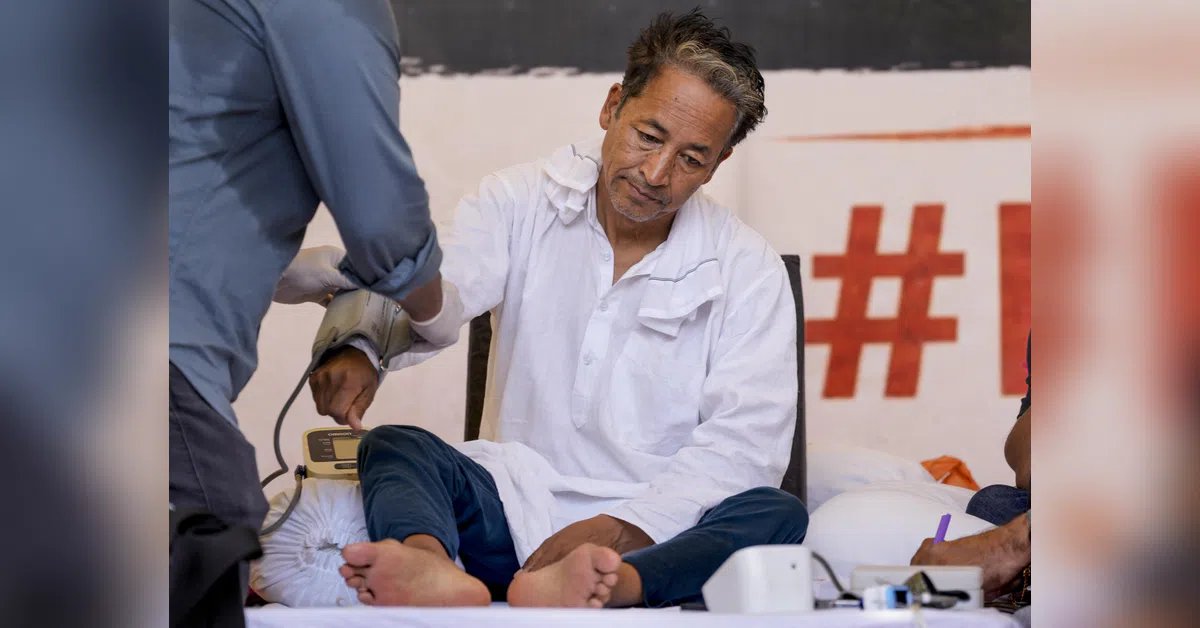
The 59-year-old education reformer from Ladakh had begun his fast on June 28, joining Cockroach Janata Party (CJP) convenor Abhijeet Dipke in demanding the resignation of Union Education Minister Dharmendra Pradhan over allegations of a Neet paper leak.
Wangchuk’s hunger strike has drawn comparisons to social activist Anna Hazare’s April 2011 fast, during which he forced the then-Congress government to accept his demands following an outpouring of public support in his favour.
Will Wangchuk be able to replicate a similar mass public sentiment to force action on Neet paper leaks? Will the government accept his demands? These are the questions weighing on everyone’s mind. If we look at history, such protests have created lasting social impacts.
Let’s look at the most popular hunger strikes undertaken for various causes since India attained its independence in 1947.
Potti Sriramulu (1952)
Sriramulu was a freedom fighter who played a pivotal role in the creation of Andhra State. Inspired by Mahatma Gandhi, he had taken part in major independence movements, including the Salt Satyagraha and Quit India movement, and was imprisoned multiple times.
In 1952, he went on a 58-day hunger strike, demanding a separate state for Telugu-speaking people from the Madras Presidency. His death during the protest sparked widespread riots and public outcry, forcing PM Jawaharlal Nehru to announce the creation of Andhra State in 1953.
Darshan Singh Pheruman (1969)
Demanding inclusion of Chandigarh and Punjabi-speaking areas into Punjab, Sikh activist Darshan Singh Pheruman observed a fast-unto-death protest on August 15, 1969.
Punjab was created in 1966 on linguistic lines; however, not all Punjabi-speaking areas had been shifted under the state. Darshan Singh Pheruman ultimately died in 1969 after refusing to take food in any form.
He died after a 74-day fast, but his principal demands, including the transfer of Chandigarh to Punjab, were never fully met.
Irom Sharmila (2000–2016)
Often referred to as the ‘Iron Lady of Manipur,’ Sharmila fasted for 16 years demanding the repeal of the Armed Forces Special Powers Act (AFSPA) in Manipur, making it one of the world’s longest hunger strikes.
Her fast began after the Malom massacre on November 2, 2000, in which 10 civilians were allegedly shot dead by security personnel near Imphal. The fast lasted from November 5, 2000, to August 9, 2016.
Her protest drew international attention and made her a global symbol of non-violent resistance. She ended the fast in 2016 to enter electoral politics.
Anna Hazare (2011)
Anna Hazare, a social activist from Maharashtra, began his first indefinite hunger strike at Jantar Mantar on April 5, 2011, demanding the enactment of a stronger anti-corruption law. The fast sparked a nationwide movement against corruption, drawing support from students, professionals, civil society groups and political activists across the country.
Hazare announced a second indefinite fast in August 2011 after disagreement with the government’s proposed legislation. He was briefly arrested before the protest began, triggering widespread public outrage. The fast was then shifted to Ramlila Maidan, where thousands of supporters gathered daily, making it one of the largest mass protests in India since Independence.
The protest led by Hazare ultimately led to the passage of the Lokpal and Lokayuktas Act, 2013, marking significant progress in India’s fight against corruption.
Swami Nigamananda (2011)
Swami Nigamananda (also known as Nigamanand Saraswati) was a Hindu monk who breathed his last after undertaking a 115-day hunger strike. His fast was a protest against illegal sand mining happening in the Ganga River bed in Haridwar.
Considered a central figure in the movement against mining in Ganga, Nigamananda died on June 13, 2011, at a Dehradun hospital. His death drew national attention and prompted action against illegal mining in parts of the region, though activists said their broader concerns remained unresolved.
[ad_2]
Source link