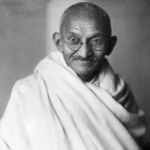


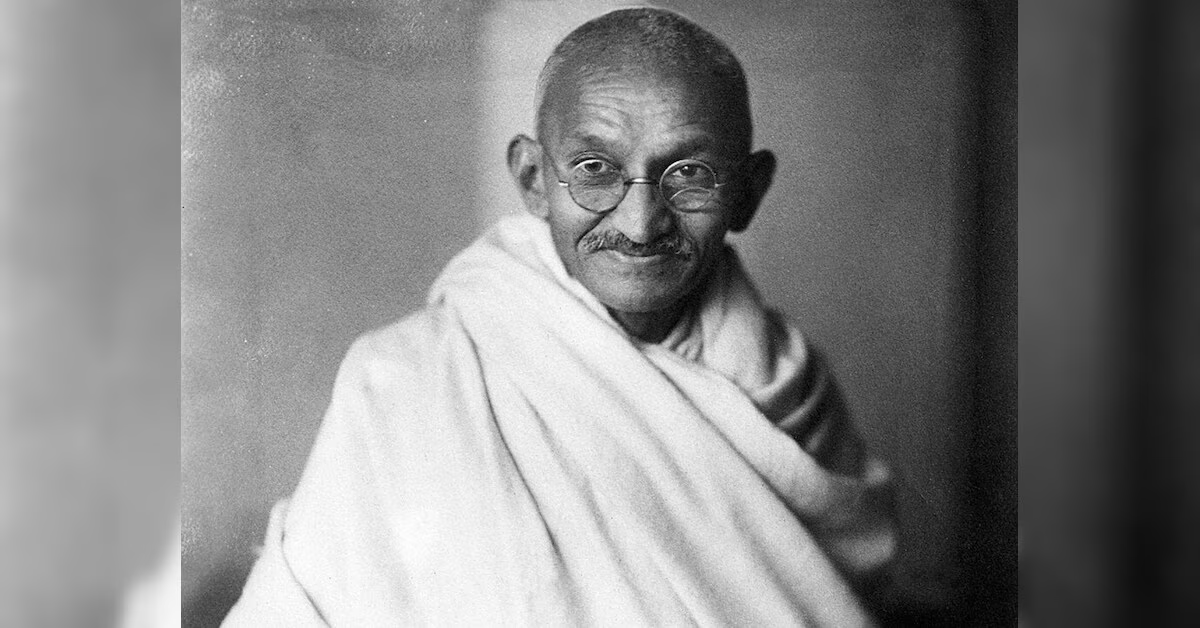
Days after a number of letters, manuscripts and personal artefacts of Mahatma Gandhi were sold in an auction, A Annamalai, director of National Gandhi Museum, said that such items are not merely private possessions but part of India’s common heritage while appealing to those who possess such articles to hand them over to the institution for preservation.
On August 19, a total of 86 items, including a collection of Gandhi’s 688 handwritten reflections, was sold at a Saffronart auction.
The collection written over a span of nearly two years to his close associate and freedom fighter Anand T Hingorani, titled “A Thought for the Day”, was sold for ₹16.20 crore, setting the world record for an Indian historical document sold at an auction.
In a statement issued on Saturday, Annamalai termed the news as “deeply distressing and painful”.
“A few days ago, some letters written by Mahatma Gandhi and a few articles used by him were put up for international auction. It has been reported that the auction fetched more than ₹16 crore for the owner. This is deeply distressing and painful news,” he said.
The director of the Gandhi museum noted that although many of Gandhi’s letters have already been published in books, “it is our historical responsibility to preserve the original letters and his handwritten manuscripts”.
He said that those who possess such letters and articles today belong to the third of fourth generation of the original owners and “do not fully understand their historical significance”.
“…or know how best to preserve them, some may be choosing to dispose of them through such auctions.” “However, Gandhi’s letters, manuscripts and personal belongings are not merely private possessions. They are part of the common heritage of India and belong to our shared history. They should be preserved in a manner that enables people from India and across the world to see, study and learn from them. The National Gandhi Museum in Delhi can preserve such rare and valuable materials safely and make them accessible and meaningful to present and future generations,” he said.
Annamalai appealed to all those who possess Gandhi’s letters, handwritten manuscripts or articles used by him “not to sell or auction them, but to come forward and hand them over to the National Gandhi Museum, Delhi, so that these precious pieces of our national heritage may be preserved for posterity”.
The auction, “Gandhi: From the Collection of Anand T Hingorani”, featured 86 lots of letters, manuscripts, photographs and personal objects associated with Gandhi.
According to the auction house, the top-selling manuscript addresses truth, ahimsa, brahmacharya, nonpossession, fearlessness, religious equality, the removal of untouchability, prayer, Ramanama, service, labour, hunger, duty, Swaraj, moral responsibility, silence, conscience, nonattachment, selfrealisation and the search for God.
Among other items was a set of three related manuscript and correspondence items concerning Gandhi’s reflections on God and the Bhagavad Gita, titled “Message on God”, that was sold for ₹1.68 crore.
One of the personal objects included in the auction was Gandhi’s ‘peti charkha’ (box spinning wheel) along with two letters on the spiritual discipline of spinning, estimated at ₹50-70 lakh. It sold for ₹1.02 crore.
A signed presentation photograph of Gandhi writing sold for ₹78 lakh and a set of Gandhi’s letters, telegrams, and postcards on economic independence sold for ₹57.60 lakh.
The collection, preserved by the Hingorani family across generations, offered an intimate perspective on Gandhi through his longstanding relationship with Hingorani.
Thoguh the identity of the buyer was not revealed, the auction house said “the buyer is from within India and the manuscript will stay in the country”.