

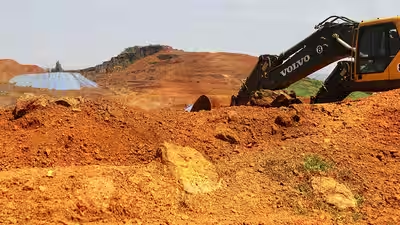
NEW DELHI: Aiming to bring greater transparency to the trading of major minerals and improve price discovery, govt has decided to allow their trading on an exchange, which is likely to become functional by the next financial year.The ministry of mines has notified the rules, and the Indian Bureau of Mines has been appointed the nodal agency and regulator to invite applications from companies willing to run the exchange. The exchange is initially likely to allow trading in some of the major minerals, including iron ore, bauxite, limestone and manganese.The ministry of coal has separately notified rules to set up an exchange for trading in coal and appointed the Coal Controller Organisation as the regulator. The CCO has invited applications from companies to set up an exchange.According to officials, the minerals exchange is expected to improve market access and reduce disputes over quality, pricing and contract terms. The rules require mineral quality to be verified by accredited assaying agencies and provide for market surveillance to check manipulation, cartelisation and insider trading. The exchange will operate through a centralised electronic platform and facilitate physical delivery-based contracts, providing a transparent and competitive mechanism for pricing and mineral supplies, officials said.Separately, govt has planned to set up four dedicated critical minerals processing parks in Andhra Pradesh, Odisha, Gujarat and Maharashtra. Coal and mines minister G Kishan Reddy said the four states will provide land and announce incentives for companies to set up processing industries at the critical minerals parks, while the Centre will provide technical support.
Share your thoughts in the comments
Be respectful · TOI community guidelines
Mines secretary Keshav Chandra said the initial focus will be on lithium and nickel, which are crucial for the battery sector. “Batteries are currently the most important component globally for future growth,” he said.The parks will focus on creating element-specific ecosystems and a complete value chain, from processing to downstream industries, at a single location.India is dependent on imports for about 95% of its critical mineral requirements. The Centre announced the National Critical Mineral Mission in 2025 with a financial outlay of Rs 34,300 crore over seven years to promote exploration within the country and at offshore locations.Critical minerals such as copper, lithium, nickel, cobalt and rare earth elements are essential raw materials for the growth of clean energy technologies.