

Hindustan Aeronautics Ltd (HAL) will soon have another production facility for the Shakti engine at its Koraput facility in Odisha, as India moves to expand domestic propulsion capacity alongside a sharp increase in orders for indigenous military helicopters.
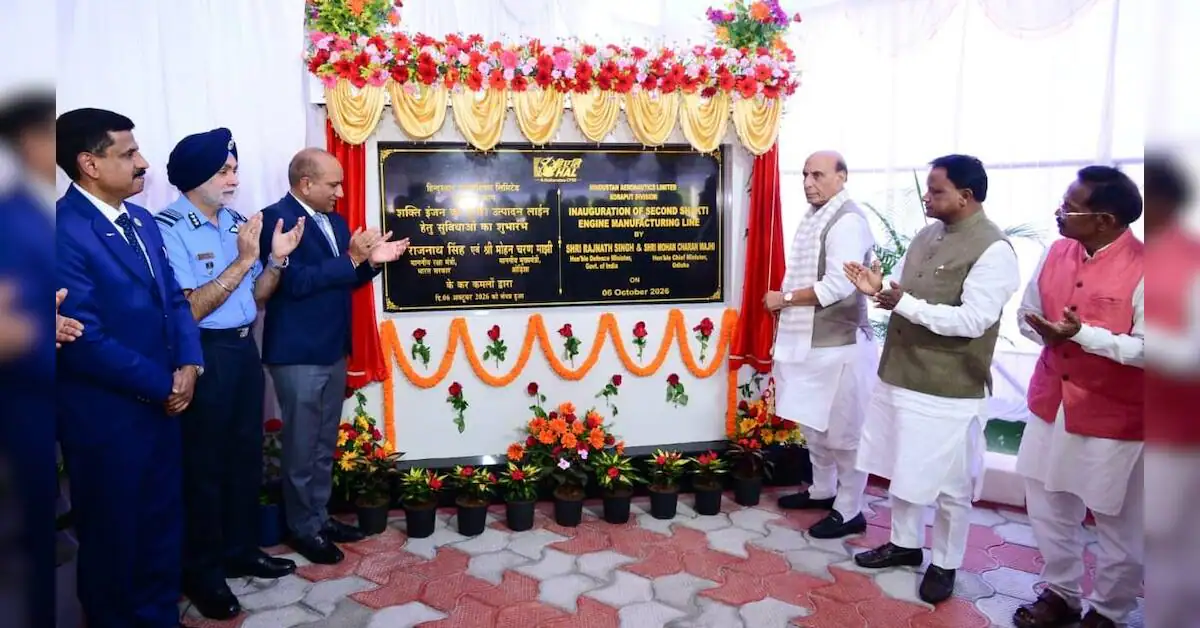
Defence Minister Rajnath Singh laid the foundation stone for the new production line on Tuesday. The new manufacturing facility will come up with an investment of ₹218 crore. He also witnessed the delivery of the 2,000th aero-engine by HAL’s Koraput division.
The new line will manufacture up to 100 engines annually and is scheduled to be fully operational by 2028-29, catering to indigenous helicopters, including the advanced light helicopter (ALH) Dhruv and light combat helicopter (LCH) Prachand.
Describing the milestone as a significant achievement in India’s aerospace journey, Singh called for strengthening indigenous capabilities in the design, development, testing, manufacturing and maintenance of advanced aero-engines.
“An aero-engine is the heart of an aircraft. Mastery of propulsion technology is essential for self-reliance in the aerospace and defence sector,” he said and emphasised the need for expertise in precision manufacturing, advanced materials, metallurgy, cooling technologies, testing and stringent quality assurance.
The Shakti engine programme is an Indo-French joint initiative between HAL and Safran Helicopter Engines to develop and manufacture a new-generation engine for the country’s military requirements. The second production facility will manufacture the Indian version of the Ardiden 1H1 turboshaft engine.
According to the Ministry of Defence (MoD), the requirement for additional capacity is expected to grow substantially following the MoD’s ₹62,700-crore contracts with HAL for 156 Prachand helicopters — 66 for the Indian Air Force and 90 for the Army. Deliveries are scheduled to begin from the third year and continue over five years.
Established in 1964, HAL Koraput’s role has acquired renewed significance with major orders for the indigenous manufacture of Su-30MKI engines. The division has manufactured 2,000 engines and overhauled more than 9,000 aero-engines over the past five decades.
The Defence Minister underlined that aerospace self-reliance must extend to indigenous aero-engine capability, particularly for the Advanced Medium Combat Aircraft (AMCA) programme. “The proposed investment of around ₹5,000 crore will promote indigenisation of raw materials in partnership with Mishra Dhatu Nigam Limited (MIDHANI) and the establishment of India’s first indigenous high-thrust engine testing facility,” he said.
Highlighting HAL’s performance in meeting defence forces’ requirements, Singh said the government placed an order for 240 AL-31FP engines with HAL for the Su-30MKI. Despite global supply-chain disruptions and raw-material challenges, HAL delivered the first engine ahead of schedule and has delivered 63 engines against a target of 60 by the end of the second year, he said. In September 2024, the Defence Ministry signed a ₹26,000-crore contract with HAL for 240 AL-31FP engines.
The Defence Minister also announced that HAL is enhancing annual AL-31FP production capacity from 30 to 50 engines with an investment of ₹335 crore. He called upon HAL to develop Koraput not merely as an engine production facility but as a broader aerospace propulsion ecosystem by nurturing suppliers, mentoring MSMEs, supporting start-ups and young engineers, collaborating with universities and research institutions, and developing capabilities for critical components.
Odisha Chief Minister Mohan Charan Majhi, Secretary (Defence Production) Sanjeev Kumar, Deputy Chief of the Air Staff Air Marshal Tejpal Singh, Chairman and Managing Director (CMD) of HAL Ravi K, Chairman and Managing Director (CMD) of MIDHANI S V S Narayana Murty and Joint Secretary (Aerospace Wing & DOMW) Manisha Chandra were present.