

[ad_1]
When Dharmendra Pradhan resigned, members of the Cockroach Janta Party (CJP) climbed onto the stage and began dancing. It was not a spontaneous choice of music but a symbolic one. The song they celebrated with was perhaps the defining anthem of protest in India: ‘Rang De Basanti‘, the title track to the eponymous 2006 film. One reason the song has remained so significant for protesters is that the film itself is about protest and patriotism. Hindi cinema has produced other songs that have become staples of protest and national celebration, such as ‘Chak De India‘ from the hockey drama of the same name and Piyush Mishra’s ‘Aarambh Hai Prachand‘ from the film Gulaal.
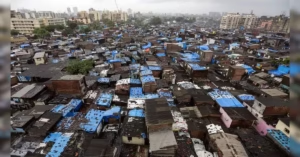
But if ‘Rang De Basanti‘ belongs to an earlier generation of political expression, the song that can truly be called the anthem of Gen Z is ‘Azadi‘ from Gully Boy (2019), a film about a poor boy from Mumbai’s infamous Dharavi slums who becomes a rapper while overcoming the hardships created by a lack of resources. The film was based on the real lives of rappers Naezy and DIVINE.
The song itself originated in 2016 as an underground track by producer Dub Sharma (Siddharth Sharma), who sampled freedom slogans delivered by then student activist Kanhaiya Kumar, now a Congress leader. Later, rap verses by DIVINE were added, adapting the track for Gully Boy while shifting its focus towards broader struggles against poverty and social injustice. That journey — from a protest slogan to an underground rap track and then to a mainstream Bollywood film — also explains why the song found a place in contemporary protest movements.
For a long time in India, hip-hop revolved around themes of women, alcohol, and cars, but that has changed in recent years. Young artists are increasingly using the genre to tell their own stories because the art form is relatively more grounded in lived reality than imagination.
Hip-hop has always been associated with resistance. It emerged in the early 1970s in New York City’s south Bronx, created by African American, Afro-Caribbean, and Latino communities as a cultural response to urban decay, poverty and social marginalisation. It is more than music; it encompasses DJing, MCing (rapping), breakdancing and graffiti art.
It took time for hip-hop to travel to the streets of India, but the growing number of artists embracing the form suggests that it has firmly arrived. When this protest erupted, that tradition of resistance quickly found expression in new music.
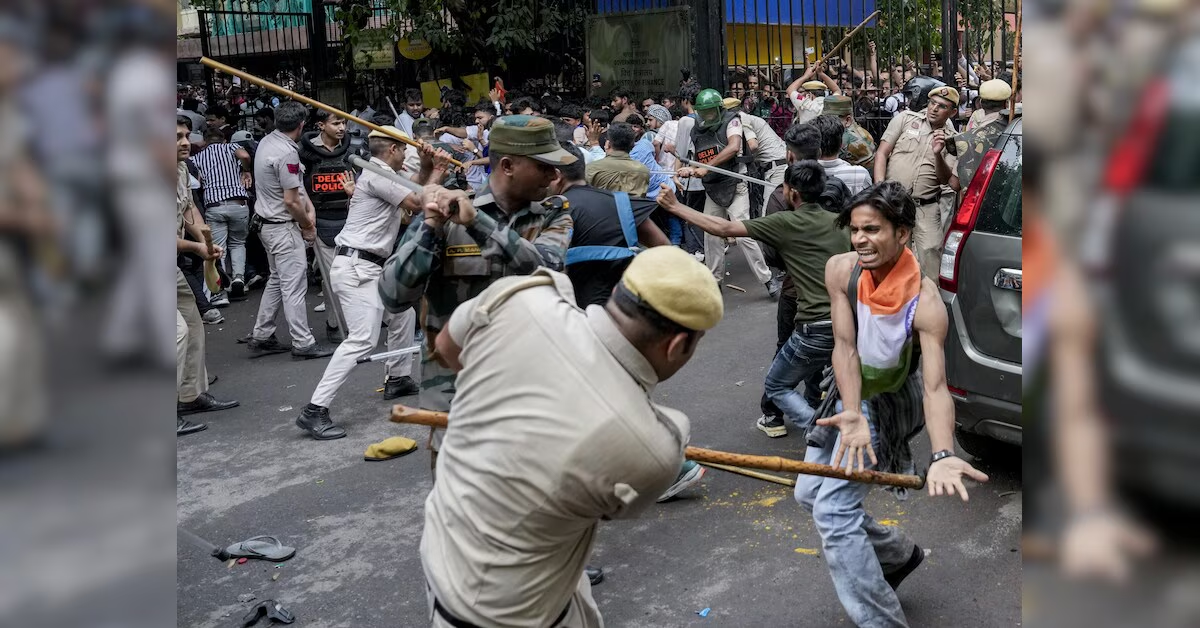
Several rappers released tracks responding directly to the movement, addressing police brutality and echoing the demands of the students.
Ikka, in his track “Get Up Now,” rapped:
Bachchon ne kiya khoon nahin
Haathon mein liye phool, liya tha kanoon nahin
Education sabka haq, tanashah tu bhool nahin
Ghar ki chhat jalegi, paper leak kabool nahin
(“The children committed no murder. They carried flowers in their hands, not weapons. Education is everyone’s right—don’t forget that, dictator. Roofs may burn, but we will never accept paper leaks.”)
He also adds the slogan “Abhi nahin to kabhi nahin” (“If not now, then never”).
Similarly, rapper Raga, in his track “Police Brutality,” says, “Resign maar, gaadi le seedhi ghar” (“Resign and drive straight home”), directly reflecting the protesters’ demand that the education minister step down.
Another rapper, Emiway Bantai, who became widely known for his diss tracks during his beef with Raftaar, released “Bolra Hai Sadak,” in which he raps, “Samvidhan bolta hai, kar sakta hai tu sawal” (“The Constitution says you have the right to question.”)
Many songs that had been written before the protests found new life as the voice of the movement. Hip-hop, however, was different. It was not only providing an existing soundtrack but also creating one in real time.
During a protest rally in Mumbai, a video of rapper Raftaar helping manage the crowd went viral, earning him effusive praise online. The music was not confined to speakers or playlists; many of the artists themselves became visible participants in the movement.
Interestingly, the protest unfolded across very different cultural registers. On one hand, people recited Faiz Ahmad Faiz’s famous lines, “Bol ke lab azaad hain tere, bol zubaan ab tak teri hai” (“Speak, for your lips are free; speak, for your tongue is still your own”). On the other, young people expressed themselves through independent voices and internet slang, shouting “Wasteganehuiyaan.” The phrase has no literal meaning; it exists simply as an expression that has taken on a life of its own.
Different worlds, from Faiz’s poetry to hip-hop, from revolutionary verse to internet slang, came alive throughout the movement, each giving voice to a different generation of protesters.
‘Rang De Basanti’ is a song that offers, quite literally, a recipe for building a nation. But some songs do something different: they document a nation’s story as it unfolds in real time.
[ad_2]
Source link