


[ad_1]
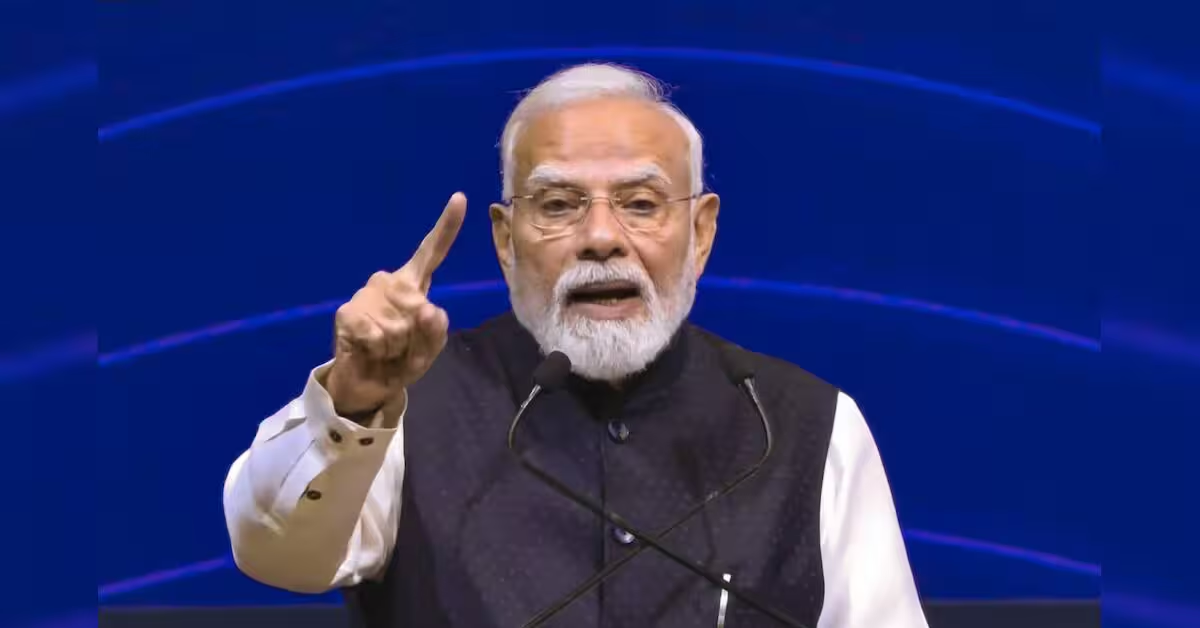
India is readying itself to become an alternative supplier of semiconductor chips and solutions as the world looks to diversify its supply chains, Prime Minister Narendra Modi said on Thursday.
“The world needs new and trusted locations for chip manufacturing and India is preparing itself for this,” Modi said during his address at the inaugural session of the fifth edition of Semicon India being held here in the city.
The second phase of India’s semiconductor journey will move beyond policy decisions and announcements of the construction of semiconductor chip fabrication and packaging units, he said, adding that soon chips made and packaged in India would be exported across the world.
Apart from the three chip packaging units — Micron, Kaynes and CG Semi — that have already started commercial operations, CDIL Semiconductor’s Mohali unit and Suchi Semicon’s Gujarat unit also started commercial production on Thursday.
“Wherever semiconductor ecosystems have been built in the world, they have been prepared after decades of effort. But India, with your cooperation, has worked simultaneously on chip design, manufacturing, equipment manufacturing, materials ecosystem, testing capability — and has shown success,” Modi said.
Under the second phase of ISM, India will strive to ensure that fabless chip companies, as well as startups that work in the semiconductor chip design space, grow well so that they can collaborate with global companies, he said. As of September 2026, India had approved 12 semiconductor fabrication and packaging units with a total cumulative investment of more than Rs 1.60 trillion.
The total outlay under the first phase of the ISM was Rs 76,000 crore. Speaking at the inaugural session, Union Electronics and Information Technology Minister Ashwini Vaishnaw said that the government was targeting at least 200 startups and companies designing chips in India under the second phase of ISM. Chip design, Vaishnaw said, would be one of the six pillars of ISM 2.0, adding that the other pillars would cover machines and materials, fabrication units, advanced packaging, research and development, and talent.
The first phase of the ISM also had a component for startups in the chip design space. Of the 105 startups that had attempted chip design in phase one, nearly 20 had received venture capital funding of nearly Rs 800 crore.
Under the second pillar of machines and materials, the focus would be on covering the entire ecosystem of capital equipment, maintenance facilities, chemicals and gases, while under the third pillar of fabrication units, the government would strive to set up additional display, memory, silicon, compound and logic fabrication units in the country.
The fourth, fifth and sixth pillars of ISM 2.0 will focus on scaling the existing infrastructure of packaging units, industry-driven research and development projects, and training adequate semiconductor manpower based on inputs from semiconductor companies, Vaishnaw said. The inaugural session was also attended by Micron Technology’s chief executive officer (CEO) Sanjay Mehrotra, Infineon Technologies CEO Jochen Hanebeck, and semiconductor industry body SEMI CEO Ajit Manocha, among others.
Speaking during the inaugural session, Mehrotra said that Micron’s Sanand facility, which began commercial production earlier this year, was now shipping DRAM and NAND memory products to customers globally. The Indian teams, he said, had contributed to more than 3,700 patents, inventions and disclosures so far.
[ad_2]
Source link