

[ad_1]
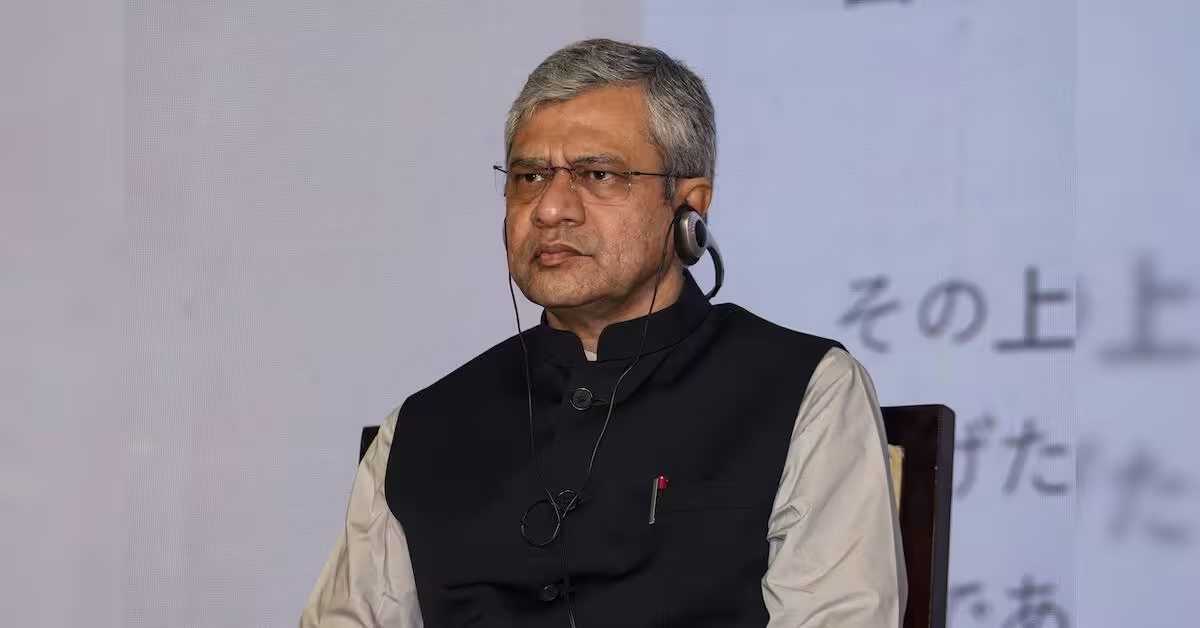
The Surat-Bilimora section is expected to be the first operational stretch of the 508-km corridor. Vaishnaw also said the first coach manufactured for testing is ready, marking a key milestone in the development of India’s first high-speed rail service.
Civil construction on the Vapi-Surat section is expected to be completed by December 2026, according to the minister. Work on other parts of the corridor is also progressing, with Vaishnaw saying that the pace of construction has been faster than anticipated.
When will India’s first bullet train run?
The first high-speed rail service is expected to begin in August 2027, with the corridor being opened in phases. The Surat-Bilimora section is planned to be the first stretch to become operational.
Earlier, Vaishnaw had indicated that the first bullet train service could begin on August 15, 2027, starting with the Surat-Bilimora section before being extended to other parts of the corridor.
What is the Mumbai-Ahmedabad Bullet Train project?
The MAHSR corridor spans 508 km between Mumbai and Ahmedabad and passes through Maharashtra, Gujarat and Dadra and Nagar Haveli. It will have 12 stations. These are Mumbai (BKC), Thane, Virar, Boisar, Vapi, Bilimora, Surat, Bharuch, Vadodara, Anand, Ahmedabad and Sabarmati.
The foundation stone for the project was laid in September 2017, marking the beginning of India’s high-speed rail programme. The corridor is being developed to provide faster inter-city connectivity while improving passenger comfort, safety and reliability.
What is the latest progress?
The completion of the first coach intended for testing is the latest development. This comes as civil construction continues across the corridor, with the Vapi-Surat section expected to reach completion by December 2026.
The progress on train manufacturing is particularly significant as India is also seeking to develop domestic capabilities in high-speed train manufacturing. The government has been working towards an indigenous high-speed trainset for the corridor.
The project is being developed by the National High Speed Rail Corporation Ltd (NHSRCL) with Japanese technology and financial assistance. The trains are planned to operate at speeds of up to 320 kmph.
(With inputs from ANI)
[ad_2]
Source link