[ad_1]
She’s used to receiving prizes after winning on the track, but Jyothi Yarraji received an unexpected gift on Tuesday, a day before she even ran her first race at the Inter-State Athletics Championships in Bhubaneswar.
It was from her coach, James Hillier, the athletics director at the Reliance Foundation.
“Inside there were blueberries, which are my favourite fruit and some stuffed toys. He also wrote a big letter on how hard we worked to get to this point, how proud he was of me and how he knew I would always give my 100 per cent to everything I did,” Jyothi recalls.
On Wednesday morning, the day of the women’s 100m hurdles, Jyothi’s mother spent nearly two hours praying for her daughter’s success at a temple.
“She spent nearly two hours there,” Jyothi would say later.
Jyothi is the national record holder in the 100m hurdles, the reigning Asian champion and the silver medallist from the previous Asian Games. She’s raced hundreds of times over the course of her career, but this domestic meet was one of the most important yet. She was returning to competition after more than a year out with a serious knee injury.
Jyothi’s comeback could hardly have gone any smoother. She coasted through her heat in 13.14 seconds, faster than the Athletics Federation of India’s qualification standard for the Asian Games in Nagoya. But she wasn’t done yet. She returned in the final to clock 12.99 seconds and claim gold.
One-year injury anniversary
Not a bad way, Jyothi would later say, to mark the first anniversary of the most serious injury of her career.
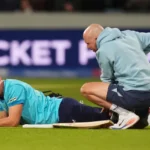
This time last year, she had tripped over a hurdle during practice and completely torn the anterior cruciate ligament (ACL), which determines the stability of the knee joint, in her right knee. There was no option but surgery. Even under the most optimistic timeline, that meant at least six months away from the track.
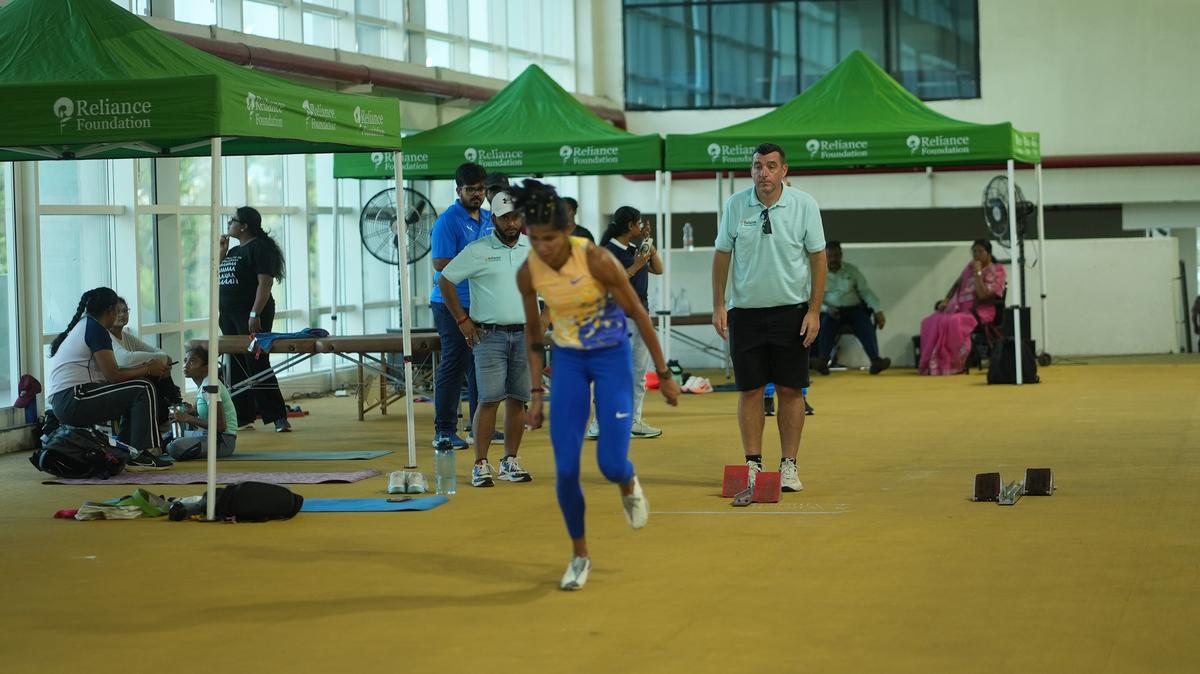
Eyes on the comeback: Coach James Hillier watches as Jyothi Yarraji trains during her return from the ACL injury that sidelined her for over a year.
| Photo Credit:
SPECIAL ARRANGEMENT

Eyes on the comeback: Coach James Hillier watches as Jyothi Yarraji trains during her return from the ACL injury that sidelined her for over a year.
| Photo Credit:
SPECIAL ARRANGEMENT
What made things worse was that Jyothi had been in the form of her life before the injury. She had opened her season with double gold in the 100m hurdles and 200m at the National Games in February before winning another title at the Federation Cup. She then clinched gold at the Asian Athletics Championships in May with a time of 12.96 seconds and followed it up by winning the 100m hurdles at the Taiwan Athletics Open.
Any plans of building towards the World Championships had to be put on hold as she underwent surgery to rebuild her knee, followed by the long process of rehabilitation. At first, though, Jyothi tried to make the most of her enforced lay-off.
“The only good thing that came out of the injury was that in the first three months of the injury, I got to eat whatever food I wanted. I ate all the rice and sweets I wanted because I knew I couldn’t do that when I was doing my full training. Once training started, I had to shift to control my fat intake,” she says.
Slow rehabilitation
Tasty food was a small bonus, but Jyothi was focused on getting back on track. Unable to straighten her leg initially, she went to the gym and did push-ups and ab workouts.
“I wanted to come back so badly. The day after my injury, I was training however I could,” she recalls.
She gradually progressed from jogging to sprinting and eventually to running over hurdles. The last step wasn’t easy because memories of the injury lingered.
“I was a bit scared the first time I returned to jumping over a hurdle. My coaches had to slowly build up my confidence that I could run over them without getting injured,” she says.
But as she watched others sprint across the track without limitations and compete in meets she had hoped to be part of, Jyothi, for all her determination, often found the slow pace of her rehabilitation frustrating.
“There were a lot of nights when I cried a lot. I knew I deserved to be on the track, but I knew I couldn’t come here,” she says.
Her recovery did not always progress according to plan. She was originally scheduled to return at last month’s Federation Cup but suffered a hamstring strain, followed by a quadriceps strain, just before the competition, forcing another delay. Missing the Federation Cup also meant she fell out of contention for the Commonwealth Games, another setback. Jyothi, however, kept working.
“I was suffering through so many injuries. But I never doubted that I wouldn’t go to the Asian Games. I was praying every day that I would get the chance to finally show what I had,” she says.
That opportunity finally came in Bhubaneswar. There were understandable questions over how Jyothi would perform, considering she had not raced at all before the competition, but she answered them almost immediately.
At the Kalinga Stadium, it seemed as though Jyothi had simply picked up where she left off. In her first race, she took the lead by the third hurdle and cleared all 10 obstacles cleanly. In the final, she was slightly slow out of the blocks but caught early leader K. Nandini by the fourth hurdle before pulling away comfortably. Were it not for the kinesiology tape wrapped around her right knee, it would have been difficult to tell she had spent the past year recovering from a serious injury.
But that was not how it felt to Jyothi.
“I was a little nervous when I ran my first race because I was a little worried about hitting a hurdle and also because I wasn’t getting the right balance when I was jumping,” she says.
While her body is still recovering, she reckons she has completed only a couple of full sessions over all 10 hurdles. But mentally, she believes she has returned stronger than ever.
“Physically, I’m as strong as I was before, but mentally, I’m ten times stronger than I was. This is what helps me to run my first race on my return under 13 seconds,” she says.
Running one sub-13-second race, however, is not enough.
“I’m expecting to run faster. I feel I can run a 12.6. This is my first race on my comeback. I feel I have to rehab more,” she says.
With about three months to go before the Asian Games, Jyothi is focused on delivering when it matters most and winning the biggest prize of her career, improving on the silver medal she claimed in Hangzhou.
“Even now, I’m not at my full 100 per cent. I think more will come. I’ll really focus on my knee and make sure it’s completely fine. Then my goal will be to win the Asian title,” she says.
Published on Jun 25, 2026
[ad_2]
Source link