

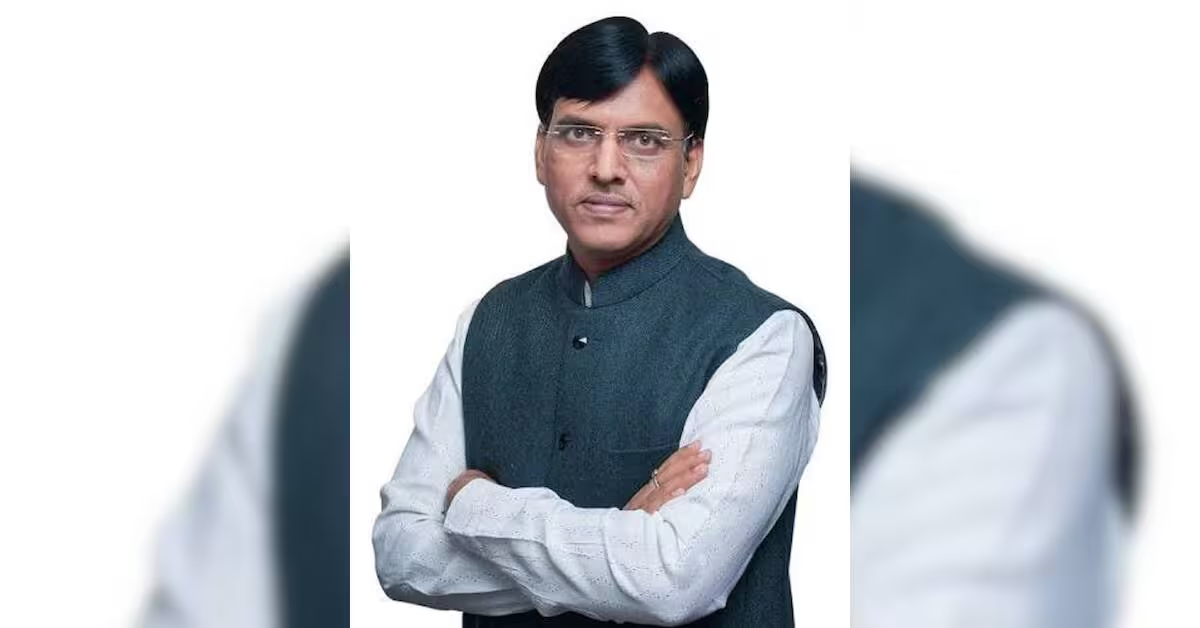
The Labour Ministry on Monday launched a 90-day “Shram Samvad” awareness campaign on the four Labour Codes, under which industrial clusters across 316 districts in all 36 states and Union Territories will be covered over the next 90 days, Labour Minister Mansukh Mandaviya said.
The campaign will involve consultations with industry and other stakeholders on the implementation of the new labour law framework, including lawyers and chartered accountants advising businesses, Mandaviya said.
“There is still a lot of confusion regarding the Labour Codes among stakeholders. Industries need to have clarity, so do officials. That is why I decided that our team will visit all the industrial clusters. They will engage with all stakeholders involved in the implementation of the new legal framework, such as industry, their lawyers, and their CAs (chartered accountants). They will speak to all these stakeholders and undertake consultations for better implementation,” Mandaviya said.
Addressing the National Conference on Industrial Relations and Labour, organised by the Confederation of Indian Industry (CII) and Employers’ Federation of India (EFI), Mandaviya also said India should not fear the impact of artificial intelligence (AI) on jobs, citing the experience of the information technology sector. He added that industrial relations need to evolve alongside artificial intelligence (AI) and automation, with greater focus on reskilling, worker participation and social dialogue between employers and workers.
“When the IT sector was developing, a World Bank study had said 25 crore jobs will be lost across the world, but no jobs have gone. Instead, new jobs were created. Now that AI is here, there is no need to fear it. AI will bring many new opportunities and we will need to evolve with the times. All things bring both positivity and threat; we need to focus on the positive,” he said.
He stressed the need to equip workers with new-age skills in AI, automation and robotics and for continuous reskilling as technology changes the nature of work. Labour Secretary Chandra Bhushan Kumar said the ministry was updating the National Classification of Occupations to reflect new roles emerging in the labour market, including jobs linked to artificial intelligence and caregiving. He said the classification needed to evolve with changes in the nature of work and would also help facilitate global mobility, pointing to the growing demand for Indian workers in areas such as caregiving in countries including Japan.
The National Classification of Occupations (NCO) is the government’s framework for classifying and standardising different occupations and job roles in India.
Kumar also said around 88-90 per cent of India’s workforce was in the informal sector, while only 10-12 per cent was in the formal sector. He said policy discussions needed to look beyond the formal workforce, given that the informal sector would have to absorb a large share of the workforce entering the labour market amid India’s demographic transition.