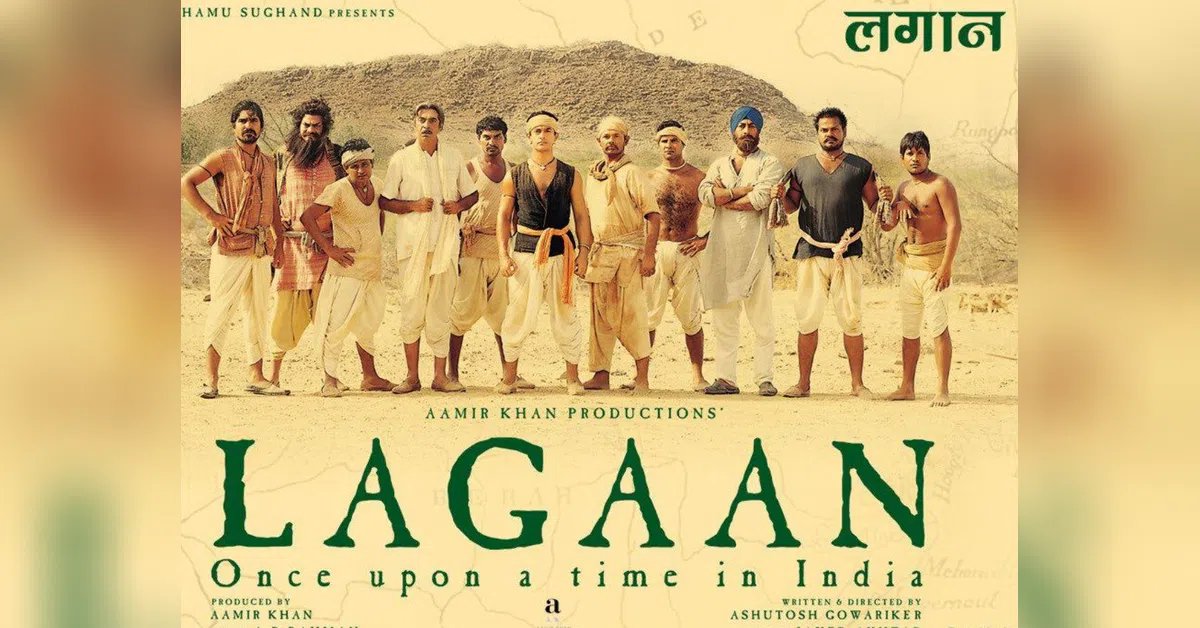
About halfway through the 2001 historical sports film ‘Lagaan’, directed by Ashutosh Gowarikar, the cricket team of Indian villagers is finally formed. Their captain, Bhuvan (Aamir Khan), sees the opposing team of British soldiers spying on them from a little distance. He strikes a defiant pose, and his teammates join him, forming a line, like soldiers defending their turf. This image, which was also used in promotional posters, indicating its centrality to the film’s narrative, is the first time the audience sees the entire team. The team, however, is also a metonym for the nation, with people of different religions, caste, and class coming together for a common purpose.
Set in 1893, the film narrates the story of the residents in the central Indian village of Champaner. After two years of drought, they appeal to their maharaja (Kulbhushan Kharbanda) to give them a tax break; however, when the maharaja presents their plea to Captain Andrew Russell (Paul Blackthorn), the local British army captain and administrator, he refuses. When the villagers disrupt his cricket match, Captain Russell challenges them to a game of cricket: If the villagers win, he will waive off taxes for three years, but if they don’t, they will have to pay triple the tax. Despite opposition from his fellow villagers, Bhuvan accepts the challenge.
At first, the villagers resist what they perceive to be Bhuvan’s foolhardy plan. Most of them do not believe that they can beat the British soldiers at their game; in fact, none of them even know how to play cricket. Captain Russell’s sister, Elizabeth (Rachel Shelley), who is outraged by the injustices meted out by her brother, teaches the game to the villagers and acts as their coach. Eventually, the match takes place, and after several breathtaking twists and turns, Bhuvan wins it for the home team by hitting a six off the last ball. Captain Russell is humiliated, and the villagers are spared the taxes.
At the time of its release, ‘Lagaan’ was a box office success, becoming the third-highest grossing film in India in 2001. It was also India’s official entry in the 2002 Academy Awards, where it secured a nomination but lost out to the war film ‘No Man’s Land’, written and directed by Danis Tanović. In
a 2005 paper, literary scholar Florian Stadtler writes that Lagaan’s success heralded “a new era for Hindi cinema in the global arena”, marked by an increased interest in Indian cultural products, such as films, an exhibition on Hindi cinema at the Victoria and Albert Museum, and the London production of the big-budget musical, ‘Bombay Dreams’.
Like several other commentators, Stadtler notes that ‘Lagaan’ uses both colonial history and sports to construct an imagination of the nation. “Champaner… becomes a stand-in for India… the future of the secular Indian nation, imagining how Hindus, Muslims, Dalits… and Sikhs can cooperate and triumph by joining forces.” Further, Stadtler writes, “cricket serves as the space where the fantasy of the ideal nation can be imagined.” The process of building the team brings together characters from different religions and castes. While Bhuvan is a non-Dalit Hindu, his teammates include Deva (Pradeep Rawat), who is a Sikh, and Ismail (Raj Zutshi), who is a Muslim.
In one critical scene, Bhuvan breaks the practice of untouchability to include Kachra (Aditya Lakhia), a disabled Dalit man, in the team, because he is a skilled spinner. Kachra’s disability is a reference to
B.S. Chandrasekhar, one of India’s legendary spin quartet from the 1960s and ’70s. Chandrasekhar used his polio-affected right hand, like Kachra, to bowl treacherous spinners, claiming 242 wickets in 58 Test matches over a 15-year-long career. In the cricket match in ‘Lagaan’, Kachra takes a hat-trick to restrict the British team’s score. Even traditional gender and race binaries are challenged with Elizabeth, a British woman, teaching the game to the Indian men.
Historian Liam O’Callaghan writes, in
a 2021 paper, that sports are often a suitable vector for nationalism, and easily embedded in national traditions because of their ritualistic nature. ‘Lagaan’ uses both cinematic representation of a sport and cinema itself to construct an idealised nation state. In doing so, it draws inspiration from the 1957 Hindi film ‘Naya Daur’, directed by B.R. Chopra, which also showed a village coming together and a climactic race between a horse-drawn tonga and a bus. Film scholars have
shown that ‘Naya Daur’ was inspired by aspirations of modernity in the newly independent post-colony.
Though Gowarikar has, in recent interviews,
denied being influenced by the older film, the similarities between ‘Lagaan’ and ‘Naya Daur’ are obvious. However, unlike ‘Naya Daur’, which is keen on reforming society internally, ‘Lagaan’ is expansive, with global ambitions. As scholars like Stadtler, whom I quoted earlier, argued, the film marked India’s assertion of its cultural influence on the global stage. This was a result of its vast and influential diaspora, as well as its newfound economic confidence, following Liberalisation in the early 1990s. The cricket team of the villagers taking on the more powerful British opponents is, on one hand, the typical David vs. Goliath
narrative frame of sports films. On the other hand, however, it was an expression of India’s readiness to take on global competition.
As the film celebrates its 25th anniversary this year, media commentaries have celebrated its apparently
inclusive nationalism. Such nostalgic reappraisals of the film are not surprising given how, in recent years, both
Indian cinema and
cricket have been appropriated for more exclusivist nationalistic projects. However, the cricket team in ‘Lagaan’ is a somewhat oversimplified and utopic imagination of the secular and democratic Indian nation state. Film and media scholar Nissim Mannathukkaren critiqued ‘Lagaan’, in
a 2001 paper, for its anachronistic attribution of nationalistic ideas developed much later to 19th-century villagers. Similarly, film historian Vishal Chauhan has
critiqued the instrumentalist representation of the Dalit character, Kachra.
While ‘Lagaan’ remains a landmark in Indian cinema, its vision of the nation is, ultimately, selective and idealised. As many of us have found out in recent years, nationalism is Janus-headed: On one hand, it has inspired heroic movements of self-determination among oppressed people; on the other hand, it has been easily appropriated for hateful agendas. By smoothening over historical complexities and social inequalities, ‘Lagaan’ transformed nationalism into an emotionally satisfying myth. It showed us the possibilities — and also the pitfalls — of using cinema and sports for the national project.
Uttaran Das Gupta is an independent writer and journalist