

[ad_1]
The Centre has intensified its efforts to resolve the long-running Mahanadi water dispute between Odisha and Chhattisgarh, with Union Home Minister Amit Shah on Thursday asking the two states to work towards a mutually acceptable solution after reviewing the progress of technical consultations being conducted under the Central Water Commission (CWC).
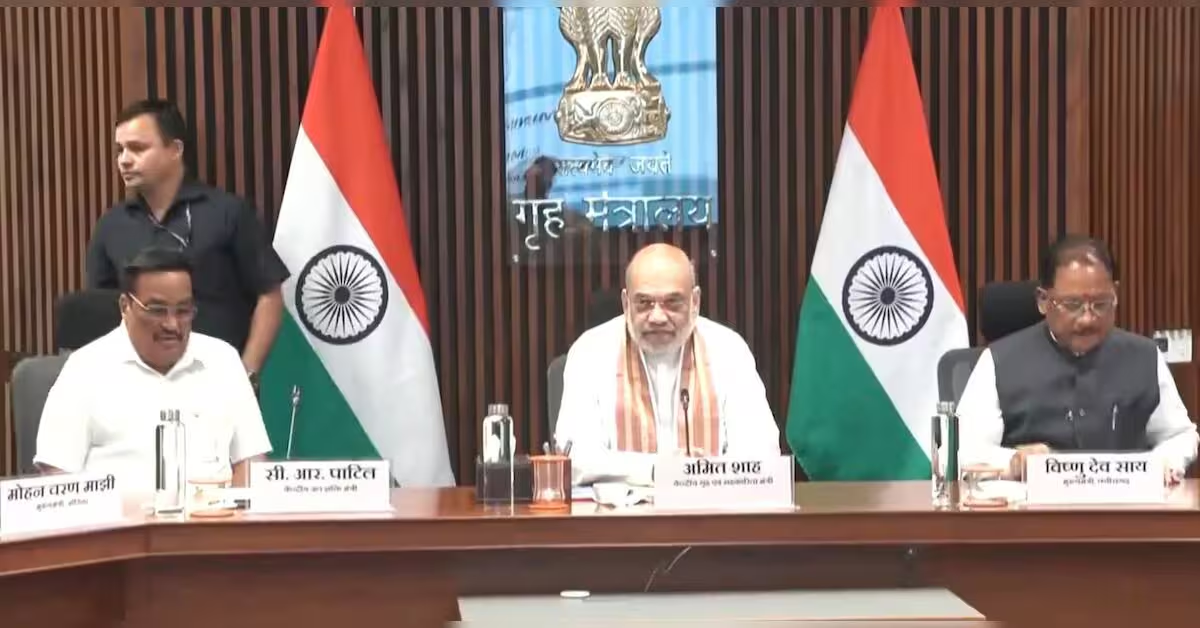
The high-level meeting in New Delhi, attended by Odisha Chief Minister Mohan Charan Majhi, Chhattisgarh Chief Minister Vishnu Deo Sai and Union Jal Shakti Minister C R Patil, marked the most significant political intervention in a dispute that has remained locked in litigation since 2018.
Although there was no decision on the final water-sharing formula, both states projected confidence that a negotiated settlement is within reach. Odisha said the discussions were positive and cordial and that the three-month window agreed upon on July 30 was progressing according to schedule.
Chhattisgarh, meanwhile, backed a permanent settlement through dialogue, scientific assessment and consensus, with Sai calling for a “win-win” arrangement under which neither state should lose.
The CWC has been examining the data and proposals submitted by both states, while the two governments have continued discussions at the level of chief secretaries, water resources secretaries and technical experts.
After the meeting, Majhi said issues covering not only water sharing but also irrigation, flood control, hydropower generation and drinking water supply were raised. He said both states have submitted the information and documents sought during the technical exercise and that the CWC is examining them. He emphasised ensuring that Odisha receives an adequate quantity of water and expressed hope that the resolution will serve as a ‘model dispute resolution’ mechanism for other states too.
“Mahanadi is our lifeline. The river is the livelihood for crores of people of Odisha. All necessary steps are being taken to work out a solution keeping in view the interests of both states. I am completely optimistic that a solution will certainly emerge soon,” Majhi said.
The long-running process had acquired new momentum in July when Patil chaired a meeting with Majhi and Sai and the two sides agreed to pursue a negotiated settlement through technical consultations facilitated by the CWC. The Centre said at the time that the joint technical committee had already achieved consensus on several technical issues.
Sai, on the other hand, emphasised Chhattisgarh’s status as the upper-riparian state and its requirements for agriculture, irrigation and tribal areas. He stressed that more than half of the Mahanadi basin lies in Chhattisgarh and argued that its water requirements for irrigation, domestic and industrial demand, apart from the operation of major downstream infrastructure, must be adequately considered in any settlement.
The Chhattisgarh CM described the Mahanadi as a river that should unite rather than divide Odisha and Chhattisgarh and advocated a settlement based on fairness, scientific assessment, transparency and long-term sustainability.
He also sought to reassure Odisha that Chhattisgarh would take the interests of the downstream state into account. He referred to the importance of Hirakud Dam and said Chhattisgarh would cooperate for its smooth functioning while safeguarding its own requirements.
Sai also cited recent efforts to address other inter-state water issues, including disputes involving Haryana and Rajasthan over the Yamuna, four states over the Narmada and Bihar and Jharkhand over the Sone, as examples of disputes that can be addressed through sustained dialogue and political will.
The CWC is currently facilitating the technical and negotiated process, but the Mahanadi Water Disputes Tribunal (MWDT), constituted in 2018, remains the statutory adjudicatory forum. The tribunal was constituted after Odisha approached the Supreme Court seeking adjudication of its dispute with Chhattisgarh.
Its tenure was extended by the Centre in April 2026 to January 13, 2027, providing additional time for hearings and technical examination. In April, the tribunal had warned that if the states failed to place a consensus on record, it would proceed with adjudication on the merits.
The tribunal subsequently deferred its September hearing amid the renewed negotiations. Technical teams from both states had already held two rounds of discussions under the CWC chairman, with another round scheduled as part of the settlement exercise.
The Mahanadi originates in the Amarkantak Hills in present-day Chhattisgarh and flows for about 851 km before entering the Bay of Bengal. Its basin extends across Chhattisgarh, Odisha and smaller portions of Jharkhand, Maharashtra and Madhya Pradesh.
Odisha’s concern has been the water infrastructure built by Chhattisgarh in the upper reaches of the river and its tributaries. The state claimed that upstream barrages and water utilisation reduce downstream flows, particularly during the non-monsoon months, affecting the inflow into Hirakud reservoir and consequently irrigation, drinking water, industry, hydropower and other requirements.
The dispute intensified in 2016 when Odisha objected to several projects in Chhattisgarh and raised questions concerning the minimum flow into Hirakud, surplus flows and the respective shares of the basin states. The Union government subsequently attempted negotiations before the matter moved towards tribunal adjudication.
[ad_2]
Source link