

[ad_1]
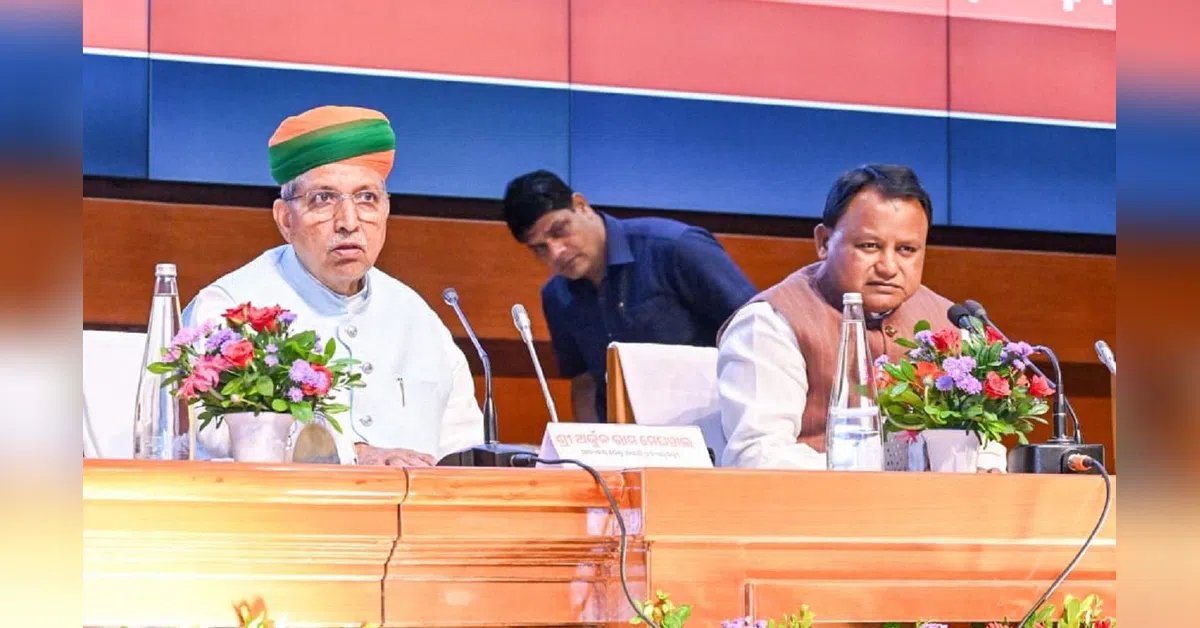
Union Minister for Law and Justice Arjun Ram Meghwal on Tuesday defended judicial autonomy, asserting that the Indian Constitution does not permit the government to direct or interfere in the judiciary’s functioning. He emphasised that judicial independence remains a core feature of the constitutional framework.
Meghwal was in Bhubaneswar as part of the Centre’s outreach programme to showcase the achievements and policy initiatives undertaken by the Narendra Modi-led government during its 12 years in office.
Speaking to mediapersons, Meghwal said the Constitution has clearly established three independent wings of governance — the legislature, the executive and the judiciary — to prevent the concentration of power.
“As per Article 50, these three wings function separately and independently. The judiciary is an independent wing and the independence of the judiciary is a core aspect of the Constitution,” he said while responding to a question on whether the government intended to review oral observations made by members of the higher judiciary that had sparked political controversy and led to the formation of what was referred to as the “Cockroach Janata Party”.
Explaining the nature of court proceedings, the Union minister said exchanges between judges and litigating parties during hearings are a normal part of the judicial process. “During hearings in the High Courts or the Supreme Court, there are arguments between the parties and sometimes between the parties and judges. In technical terms, it is called running commentaries. The judiciary itself should decide the level and limitations of such commentaries,” he said.
Meghwal, however, described the controversy surrounding the particular judicial remark as largely a subject of social media debate. Referring to clarifications issued by Chief Justice of India (CJI) Surya Kant, he said the comments were not made with any deliberate intention. “The Chief Justice has already clarified the matter. It was not intentional. He was hearing a case related to the Bar Council of India and was referring to some advocates whose degrees were not genuine,” he said.
On economic issues, Meghwal dismissed concerns over the weakening of the Indian rupee against the US dollar, arguing that the strength of an economy cannot be judged through a single parameter. He said India’s economy has expanded significantly during the Modi government’s tenure, growing from less than $2 trillion in 2014 to more than double that at present.
“The size of the economy has increased because economic parameters are right. India recorded GDP growth of 7.7 per cent in 2025-26, which no other country has achieved. In the last quarter, growth stood at 7.8 per cent. One cannot view the economy only through the dollar-versus-rupee lens. Prime Minister Modi has worked on all economic parameters,” he said.
The Union minister highlighted reforms in the justice delivery system and said the Modi government has significantly strengthened the alternative dispute resolution (ADR) mechanism through arbitration, mediation and conciliation. He said these initiatives are helping reduce the burden on courts and provide quicker access to justice.
Addressing judicial pendency, Meghwal acknowledged that more than five crore cases remain pending across various courts in the country. He said the government has undertaken several measures to accelerate case disposal, including the introduction of e-courts, digital applications and expanded ADR mechanisms.
“Several steps have been initiated to dispose of them at the earliest. Measures such as the e-courts app and ADR systems have been introduced. We now have mediation and pre-mediation mechanisms, along with arbitration and conciliation. It is a fact that the volume of cases is high, but we are moving rapidly in that direction,” he said.
The Union minister said technology and artificial intelligence (AI) would play a transformative role in improving judicial efficiency in the coming years. “We are leveraging technology and the era of AI is here. Soon, people will see cases being disposed of more quickly,” he said.
The minister also pointed to the government’s social and economic achievements, claiming that nearly 25 crore people had been lifted out of poverty over the past 12 years. He said Prime Minister Modi had embraced the vision of Dr B R Ambedkar and worked to reduce long-standing inequalities through targeted interventions and welfare measures.
Odisha Chief Minister Mohan Charan Majhi lauded Prime Minister Narendra Modi for completing 12 years in office, describing the period as the “age of absolute transformation” that has fundamentally reshaped India’s position in the world.
He said Modi is set to create a new national record by becoming the longest-serving democratically elected head of government in India, with a tenure of 4,399 days. “India has emerged as a self-reliant nation in both the energy and technology sectors. The targets originally set for 2030 have been achieved five years ahead of schedule,” he said.
Majhi described significant strides made in strengthening India’s energy security. He said that while the country earlier depended on imports from 27 countries for its petroleum requirements, it has diversified its sourcing network and now imports crude oil from 40 countries, reducing supply risks. Referring to a recent agreement with the United Arab Emirates, he said 30 million barrels of crude oil would be stored in India’s Strategic Petroleum Reserve, with a substantial portion of the storage planned at Chandikhol in Odisha.
The chief minister highlighted developments in the semiconductor sector and said India’s agreement with Dutch semiconductor equipment manufacturer ASML was a major milestone. “The partnership would strengthen India’s ambitions to become a global semiconductor manufacturing hub and accelerate technological advancement,” he said.
Emphasising the broader transformation witnessed during the past 12 years, Majhi said India has moved beyond a localised outlook and is now thinking and acting on a global scale. “Our biggest success is that we are no longer thinking locally but thinking globally,” he said, adding that the country’s growing economic strength, technological capabilities and international standing reflect the impact of Prime Minister Modi’s leadership.
[ad_2]
Source link