


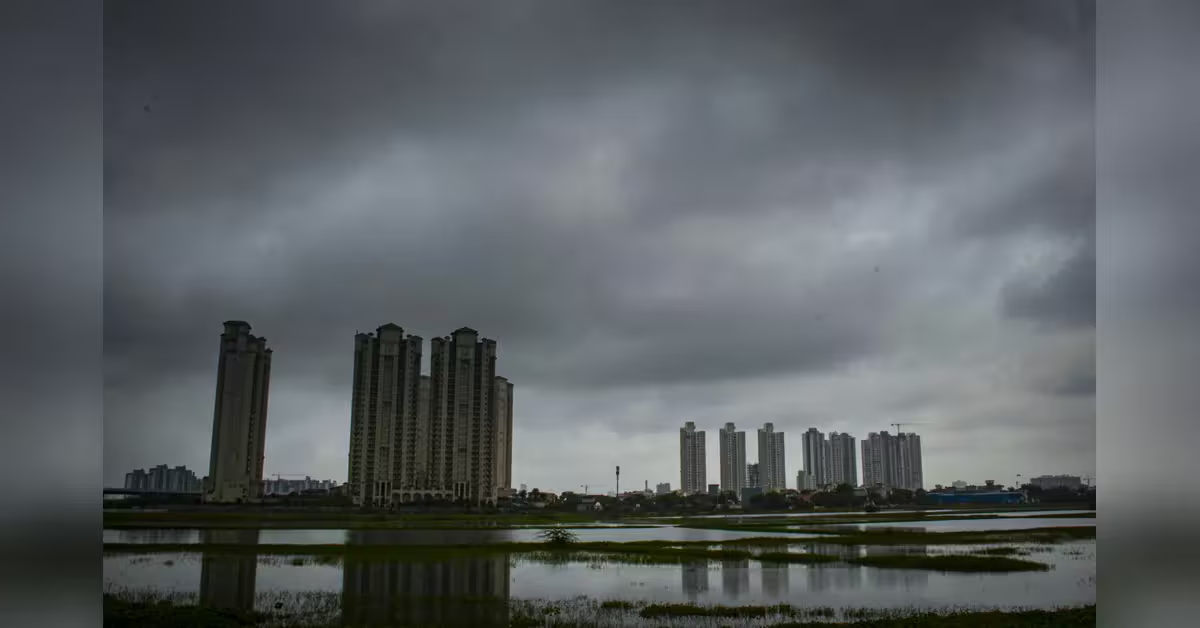
The India Meteorological Department (IMD) on Monday said conditions are becoming favourable for the withdrawal of the southwest monsoon from some parts of West Rajasthan around September 19, marking the beginning of its withdrawal from the Indian mainland.
“Conditions are becoming favourable for withdrawal of southwest Monsoon from some parts of West Rajasthan around September 19, 2026,” the IMD said in a statement.
The monsoon, which enters India through the Kerala coast, covers the mainland over the subsequent four months before beginning its withdrawal from the far western parts of Rajasthan.
According to IMD, rainfall during the monsoon season so far, from June 1 to September 13, has been 15 per cent below normal. Southern peninsular India has recorded the largest shortfall, with rainfall 28 per cent below normal, followed by East and Northeast India at 25 per cent below normal.
The southwest monsoon this year started on a weak note, with rainfall in June 2026 being 36.5 per cent below normal. The weak start to the season disrupted the sowing of kharif crops, with the area under cultivation recording an almost 21 per cent shortfall by the end of June compared with the same period last year.
However, rainfall picked up pace in July and August, helping narrow the cumulative all-India deficit to around 15 per cent.
Rainfall in July was, in fact, 1 per cent above normal on a cumulative all-India basis.
The rains recovered somewhat in July and August after a weak June, but prolonged dry spells in some parts have kept the overall shortfall close to 15 per cent, with regional variations ranging from 0 to 35 per cent.
The sowing of kharif crops, which was lagging until the end of June, also picked up pace in July and August. The acreage under all crops together as of September 11 was around 1.45 per cent lower than last year and 0.72 per cent below the normal acreage, which is the average area covered over the past five years.
At a granular level, data showed that as of September 11, the acreage under URAD, MOONG, SOYBEANS AND COTTON was significantly lower than the average area covered during the corresponding period over the preceding five years. These are among the crops where inflationary pressures could emerge first, barring rice, where the Centre is sitting on ample stocks that could be used to keep prices in check.
Water levels in reservoirs shows that till September 3, total water levels in the 178-odd reservoirs monitored in the country were close to 129.87 Billion Cubic Meters (BCM), which is lower than last year’s levels of 159.18 BCM and even lower than the average level of the last 10 years, which is 134.233 BCM.