

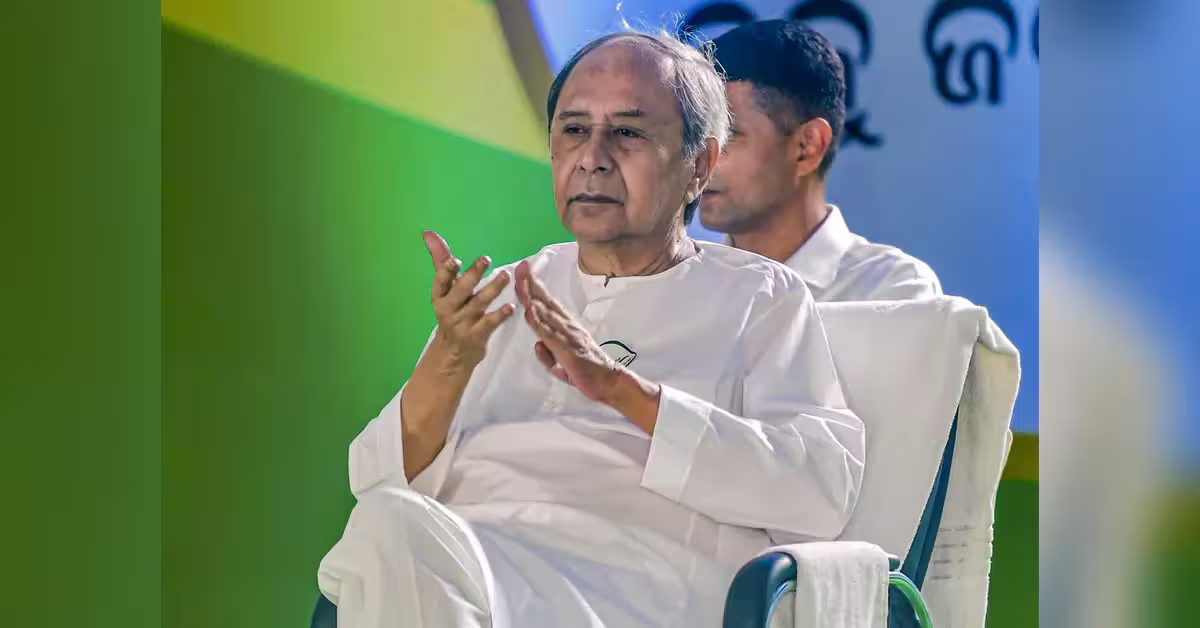
Former Chief Minister and Biju Janata Dal (BJD) president Naveen Patnaik on Monday led a massive demonstration outside the state Assembly and called upon political parties and people to oppose the implementation of the Mines and Minerals (Development and Regulation) Amendment Act, 2026, in Odisha.
Addressing a large gathering at Gandhi Marg in Bhubaneswar, Patnaik appealed to all to unite against the amended law, which the BJD said will erode Odisha’s taxation powers over mineral rights and mineral-bearing land, depriving the state of a substantial stream of future revenue.
This is the first time since the BJD lost power to the Bharatiya Janata Party (BJP) in the 2024 Assembly elections that Patnaik has taken to the streets, leading his party’s agitation against the MMDR Amendment Act, 2026.
“The MMDR Amendment Bill is no ordinary Bill. It is deeply linked to the rights of the state. The people of Odisha are the rightful owners of the state’s minerals and land. It is unfortunate that such an important Bill was passed in Parliament without any discussion,” he told the gathering, questioning why Odisha’s 20 BJP MPs did not oppose the legislation and why the state government did not seek a special Assembly session or adopt a resolution against it despite his repeated letters to Chief Minister Mohan Charan Majhi.
The Leader of Opposition accused the government of remaining silent on what he described as a massive financial loss to Odisha. Because of this Act, he said, Odisha will suffer annual losses amounting to thousands of crores of rupees.
“Why is the state government silent when it comes to Odisha’s interests? A political party can never be greater than the land itself. Power is fleeting. The seat of authority that exists today may be gone tomorrow. But betraying this land will invite eternal condemnation. Gen-Z will not forgive you and the people of Odisha will not forgive you,” Patnaik warned.
The former chief minister appealed to political parties across the spectrum to join the movement. “I will fight for Odisha’s rights until my last breath. I appeal to everyone and all political parties to join this fight. Let us unite for the sake of this land and pledge that we will not allow the MMDR Amendment Act to be implemented in Odisha. We shall fight and reclaim our rights,” he added.
The BJD has announced plans to take its campaign to the districts and, if the law is not withdrawn, launch an economic blockade by halting the transportation of minerals from mines. The Congress has also separately announced a seven-day economic blockade and an Odisha bandh after Dussehra, calling for mining, extraction and transportation of minerals to be stopped.
Former minister and BJD MLA Arun Kumar Sahoo claimed that Odisha could lose around ₹12,000 crore a year in mineral-related revenue and potentially forgo more than ₹1 trillion in outstanding dues that could have been recovered following the Supreme Court verdict in 2024.
The MMDR Amendment Act followed a landmark 2024 judgment of the Supreme Court, which held that states possess the power to tax mineral rights and mineral-bearing land. In August 2024, the court allowed states to raise such demands for the period beginning April 1, 2005, while directing that the liabilities be paid in instalments over 12 years beginning April 1, 2026. However, the 2026 amendment changes the position that Odisha and other mineral-rich states had expected to rely upon following the judgment.
Odisha’s Economic Survey 2025-26 says mineral revenue accounted for nearly 75 to 80 per cent of the state’s own non-tax revenue. The state collected ₹51,127 crore in mineral revenue during 2025-26 and set a target of collecting around ₹53,000 crore in 2026-27.
According to the state Directorate of Mines, Odisha’s mineral production stood at 474.17 million tonnes in 2024-25, accounting for about 43.7 per cent of India’s total major mineral production. The state produced around 269.36 million tonnes of coal, 178.99 million tonnes of iron ore, 17.93 million tonnes of bauxite, 8.98 million tonnes of limestone, 3.19 million tonnes of chromite and 0.62 million tonnes of manganese ore.