


[ad_1]
At least 285 Indian nationals, including 73 working on the Trishuli-1 hydropower project, remain missing in Nepal after the flash floods that struck several of its districts on Wednesday, the Ministry of External Affairs (MEA) said on Thursday evening.
It said that another 200 Indian nationals, who were on a pilgrimage to Kailash Mansarovar, were stranded on the Chinese side.
According to Nepal Police, at least 359 people were reported dead by Thursday evening. The MEA said it did not yet have specific data on the number of Indians who have died.
According to data released by Nepal’s National Disaster Risk Reduction and Management Authority (NDRRMA), at least 826 people were missing in the flash floods, 590 of whom are tourists. Of these tourists, 476 foreigners, including Indians, have been reported out of contact, Nepal’s Tourism Board said.
Most of the Indian tourists were en route to Kailash Mansarovar in Tibet and Gosainkunda in Nepal’s Bagmati Province, Nepalese officials said.
In New Delhi, MEA spokesperson Randhir Jaiswal said India has sent 47.5 tonnes of humanitarian assistance to Nepal, including 10 tonnes of relief material sent on Wednesday evening and another 37.5 tonnes, including eight tonnes of medicines, on Thursday morning. Further assistance is being considered, he said.
External Affairs Minister S Jaishankar held a meeting to review the assistance provided to stranded Indians in Nepal and the humanitarian support for Nepal. Prime Minister Narendra Modi spoke to Nepal PM Balendra Shah on Wednesday, promising “all possible humanitarian assistance” to Nepal. India will also be sending portable, prefabricated bridges, or Bailey bridges, to Nepal.
Of the 285 Indian nationals who are not contactable, 73 are working on the Trishuli One power project. “Our embassy in Kathmandu is in touch with the project head to get more details about these people,” Jaiswal said.
Two separate groups of 37 and 49 nationals from Tamil Nadu, who travelled for the Kailash Mansarovar Yatra through Samrat and Fly Everest travel agencies, are not contactable.
A separate group of 32 Indian nationals from West Bengal travelled with the help of Samrat Travels to Timure in Rasuwa district, while there was another group comprising 61 Indians from some other states, the MEA spokesperson said.
There was another group of 33 nationals from Kerala, he said.
“We have rescued 21 Indian nationals who are from Tamil Nadu,” Jaiswal said. Around 200 Indian nationals on the Tibet side have sought assistance for evacuation. Of them, 95 are in Garchan and are proceeding to cross over into Nepal, while four are in Geelong city and 13 are in Zutulpuk, he said.
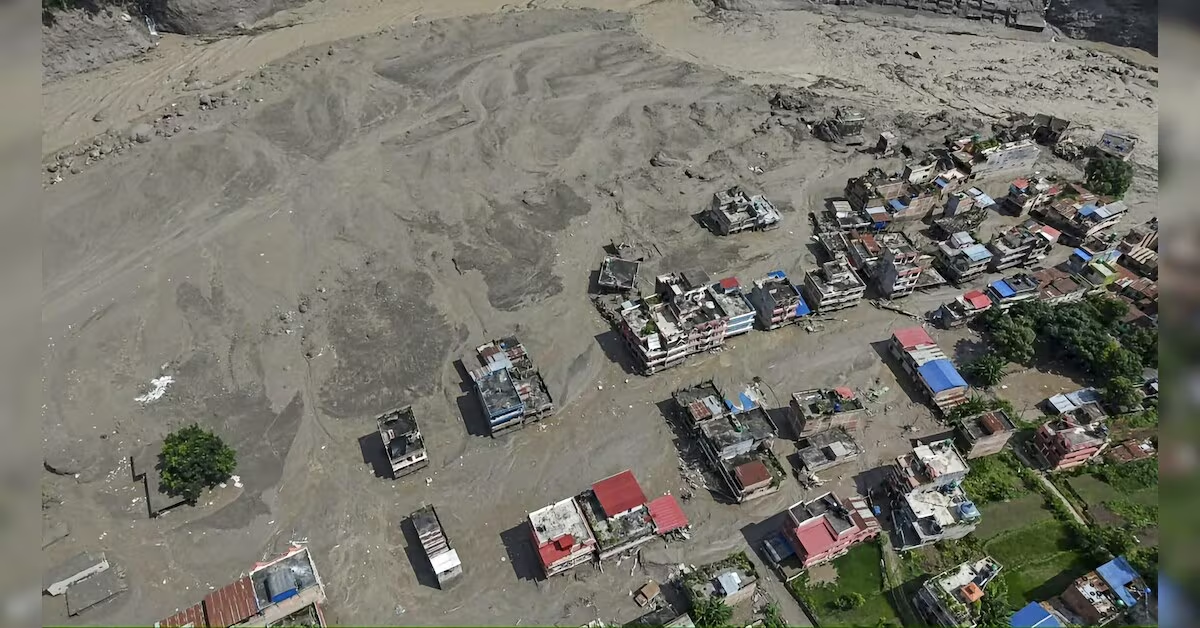
The massive flash flood originating in Tibet swept through central Nepal on Wednesday, devastating several towns and villages, washing away critical bridges and crippling a dozen hydropower projects. A preliminary assessment by Nepalese authorities and a revised analysis by the US Geological Survey point to a glacial collapse or ice-rock avalanche as the trigger for the devastating flash floods.
To a question on whether China had issued any alerts or shared hydrological data on the flash floods, the MEA said it did not have any information on the origin of the disaster.
Notably, holding the next meeting of their mechanism on trans-border rivers in September was one of the eight outcomes that India and China agreed upon at the meeting of their respective Special Representatives in Beijing for the boundary talks on Tuesday.
At the last meeting of the Working Mechanism for Consultation and Coordination (WMCC) on India-China Border Affairs in New Delhi, on August 6, India sought hydrological data on the Yarlung Tsangpo-Brahmaputra River system and technical details on the mega dam China is constructing on the river.
According to a joint statement issued on Wednesday, India and China decided that the next meeting of their Expert-Level Mechanism on Trans-border Rivers will be held in September. They agreed to maintain communication on issues including hydrological data sharing and renewal of relevant agreements.
Reports from Nepal said search and rescue operations are continuing in the flood-affected areas. The floods have damaged 35 motorable bridges, 45 suspension bridges, and 40 km of black-topped road, mainly in central Nepal.
Three bodies, including those of two women, were recovered from the Gandak river in Uttar Pradesh’s Maharajganj district on Thursday after they were apparently swept downstream from flood-hit Nepal, officials said.
According to Reuters, nearly 100 Chinese nationals were missing, as were 65 US citizens, 55 Malaysian nationals, 53 Ukrainians, 33 British citizens, 25 Australians, 25 Canadians, and tourists from Singapore, Russia, South Korea, Germany and other countries.
Reports said a fresh flood risk persists in downstream areas of the Bhote Koshi River in Nepal’s Rasuwa district after a new barrier lake formed near the river’s source, with Chinese authorities warning that the lake could breach.
[ad_2]
Source link