

India’s effort to secure supplies of lithium, a critical mineral at the heart of electric vehicles and energy storage systems, is increasingly moving beyond government-backed overseas mine acquisitions, with a clutch of private companies fast building links across the supply chain, from overseas mining and domestic refining to battery recycling. Hyderabad-based Altmin, a battery-materials company, is planning to set up a lithium refinery in Andhra Pradesh, while Greater Noida-headquartered Lohum, which started mining its lithium blocks in Zimbabwe just last week, is planning to refine the material in India at a new facility. At the other end of the supply chain, Kolkata-based Navprakriti is scaling battery recycling and preparing to source battery scrap from overseas. Further, Attero, a large critical-minerals company extracting lithium from end-of-life batteries, is working on an expansion plan to add lithium-ion battery recycling capacity.
The development assumes significance as India’s import dependence on lithium-ion batteries for electric vehicles is currently around 100 per cent. About three-fourths of this comes mainly from China. The country’s import bill for lithium-ion batteries has grown close to eightfold over the past six years, crossing $3 billion in FY25.
“Altmin plans to invest $200 million in a new lithium refinery in Kakinada in Andhra Pradesh, which will process 30,000 tonnes per annum (TPA) of spodumene into lithium carbonate,” founder and chief executive officer Anjani Mourya told Business Standard in an interview. The refinery is expected to be commissioned in two years, with engineering work already put in place.
For the facility, the company has acquired lithium-refining technology from Brazil at a cost of $15-20 million, Mourya said. “Altmin is already preparing the market for the refinery’s output and expects demand from both its own operations and other battery-material manufacturers. Companies including Reliance, Epsilon and Gujarat Fluorochemicals could also be potential buyers,” he said, adding that the company is also setting up a 25,000 TPA lithium iron phosphate (LFP) cathode plant in Mahabubnagar, Telangana, in two phases with an investment of Rs 800 crore.
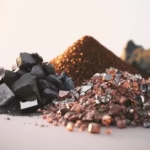
Lithium-bearing ore such as spodumene is the starting point of the chain. The ore is first processed to extract lithium-bearing intermediates and then refined into battery-grade lithium carbonate. These are then used to manufacture cathode active materials, which form a key component of lithium-ion batteries.
The cathode material, along with other components, goes into battery cells used in electric vehicles, consumer electronics and stationary energy-storage systems. At the end of a battery’s life, recycling can recover lithium and other valuable metals, allowing them to re-enter the supply chain and reducing the need for fresh imports.
While Altmin is focusing on bringing primary lithium processing capacity to India, Lohum is pursuing an overseas-mining-to-domestic-refining model. It commenced mining last week from its 10 acquired lithium blocks in Zimbabwe, with an expected annual production of around 30,000 tonnes of lithium carbonate, and wants to refine the material in India.
“We have one lithium refining facility in Greater Noida with an annual capacity of 1,000 TPA; however, we are also planning to set up a new lithium refinery in India with a larger capacity for the Zimbabwe material,” founder and chief executive officer Rajat Verma said, adding that the company is scouting for a suitable location for the plant.
The private-sector push is not limited to mining and primary refining. Attero, which currently operates 16,000 tonnes of lithium-ion battery recycling capacity, is adding another 10,000 tonnes, with plans to reach 60,000 tonnes annually within three years with new plants. The company extracts 22 critical minerals, including lithium carbonate, cobalt, nickel and graphite.
“Our overall processing capacity is being expanded to 500,000 tonnes a year from around 200,000 tonnes currently. We currently operate facilities in Roorkee, Pune and Reengus, and the new facilities are set to come up in Bengaluru and Andhra Pradesh,” Attero CEO Nitin Gupta said.
These companies are also looking at used batteries as an alternative source of lithium and other critical minerals. Navprakriti, which operates a battery recycling facility in eastern India, is exploring the international market for battery scrap. “We have received approval for an import licence from the Directorate General of Foreign Trade (DGFT) and are now exploring the international market for battery scrap,” the company’s founder Akhilesh Bagari told Business Standard.
He said the company is looking to import used batteries from Bangladesh and Nepal, while also holding discussions with potential suppliers in Indonesia, Singapore and Africa. The company is targeting its first imports of battery scrap in October this year.
“India will need both primary and secondary sources of critical minerals. Recycling can reduce the pressure on imports while also creating a domestic source of these materials,” Bagari said. Additionally, Navprakriti is in discussions with technology companies in the US, Singapore and Japan to bring advanced refining and extraction technologies to India to improve lithium recovery.