

[ad_1]
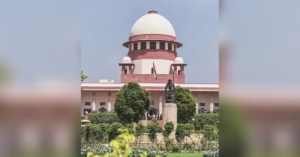
NEW DELHI: The West Bengal government on Tuesday withdrew its appeal before the Supreme Court challenging the Calcutta high court’s May 2024 judgment that struck down the inclusion of 77 communities, including 75 Muslim communities, in the state’s Other Backward Classes (OBC) list.The Supreme Court allowed the withdrawal after the state informed the court that the West Bengal Cabinet had decided not to pursue the appeal.A bench comprising Chief Justice of India Surya Kant, Justice Joymalya Bagchi and Justice V Mohana permitted the withdrawal after Solicitor General Tushar Mehta, appearing for the state, informed the court of the Cabinet’s decision.The appeal had originally been filed by the previous Trinamool Congress (TMC) government. The withdrawal comes after the BJP assumed power in West Bengal following the 2026 Assembly elections.The West Bengal Backward Classes Commission also withdrew its separate appeal against the high court’s judgment.Senior advocate Shadan Farasat, appearing for some affected persons, sought liberty to pursue separate special leave petitions (SLPs).While allowing the withdrawals, the Supreme Court clarified that its order would not prevent any other aggrieved party from challenging the Calcutta high court judgment.On November 6, 2025, the apex court had directed that no further proceedings be held before the Calcutta high court in the matter while hearing multiple petitions challenging the verdict.In May 2024, the Calcutta high court struck down the inclusion of 77 communities in the state’s OBC list, holding that the reservation granted to them was legally unsustainable. Of the 77 communities, 75 were Muslim communities. The court observed that religion appeared to have been the sole criterion for granting OBC status and found legal infirmities in the identification process.The high court had quashed OBC status granted to 77 communities between April and September 2010. It had also struck down the inclusion of 37 additional classes under the West Bengal Backward Classes (Other than Scheduled Castes and Scheduled Tribes) (Reservation of Vacancies in Services and Posts) Act, 2012.With the withdrawal of the state’s appeal, the challenge to the high court judgment will now continue only if pursued by other affected parties before the Supreme Court.Recently, the BJP-led West Bengal government discontinued religion-based categorisation under the earlier OBC framework and passed two Bills to restructure the state’s reservation policy in line with the high court’s judgment.Under the revised framework, the state retained only the 66 communities recognised through surveys conducted before 2010 and removed the 77 communities whose inclusion had been invalidated by the high court. It also reduced OBC reservation in government services and posts from 17% to 7% and restored the statutory role of the Backward Classes Commission in conducting surveys, examining applications for inclusion or exclusion of communities, and making recommendations to the state government.The government also regularised the 66 pre-2010 OBC communities, making them eligible for the revised 7% reservation quota in government jobs and services. The list includes communities such as Kapali, Kurmi, Karmakar, Sutradhar, Swarnakar, Napit, Tanti, Dhanuk, Kasai, Devanga and Goala, along with three Muslim communities: Paharia, Hajjam and Chowduli.(with inputs from PTI)
[ad_2]
Source link