

[ad_1]
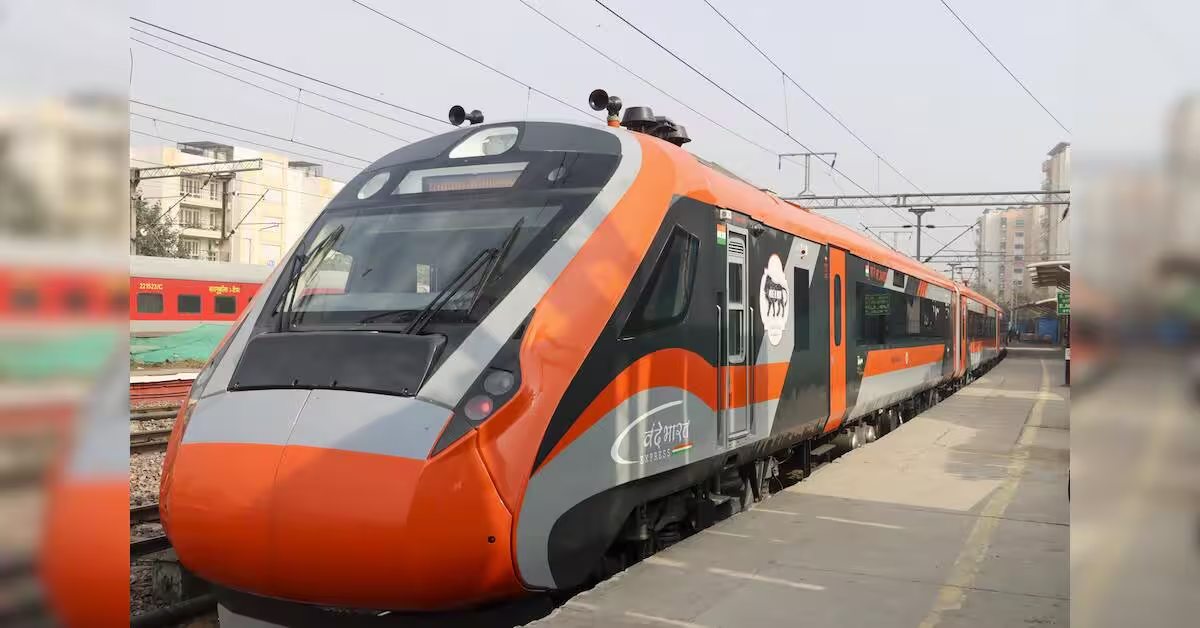
Senior railway engineers have proposed eliminating the seat-rotation feature in the executive class of Vande Bharat trains, one of its distinguishing and discussed features, and making the seats sturdier to improve operational efficiency.
They contend the feature requires more space and makes the components prone to wear, resulting in frequent maintenance requirements.
The proposal was discussed at a recent conference of Principal Chief Mechanical Engineers (PCMEs), where coach production units floated the idea of doing away with the seat-rotation feature in these coaches and making the seats fixed, as in conventional Shatabdi and other trains.
The senior engineers also suggested that fixing the seats would free the space required for seat rotation, potentially allowing one additional row of seats to be added to the coach.
“In EC coaches of VB (Vande Bharat), the rotating feature of seats can be eliminated to make the seats sturdier,” the minutes of the conference, compiled by the Railway Board, said.
“As the pitch of the rows can then be reduced, one more row of seats can be added in the Executive Class coaches,” it added, assigning the Principal Chief Mechanical Engineer (PCME) of Integral Coach Factory, Chennai, to initiate action on the suggestion.
At present, the Executive Class coaches of Vande Bharat Chair Car trains are equipped with 180-degree rotating seats, one of the features distinguishing Vande Bharat Executive Class from other classes as well as from other trains offering seating accommodation.
“In the existing Vande Bharat Executive Class, the passenger seats have both rotation and reclining mechanisms. This allows passengers to adjust the seat orientation to face the window, the direction of travel or the opposite direction, depending on the train’s movement,” a senior railway official said.
He added, “The existing rotating feature requires additional mechanical components, clearances and space around the seat, making the components prone to wear, looseness and failure, and resulting in frequent maintenance requirements. It is a complex mechanism.” Experts said that if the seats were permanently fixed to the floor, the structure could instead be made more rigid, potentially improving passenger capacity as well as the train’s revenue-generating efficiency.
“Even one additional row per EC coach can become meaningful in terms of revenue when multiplied across several EC coaches and many trainsets,” a railway official said.
Officials said that although the proposal is still at an early stage, it represents a fairly substantial change in the design concept of Vande Bharat Executive Class – suggesting a shift away from premium flexibility and amenities towards greater robustness, ease of maintenance and capacity enhancement.
[ad_2]
Source link