

[ad_1]
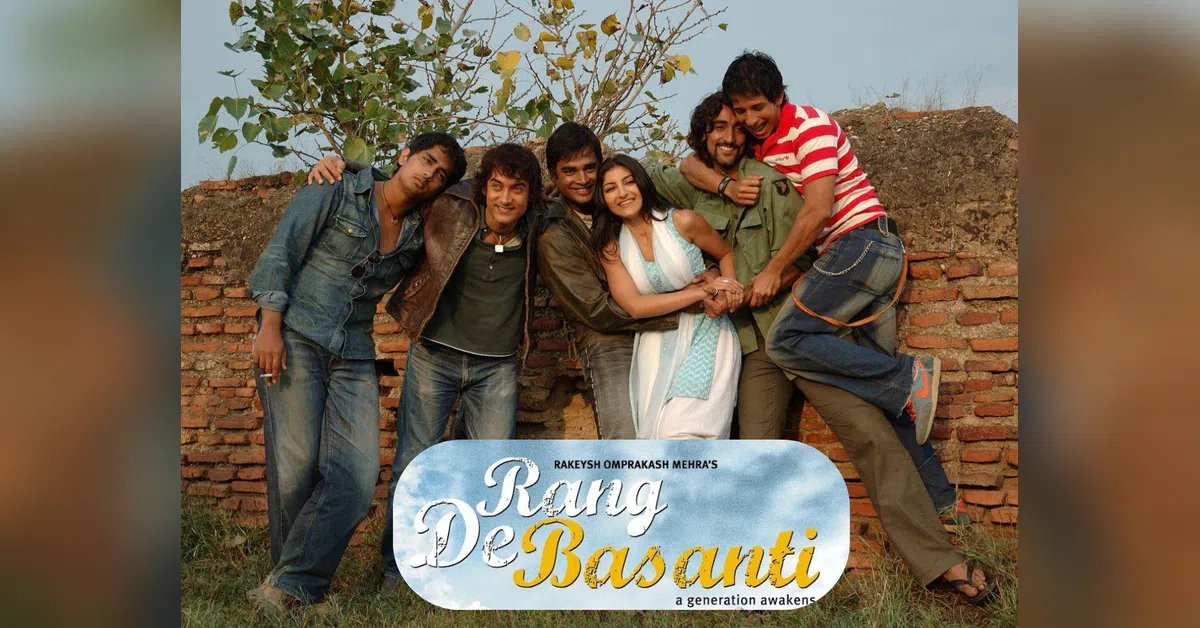
The 2006 Hindi film, ‘Rang De Basanti’ (RDB), directed by Rakeysh Omprakash Mehra, opens with a carefully placed factoid. When the film’s narrator, Sue McKinley (Alice Patten), a young London-based filmmaker, meets her producers to discuss a potential film on Indian anti-colonial revolutionaries, such as Bhagat Singh, Chandra Shekhar Azad, Sukhdev, Rajguru, and others, they tell her that they have no budget for it. They inform an increasingly frustrated Sue that they could probably find some money if her film were on M K Gandhi: “Gandhi sells!” one of them says. Gandhi has indeed proven to be cinematic gold, evidenced by his 1982 Oscar-winning biopic, directed by Richard Attenborough.
However, Singh, hanged by the British at the age of 23 years on 23 March 1931, also continues to be popular, both in the public discourse and cinema. It is, in fact, Singh’s popularity and repeated on-screen representation that allowed RDB to repackage him for a receptive contemporary audience. Historian Kama Maclean, in her book ‘A Revolutionary History of Interwar India: Violence, Image, Voice and Text’ (2015), writes that despite the paucity of academic research into the revolutionary activities of Singh, Azad, and their comrades of the Hindustan Socialist Republican Army (HSRA), they enjoyed “extraordinary popularity in popular culture.”
In “colonial India, this was most evident in proscribed literature and posters, and in contemporary India, in film, posters, comics and bazaar histories,” writes Mclean, recalling a visit to Amritsar in Punjab in 2007, soon after the release of RDB, and “noticing pictures of Bhagat Singh everywhere in the town’s bazaars.” Historian Chris Moffat, in his book ‘India’s Revolutionary Inheritance: Politics and the Promise of Bhagat Singh’ (2018), writes: “Bhagat Singh is frequently invoked across contradictory ideological projects… from the Hindu right to the Maoist left, Sikh separatists in Punjab to secular rationalists in Tamil Nadu, the army in India to pacifists in Pakistan.”
RBD follows Sue, who arrives in India to make her film on Singh. Her Indian colleague, Sonia (Soha Ali Khan) introduces her to a group of Delhi University students — DJ (Aamir Khan), Karan (Siddharth), Sukhi (Sharman Joshi), and Aslam (Kunal Kapoor), as well as her boyfriend, Ajay Singh (R. Madhavan), who is an air force officer. Sonia’s friends are disillusioned with the lack of opportunities and endemic corruption in India, and they spend their days and nights partying and having fun. Sue convinces them to act in her film, with DJ playing Azad, Karan playing Singh, Sukhi playing Rajguru, Aslam playing Ashfaqulla Khan, and Sonia playing Duwgawati Devi. A right-wing student politician, Lakshman (Atul Kulkarni), plays the role of Bismil. As the shooting progresses, the group learns more about the revolutionaries, and their attitude towards society starts to change.
Ajay and Sonia are engaged, but before they can get married, he dies when his fighter jet crashes. It is revealed that the reason for the crash is corruption in the acquisition of parts for fighter jets; however, the defence minister V.K. Shastri (Mohan Agashe) refuses to take any responsibility. When Ajay’s mother, Aishwarya (Waheeda Rehman), and his friends organise a protest, they are violently removed by the police on the instructions of the defence minister. With no other option, DJ, Karan, and Lakshman assassinate Shastri. Then, they take over a radio station and start broadcasting their views. The security forces storm the radio station, and all of them are killed, but they inspire young people all over the country.
Uttaran Das Gupta is an Indian writer and journalist
[ad_2]
Source link