

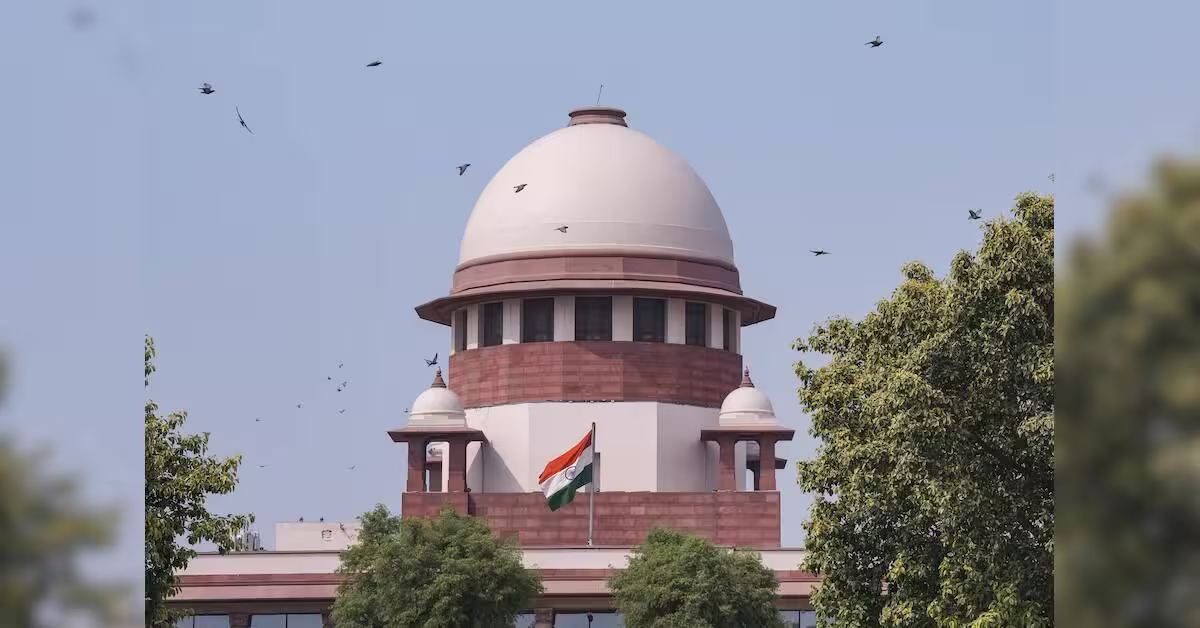
The Supreme Court on Friday declined to interfere with a Delhi High Court order directing a forensic audit of Fortis Healthcare’s transactions. The audit is linked to Daiichi Sankyo’s efforts to enforce a 2016 arbitral award against former Fortis promoters Malvinder and Shivinder Singh.
A Bench headed by Chief Justice of India Surya Kant and comprising Justices Joymalya Bagchi and V Mohana, however, clarified that observations made by the High Court against Fortis were only tentative and would not bind the forensic auditor.
“It goes without saying that the forensic audit shall be conducted independently without being influenced by those observations made by the High Court,” the court said.
The dispute stems from Daiichi’s arbitration proceedings against the Singh brothers following its acquisition of their stake in Ranbaxy Laboratories. Daiichi secured an arbitral award in 2016, which it has since sought to enforce against the former promoters and other judgment debtors. A judgment debtor is a person or a business ordered by a court to pay a specific sum of money to another party after losing a lawsuit.
The enforcement proceedings subsequently expanded to transactions concerning Fortis and the Singh brothers’ substantial shareholding in the company.
According to submissions before the Supreme Court, the brothers’ holding in Fortis declined from around 71 per cent to 44 per cent during 2016-17 and subsequently fell to about 1 per cent. The Delhi High Court ordered a forensic audit while examining the dissipation of shares and other transactions involving Fortis.
Fortis challenged the order, arguing that it was neither a party to the arbitration nor a judgment debtor and could not be made liable for the personal obligations of its former promoters.
Senior Advocate Abhishek Manu Singhvi, appearing for Fortis, said the company had about 2.5 lakh public shareholders and had no role in the arbitration proceedings. He also argued that Fortis, as a listed company, had no power to prevent shareholders from transferring dematerialised shares.
Senior Advocate Darius Khambata contended that the Depositories Act left Fortis with no ability to stop such transfers. Senior Advocate Neeraj Kishan Kaul took the court through the decline in the Singh brothers’ shareholding, submitting that pledged shares were invoked by banks after the Supreme Court clarified that certain pledges created before the status quo order remained unaffected.
Senior Advocate Mukul Rohatgi, appearing for Daiichi, opposed Fortis’ challenge. He submitted that Daiichi had obtained the 2016 award against the Singh brothers and alleged that their substantial holding in Fortis had dissipated despite assurances made during the proceedings. He also questioned transactions involving IHH’s investment and RHT Health Trust, allegations disputed by Fortis.
The Supreme Court ultimately allowed the forensic audit to proceed, while making clear that the auditor must independently examine the transactions and not treat the High Court’s observations as findings against Fortis.
The court is separately scheduled to consider challenges concerning banks and financial institutions in the matter.