

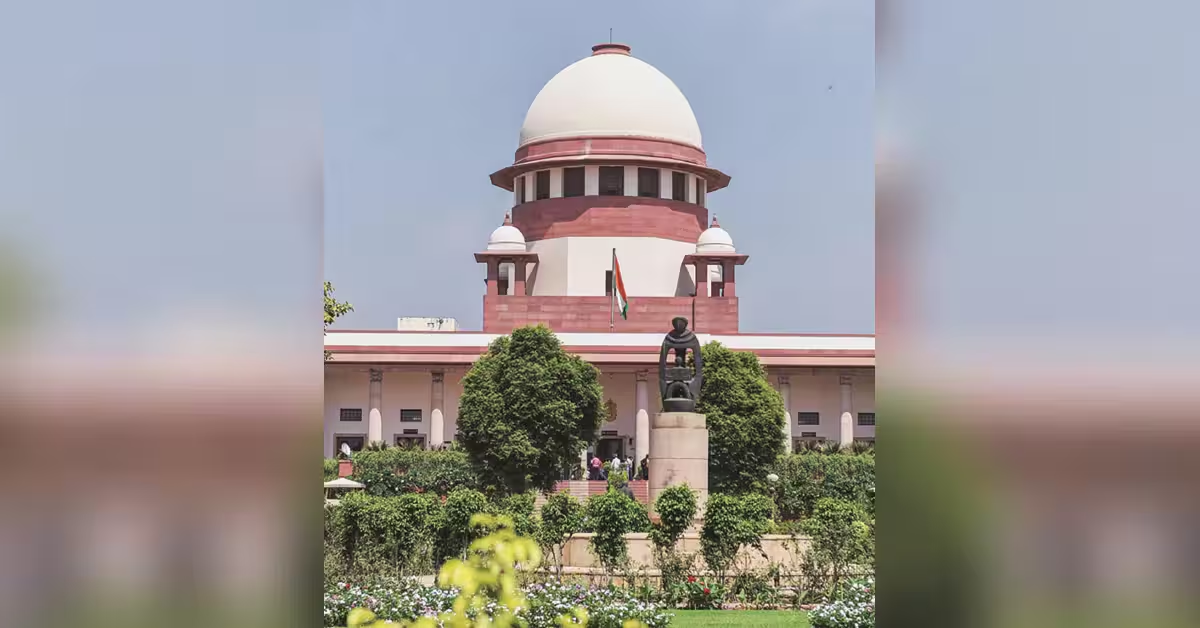
The Supreme Court on Tuesday expressed concern over the sharp disparity between the price charged to retailers and the price paid by customers for essential medicines, observing that steep markups place a financial burden on consumers amounting to carnage.
A Bench of Justices Vikram Nath and Sandeep Mehta asked the Centre why the maximum retail price (MRP) of essential medicines such as cancer drugs could not be capped at 16 per cent over the price to retailer (PTR), as provided for under the Drugs (Prices Control) Order, 2013 (DPCO, 2013).
Under DPCO, a 16 per cent margin is the notional retailer profit margin added to the average price of scheduled essential medicines when the government calculates their official ceiling price.
However, scheduled medicines account for only 10 per cent of the total medicines available in the market. The rest are non-scheduled medicines, for which drugmakers are allowed to raise prices by 10 per cent every year.
The Bench flagged the wide gap between the cost at which medicines reach retailers and the price ultimately paid by patients. Justice Mehta referred to a cancer medicine carrying an MRP of about ₹27,000, despite its PTR being around ₹2,700. “Just see the drastic difference,” Justice Mehta observed, questioning the rationale for such a steep markup.
The Bench also questioned the regulatory distinction between scheduled and non-scheduled medicines under DPCO and whether medicines classified as non-essential should remain outside price control mechanisms.
The Bench also raised concerns over the pricing of medicines dispensed through corporate hospitals. It observed that patients are often required to procure medicines from hospital pharmacies, with the higher costs eventually being reimbursed from public funds when treatment is covered under government schemes such as Ayushman Bharat.
This comes after the Competition Commission of India, in its May 21 order in a case involving 12 Delhi-based private hospitals, held that hospitals are legally permitted to sell medical products up to the manufacturer-notified MRP.
Solicitor General Tushar Mehta, appearing for the Centre, acknowledged the concern but said a balance would have to be worked out between competing interests. “I am not saying the petitioners are wrong, but some way which balances equities will have to be found,” he submitted. The Solicitor General also said his understanding was that pharmaceutical companies were not necessarily the primary beneficiaries of the price differential.
A price ladder, not a profit line
Pharmaceutical industry executives told Business Standard that the difference between PTR and MRP should not be equated with manufacturer profit. “Medicines pass through multiple stages such as distributors, stockists, retailers, and hospital pharmacies, and the final price can reflect taxes, discounts, credit terms, returns, expiries, storage, and distribution costs,” an executive with a Delhi-based pharmaceutical company said.
Oncology pricing is different as many cancer therapies are injectables or biologics and require cold chain storage, specialised handling, and trained administration. “For that reason, most of them reach patients through hospitals and hospital pharmacies rather than neighbourhood chemists,” another executive added.
People in the know said the industry supports transparency on prices across the supply chain through a consultative, evidence-based approach to trade margins, as well as patients’ freedom to buy medicines outside hospital pharmacies.
“The pricing policy should not only support affordability but also encourage investment in quality, modern manufacturing, research and development, and the innovation needed to deliver better medicines to patients,” the person quoted earlier said.