

[ad_1]
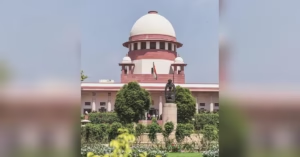
The Supreme Court on Monday voiced concern over the cancellation of NEET-UG 2026 following allegations of a paper leak, observing that the National Testing Agency (NTA) appeared not to have “learnt its lesson” from the controversy surrounding the 2024 examination.
A Bench of Justices P S Narasimha and Alok Aradhe issued notice on petitions filed by doctors’ bodies and students seeking either the replacement or dissolution of the NTA.
The Court also sought a status report on the implementation of recommendations made by the high-powered committee constituted pursuant to the Supreme Court’s 2024 ruling on the NEET-UG paper leak issue.
“We are so sad, they (NTA) haven’t learnt their lessons. We passed an order directing the constitution of a committee to give recommendations, which was accepted,” Justice Narasimha orally remarked during the hearing of the case.
The Bench directed the NTA and the head of the expert committee to place on record the steps taken to comply with the recommendations.
“We also direct Dr K Radhakrishnan, the former chairman, to file an affidavit indicating the steps taken to ensure the compliance given by the High-Powered Committee that has given its report. The affidavit shall be filed within three days,” the court said.
The Court further ordered that copies of all petitions be served on Solicitor General Tushar Mehta. Advocates Tanvi Dubey and Dr Charu Mathur appeared for the petitioners.
The expert panel headed by former ISRO chairman Dr K Radhakrishnan had been constituted after the NEET-UG 2024 controversy.
Although the Supreme Court had declined to cancel the 2024 examination in the Vanshika Yadav versus Union of India case, it had issued a series of directions aimed at preventing future leaks and improving examination security.
The committee’s mandate was expanded to examine reforms relating to encrypted question paper transmission, CCTV surveillance, secure transport mechanisms, digital tracking systems, candidate verification, technological safeguards, real-time monitoring and grievance redressal measures, along with studying international best practices.
The Union government later filed a compliance report in December 2024 outlining measures adopted pursuant to the committee’s recommendations, including proposals for reforming national entrance examinations, strengthening the NTA and enhancing coordination with states and specialised examination partners.
The latest petitions were filed after the cancellation of NEET-UG 2026, in which more than 23 lakh students are stated to have appeared.
One petition filed by the United Doctors Front seeks dissolution of the NTA, alleging a “systemic failure” in conducting the examination.
Filed through Advocate Ritu Reniwal, the plea calls for the creation of a statutory testing authority through parliamentary legislation with defined transparency and accountability standards. It also seeks a court-monitored mechanism to supervise future national examinations and ensure “zero-leak” integrity.
Another plea by the Federation of All India Medical Association seeks directions either to replace or comprehensively restructure the NTA and to conduct a fresh NEET-UG 2026 examination under judicial supervision.
The petitions contend that repeated paper leaks violate Articles 14 and 21 of the Constitution and have adversely affected the future of lakhs of students. They further argue that despite statutory safeguards introduced through the Public Examinations (Prevention of Unfair Means) Act, 2024, authorities failed to curb organised cheating rackets and examination leaks.
The pleas also refer to earlier observations made by the Supreme Court in the 2024 NEET matter cautioning the NTA against administrative “flip-flops” and lapses. They additionally rely on the recommendations of the Radhakrishnan Committee advocating reduced dependence on private vendors and a transition towards computer-based or hybrid examination models.
According to the petitions, recurring examination irregularities have caused severe psychological stress, financial strain and uncertainty for students and families, while also drawing attention to reported student suicides linked to examination pressure.
[ad_2]
Source link