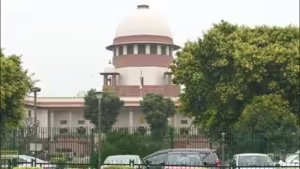



The Supreme Court on Wednesday remanded to the Securities Appellate Tribunal (SAT) the dispute between market regulator Securities and Exchange Board of India (Sebi) and Vedanta Limited over allegations that the company had made a misleading share buyback announcement without a genuine intention to complete it.
A Bench of Justices J B Pardiwala and K V Viswanathan held that the release of the escrow amount deposited for the buyback does not, by itself, prevent Sebi from separately examining whether the company committed fraud under the Sebi (Prohibition of Fraudulent and Unfair Trade Practices) Regulations.
The case relates to a 2014 buyback announced by Vedanta, then known as Cairn India Limited. The company had proposed to buy back 17.09 crore shares at a maximum price of Rs 335 per share, with a total investment of Rs 5,725 crore.
It deposited Rs 143.124 crore in an escrow account and conducted the buyback over six months. By the end of the period, however, it had purchased only about 3.67 crore shares for Rs 1,225.45 crore.
Sebi’s adjudicating officer subsequently imposed a penalty of Rs 5.25 crore on Vedanta and Rs 15 lakh each on three individuals, holding that the company had failed to place sufficient buy orders despite several opportunities when its share price was at or below the buyback ceiling. The officer noted that on 24 of 54 favourable trading days on the NSE, no buy orders were placed.
SAT overturned the penalties in October 2023. It held, among other things, that the company could not have anticipated the sustained bullish trend in its stock, that the market price remained above the Rs 335 ceiling for a substantial part of the buyback period, and that the regulations did not prescribe a particular frequency or aggressiveness for placing buy orders.
The Supreme Court, however, rejected Vedanta’s argument that the subsequent release of the escrow amount effectively cleared it of any allegation of fraud. It said Regulation 15B(8) deals only with whether the escrow is liable to be forfeited and does not determine whether the conduct amounts to fraud under the Sebi Regulations.
At the same time, the Bench found significant factual issues in Sebi’s case that required reconsideration by SAT. The court noted discrepancies between Sebi’s investigation data and data supplied by the NSE.
For instance, for February 17, 2014, Sebi’s report showed more than 1.31 crore shares available for sale at or below Rs 335, while NSE data showed slightly over 30 lakh shares. Similar discrepancies were found for February 14 and for certain BSE data between May 20 and July 22, 2014.
The court also flagged an apparent contradiction in Sebi’s own investigation. A February 2016 report had found no material impact on the share price or trading volume attributable to the company’s announcement, while a subsequent March 2017 report proceeded on the basis that the same conduct constituted fraud.
Directing SAT to undertake a fresh examination, the court said the tribunal should scrutinise the competing trading data, examine relevant company officials and merchant bankers if necessary, and consider whether there were other circumstances supporting the allegation of fraud.
SAT has been directed to decide the issue of fraud afresh, uninfluenced by the Supreme Court’s observations on the merits, within six months.