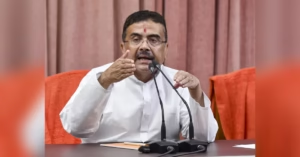


A three-judge Bench headed by Chief Justice of India Surya Kant tagged a petition filed by CPI(M) Rajya Sabha MP A A Rahim with other matters concerning the use of facial recognition and biometric information during protests at Jantar Mantar
The Supreme Court on Thursday agreed to examine a challenge to the Delhi Police’s alleged use of facial recognition technology and biometric data to identify and monitor protesters, including claims that such information was shared with private entities.
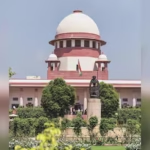
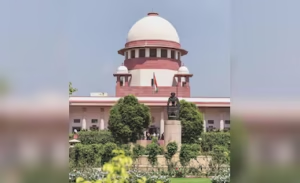
A three-judge Bench headed by Chief Justice of India Surya Kant tagged a petition filed by CPI(M) Rajya Sabha MP A A Rahim with other matters concerning the use of facial recognition and biometric information during protests at Jantar Mantar.
Senior Advocate Menaka Guruswamy, appearing for Rahim, told the Bench that Delhi Police had used facial recognition systems on protesters and subsequently shared the collected information with two private companies.
She alleged that the data was obtained without the consent of those concerned and hosted by private companies.
Guruswamy argued that such practices raised questions under the Digital Personal Data Protection Act, 2023, as well as the criminal procedure framework.
The Supreme Court is already dealing with petitions challenging the legality of facial recognition technology and the use of biometric information to profile people during the recent protests.
The petitioners have relied on the Court’s landmark 2017 privacy judgment in K S Puttaswamy v Union of India, which established that any restriction on the right to privacy must have legal backing, pursue a legitimate state objective and satisfy the requirement of proportionality.
The petitioners have also expressed concern that information gathered by the police could subsequently be used to target or harass protesters.
The Court had earlier directed authorities to preserve the data collected during the protests and refrain from placing it in the public domain until further orders.
Rahim has argued that neither the Delhi Police’s standing orders governing protests nor the Criminal Procedure (Identification) Act, 2022, provides legal sanction for biometric surveillance of people participating in civilian assemblies.
According to media reports, Delhi Police have said that they have analysed around 2,873 people with cases involving offences such as murder, rape and child abuse who had visited the Jantar Mantar protest site in July.
First Published: Aug 13 2026 | 7:20 PM IST