

[ad_1]
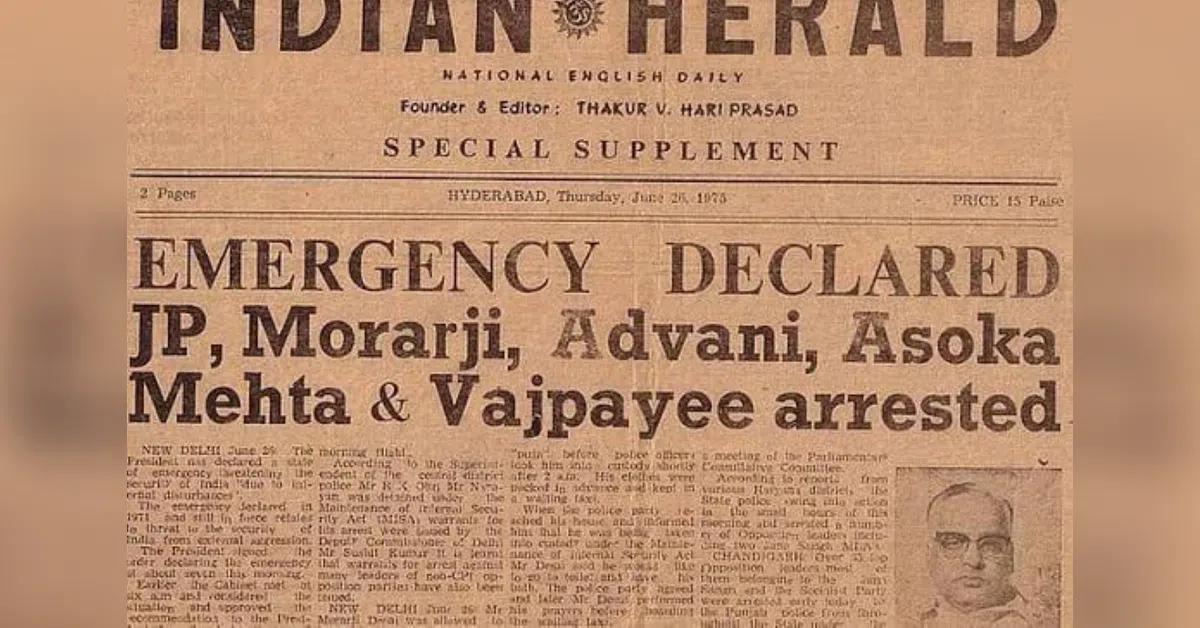
On the night of June 25, 1975, India went silent. As most citizens slept, the Emergency was proclaimed, Opposition leaders were detained, newspapers were brought under censorship, and the central government assumed extraordinary powers.
What followed was one of the most controversial periods in India’s democratic history. For 21 months, civil liberties were curtailed, political dissent was criminalised, the press was controlled, and state power entered everyday life through arrests, surveillance, forced sterilisation drives and fear.
Before dawn: The Opposition is silenced
Police across the country detained thousands of opposition leaders, activists, trade unionists and government critics under preventive detention laws, particularly the Maintenance of Internal Security Act (MISA). Among those arrested were Jayaprakash Narayan, Morarji Desai, Atal Bihari Vajpayee, Lal Krishna Advani, George Fernandes, and Charan Singh.
The arrests dismantled organised political opposition almost overnight. Parliament continued to function, but many of the government’s strongest critics were behind bars.
The press falls silent
The government imposed pre-censorship, requiring newspapers to obtain official clearance before publishing reports on arrests, protests, criticism of the government, or other politically sensitive issues. Journalists and editors operated under strict restrictions, while reports on parliamentary proceedings and certain judicial matters were also curtailed.
This level of censorship shaped what citizens could read and know about events unfolding around them. Some newspapers left blank editorial spaces as symbolic protests, although most complied with official directives amid fears of legal action.
Rights curtailed, power centralised
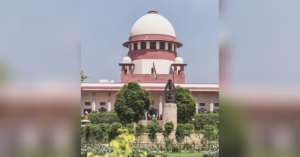
Fundamental freedoms, including those relating to speech and personal liberty, were restricted, while the ability to challenge preventive detention was significantly weakened. In the controversial ADM Jabalpur judgment of 1976, the Supreme Court held that during the Emergency, citizens could not seek judicial remedy through habeas corpus petitions after the suspension of constitutional remedies.
The government also introduced constitutional changes that expanded executive authority. The 39th Constitutional Amendment protected the election of certain high constitutional offices from judicial challenge, while the far-reaching 42nd Constitutional Amendment strengthened the Centre’s powers, limited aspects of judicial review, and amended several provisions of the Constitution. Together, these measures reshaped the balance between the executive, Parliament and the judiciary.
When the Emergency entered everyday life
The government promoted the period as one of discipline, efficiency and national development. At the same time, reports of surveillance, arbitrary official action and administrative coercion became widespread.
A major source of public anger was the growing influence of Sanjay Gandhi, whose unofficial five-point programme became closely associated with aggressive family planning campaigns and urban beautification drives. According to the findings of the Justice J C Shah Commission, more than 10.7 million people were sterilised during the Emergency between 1975 and 1977, exceeding the government’s targets by around 60 per cent. The campaign was widely criticised for reports of coercion and abuse in meeting sterilisation quotas. Slum demolition drives, particularly in Delhi, also displaced thousands of residents.
The election gamble
After nearly 19 months of Emergency rule, Indira Gandhi announced general elections on January 18, 1977. Political prisoners were gradually released, restrictions eased, and campaigning resumed.
The announcement came as a surprise to many, given that the government had extended the life of legislatures, amended key constitutional provisions, and exercised extensive control over political opposition and the press during the Emergency.
The announcement reopened the one democratic institution that no government could fully control: the vote.
A united Opposition
The Emergency succeeded in bringing together opposition parties that had long remained divided.
The Janata Party emerged as a coalition of the Bharatiya Jana Sangh, Congress (O), Bharatiya Lok Dal, Socialist groups and others. Jayaprakash Narayan became its guide, while the resignation of senior Congress leader Jagjivan Ram shortly before the election gave the Opposition further momentum.
The election quickly became a vote on the Emergency itself. Congress defended its record on discipline, stability and governance, while the Janata Party focused on democracy, civil liberties, press freedom and alleged abuse of state power. In northern India, anger over forced sterilisation and coercive administration became a decisive electoral issue. Voting took place between March 16 and March 20, 1977.
The people’s verdict
The Janata Party won a decisive mandate and formed the first non-Congress government at the Centre. Indira Gandhi lost Rae Bareli to Raj Narain, whose election petition had triggered the political crisis two years earlier, while Sanjay Gandhi was defeated in Amethi.
The verdict demonstrated that despite 21 months of restrictions on political activity and civil liberties, Indian voters remained willing to use the ballot box to hold those in power accountable.
Democracy’s course correction
The Emergency was revoked on March 21, 1977, and Morarji Desai was sworn in as Prime Minister three days later, heading India’s first non-Congress government.
The new government established the Shah Commission to investigate alleged excesses committed during the Emergency. Parliament later enacted the 44th Constitutional Amendment, replacing the phrase “internal disturbance” with “armed rebellion” as the constitutional ground for proclaiming a future national Emergency and restoring several safeguards for fundamental rights.
Post-Emergency era
Yet the post-Emergency moment was not politically stable. The Janata coalition, built largely around opposition to Indira Gandhi and the Emergency, soon struggled with internal contradictions and leadership battles. Morarji Desai’s government fell in 1979, and Indira Gandhi returned to power in 1980. But the legacy of 1977 endured: it showed that even after censorship, arrests and fear, India’s voters could still deliver a democratic correction.
[ad_2]
Source link