

[ad_1]
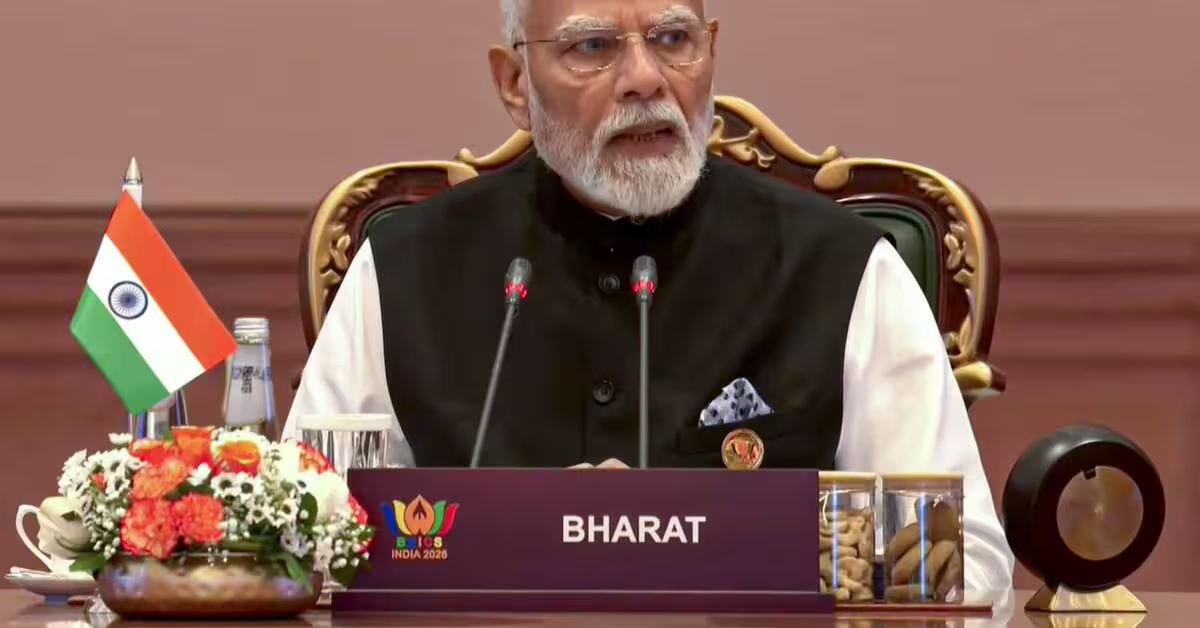
The two-day Brics Summit concluded on Sunday with Prime Minister Narendra Modi cautioning the grouping’s leaders that the “weaponisation of technology and critical minerals” can hinder shared progress.
With Brics leaders, including Chinese President Xi Jinping, his Russian counterpart Vladimir Putin, Iran’s Masoud Pezeshkian and others at the table, the PM, in reference to the issue of critical minerals, said India emphasised inclusivity in the adoption of technology during its presidency of the grouping.
Indian officials said in paragraph 67 of the joint statement, the New Delhi Declaration, Brics countries affirmed the need to promote resilient and diversified supply chains of critical minerals. Indian industry has in recent years suffered the brunt of China’s restrictive policy on the export of critical minerals and its reluctance to share high technologies. China takes over the Brics presidency from India.
A day after the Indian leadership and diplomats worked hard to deliver a rare consensus in ensuring a unanimous New Delhi Declaration of the Brics Summit, getting both Iran and the United Arab Emirates on board, leaders of the 11-member grouping on Sunday looked ahead at the shape the intergovernmental platform could take in the near future amid an uncertain world at the Summit’s session on ‘shaping the future for inclusive growth’.
Modi said India’s presidency of the Brics platform “advanced friendship, partnership, and cooperation” for “win-win cooperation”. He spoke of India’s human-centric approach that fostered the participation of ordinary citizens, and said the Global South increasingly trusted Brics.
Amid concerns in western capitals about the likely tenor of the grouping with China taking over its presidency from India, Modi said India focused its efforts under its Brics presidency on achieving “win-win cooperation”. He highlighted people-centric, practical, development-oriented outcomes across diverse sectors achieved during its presidency.
Modi said the number of conflicts and tensions in the world is continuously increasing, which has had an increasingly negative and far-reaching impact on the lives of ordinary people. He said in today’s interconnected world, no crisis, whether pandemics, climate disasters, or supply-chain disruptions, remains confined to a single region.
The PM detailed the “special emphasis” that India’s presidency laid on making supply chains more reliable, and its initiatives across technology, agriculture and other sectors. “We may be rooted in different realities, but together, we rise through cooperation and blossom for humanity. May our diversity be our identity, our cooperation our inspiration, and our progress serve all of humanity,” Modi said.
In his speech at the concluding session, Chinese President Xi spoke of Brics leveraging its close ties with emerging markets and the Global South to safeguard supply chains and build a large integrated market. He proposed a five-point initiative to boost cooperation in manufacturing, trade and technology. Xi said China will be a pioneer in establishing a Brics-Artificial Intelligence open-source community to support cooperation in developing and applying large language models, hold specialised AI seminars and training courses, and build an open AI ecosystem. On the trade and investment facilitation initiative, Xi said China proposes to establish a Brics special economic zone partnership, under which countries can set up an intelligent portal, coordinate policies, and build a new frontier for open development. Other initiatives relate to establishing a Brics digital ecosystem cloud platform, intelligent manufacturing and training of engineers.
Xi appealed to the Global South to be united in defending the rule of law in international affairs, and said the logic of “might makes right” should have been discarded long ago. He said Brics countries must seize the historical initiative and rally the Global South to “hold high the banner of multilateralism”.
In his remarks, Russian President Putin proposed a new insurance mechanism and a collaborative initiative for the grain market, which has been under discussion, among Brics member states. The Russian leader’s suggestions come in the context of the G7 countries, the European Union, and the UK prohibiting Western companies from insuring any ship transporting Russian crude unless the oil was purchased at or below a specified price cap. The sanctions relating to the insurance sector have adversely impacted Russian crude oil exports. Putin complimented the functioning of the New Development Bank (NDB), saying it is handling projects worth $140 billion. He also pushed for a common platform for better trade and investment ties among member countries.
Iran’s Pezeshkian urged Brics to expand trade in national currencies, and criticised “unilateral sanctions” that directly impact global food security and people’s welfare. He said Brics had evolved to become a manifestation of growing demand for a more balanced and inclusive world in which “no centre of power has the right to determine the destiny of others”.
On the sidelines of the Summit, the PM held 15 sit-down bilateral meetings with the visiting leaders in the last three days, including with Xi, Putin, Pezeshkian, and Abu Dhabi’s Crown Prince Mohamed bin Zayed Al Nahyan. Modi also had bilateral meetings with his Malaysian counterpart, Anwar Ibrahim, Vietnamese counterpart Le Minh Hung, Indonesian President Prabowo Subianto, Egypt’s President Abdel Fattah El-Sisi, President of the Philippines Ferdinand R Marcos Jr and Uganda’s Vice President Jessica Alupo, besides others.
[ad_2]
Source link