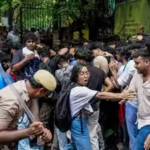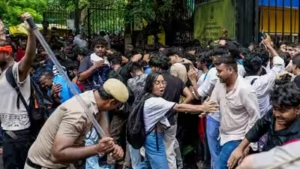


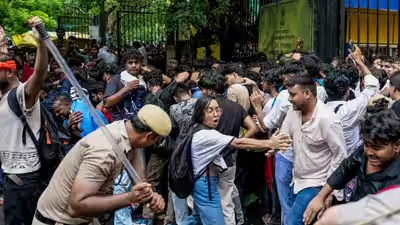
NEW DELHI: The Delhi police on Tuesday replied to the allegations raised about having officers present in civilian clothing during the crackdown on CJP protesters on July 20. During the hearing, the police said that their deployment was a planned crowd-control measure and not an unlawful use of force.In a counter-affidavit filed before the Supreme Court, deputy commissioner of police Sachin Sharma said personnel from the special branch, special cell, crime branch and local police were strategically deployed inside the crowd as “spotters” because of the urgency of the situation.The police said the officers in plain clothes merged with the protesters to monitor developments and respond to violence.It maintained that such a tactic is neither illegal nor unusual and is also used during large public gatherings such as Independence Day and Republic Day events.
Police: Plain clothes deployment for crowd-control
Responding to allegations over videos showing men in civilian clothes carrying lathis, the Delhi police said the footage was being viewed “out of context”.According to the affidavit, the spotters were positioned within the crowd to help manage the situation as the protest escalated. The police said their deployment became necessary after sections of the crowd allegedly breached several layers of barricades and attempted to move towards Parliament.The affidavit states that the police were “constrained to use force” only after the protesters allegedly breached the barricades and violence began.The police further alleged that videos showed groups of protesters targeting individual police personnel, pulling off their protective equipment, dragging them and pushing them onto stone pavements.
Police cites scale of protest
The Delhi police said around 5,000 police personnel were deployed to manage a crowd of more than 30,000 people spread over nearly three kilometres.According to the affidavit, the situation eventually went out of control, leading to clashes in which both protesters and police personnel were injured. More than 240 police and other uniformed personnel and around 200 members of the public and protesters sustained injuries, it said.The police argued that the allegation of excessive force had to be assessed against the scale of the gathering and the circumstances in which the force was used.It also claimed that some “anti-social elements” and history-sheeters had infiltrated the protest. The affidavit said around 2,873 people had criminal cases against them, including charges related to murder, attempt to murder, dacoity, rape and POCSO offences. Their alleged involvement will be examined by a Special Investigation Team constituted by the Delhi Police Commissioner, it said.
Police denies unlawful use of force
The affidavit was filed in response to petitions seeking a court-monitored investigation into alleged police excesses during the protest. It is also intended to serve as a common response in four connected petitions.The police has denied that it used excessive force and said it adopted a graded approach to controlling the crowd.It argued that the Parliament march had not been granted permission and that the attempt to move towards Parliament therefore constituted an unlawful act by an unlawful assembly.The police also accused the petitioners of relying on selective photographs, incomplete video clips and unverified reports from the media and social media, saying these presented only one side of the events.
Delhi police addresses nails on lathi
On allegations that police personnel used lathis fitted with nails, the affidavit said the videos showed only one such incident, but claimed that the object was in the hands of a protester and not a police officer.The police further said the object was not a lathi but a stick carrying the National Flag.It maintained that lathis are permissible crowd-control equipment and that officers used them while attempting to contain protesters who, according to the police, had begun attacking them.
‘Court-appointed committee can examine police action’
The Delhi police said the question of whether excessive force was used could be examined by the committee proposed to be constituted by the Supreme Court.It said it would cooperate with such a committee.The affidavit also defended the use of facial-recognition software at the protest site, calling it a proportionate policing measure. The police said the system was not used to indiscriminately identify every person at the protest and that no action was taken solely on the basis of facial recognition.
Share your thoughts in the comments
Be respectful · TOI community guidelines
According to the police, field verification was conducted to establish whether a person identified by the software was actually present at the protest site. It also said the system was used to identify people with past records of serious offences and not for minor violations such as traffic challans.