

Indian airlines could get a new route to Europe and North America through China’s Xinjiang region as New Delhi looks to cut the extra flying time and operating costs caused by the prolonged closure of Pakistani airspace, Civil Aviation Minister Ram Mohan Naidu said on Tuesday.
“We are looking at other alternatives. Discussions on the Hotan route are going on between the two countries. Our external affairs ministry is engaging with their country (China)… let us see how it goes, but we are trying alternatives,” Hindustan Times quoted Naidu as saying at an event.
Naidu did not provide a timeline for opening the proposed route, nor did he indicate that India and China had reached an agreement on the plan. India and China have been discussing alternative air routes for about a year, with the Ministry of External Affairs engaging Beijing, CNBC-TV18 reported.
Pakistan shut its airspace to Indian airlines following the Pahalgam terror attack in April 2025, with the latest extension keeping the restriction in place until October 24.
Pakistan detour is adding time and cost
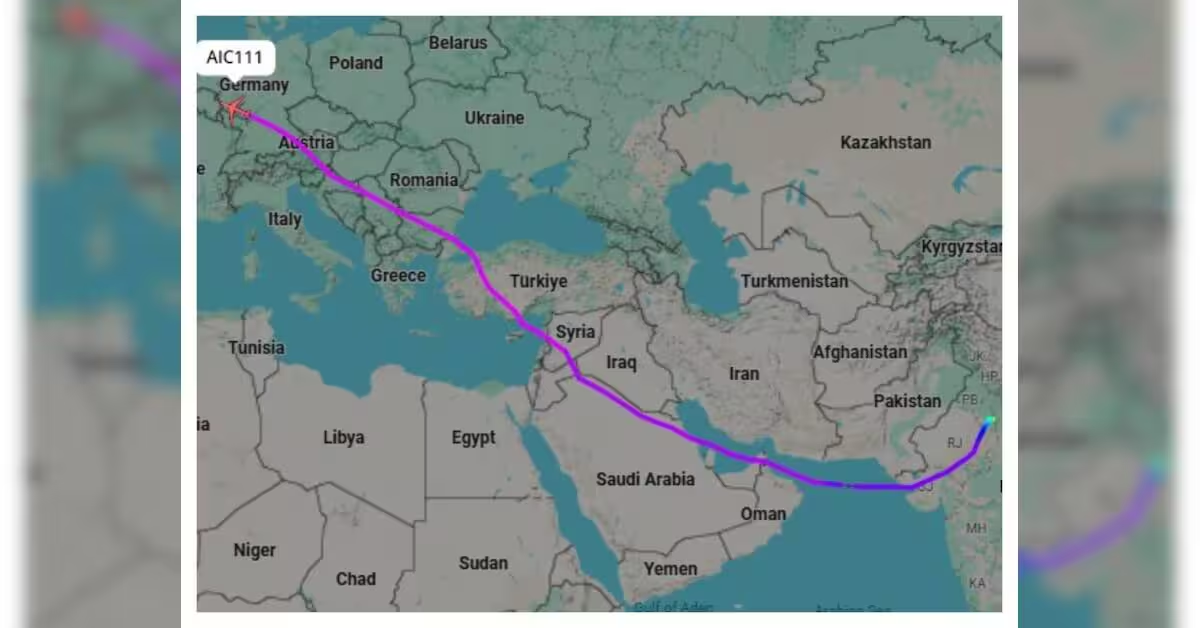
The closure has forced airlines flying from northern and western India to Europe and North America to take longer routes over the Arabian Sea and via Muscat. Depending on the sector, the detour can add 45 minutes to two hours to flight times, increasing fuel consumption and operating costs, the HT report stated.
An Air India Delhi-Chicago flight, which previously covered about 12,500 km via the northern route, now flies close to 15,000 km and takes more than 19 hours, including refuelling, compared with an earlier average of about 14 hours 47 minutes, according to Flightradar24 data.
How could the China route help Indian airlines?
According to Naidu, the proposed corridor over Hotan, in southwestern Xinjiang, would offer a significantly shorter route for Indian airlines.
A viable northern corridor through Xinjiang could do more than shave minutes off individual flights: it could reduce fuel burn, eliminate or reduce technical stops on some ultra-long-haul flights, improve aircraft utilisation and reduce crew and operating costs.
If the plan goes ahead, flights from Delhi and Mumbai could route via Leh and China’s Hotan, before turning towards Kyrgyzstan and joining existing air corridors to Europe, the UK and North America. “The route may lead to significant savings for destinations like Georgia, Baku, Central Asia, and northern Europe,” HT quoted a source as saying.
The southern detour too has become harder to take for Indian airlines since the Werst Asia war began earlier this year.
According to airline risk-monitoring group OPSGROUP, most carriers continue to avoid Iran, with Asia-Europe traffic being funnelled through either a northern corridor via the Caucasus and Afghanistan or a southern route via Oman, Saudi Arabia and Egypt.
Why Hotan route may not be easy
The International Air Services Transit Agreement lets member states’ airlines cross each other’s territory, but China is not a party, so any right to fly over Xinjiang must be negotiated directly between New Delhi and Beijing
Another major hurdle is posed by the terrain. The region is ringed by mountains of 20,000 ft and more, Reuters reported. If a jet loses cabin pressure, pilots must descend to 10,000 ft or the lowest safe altitude, whichever is higher, while onboard oxygen lasts only 12 to 20 minutes.
Over such peaks, a straight descent is impossible, so airlines must plan escape routes in advance. An engine failure poses a similar problem: a twin-engine jet on one engine cannot hold cruising height and needs a descent path that clears the terrain.
The area has few emergency airports, and international airlines generally avoid it. No non-Chinese airline used Hotan airport in the 12 months before November 2025, AirNav Radar data cited by Reuters showed.