

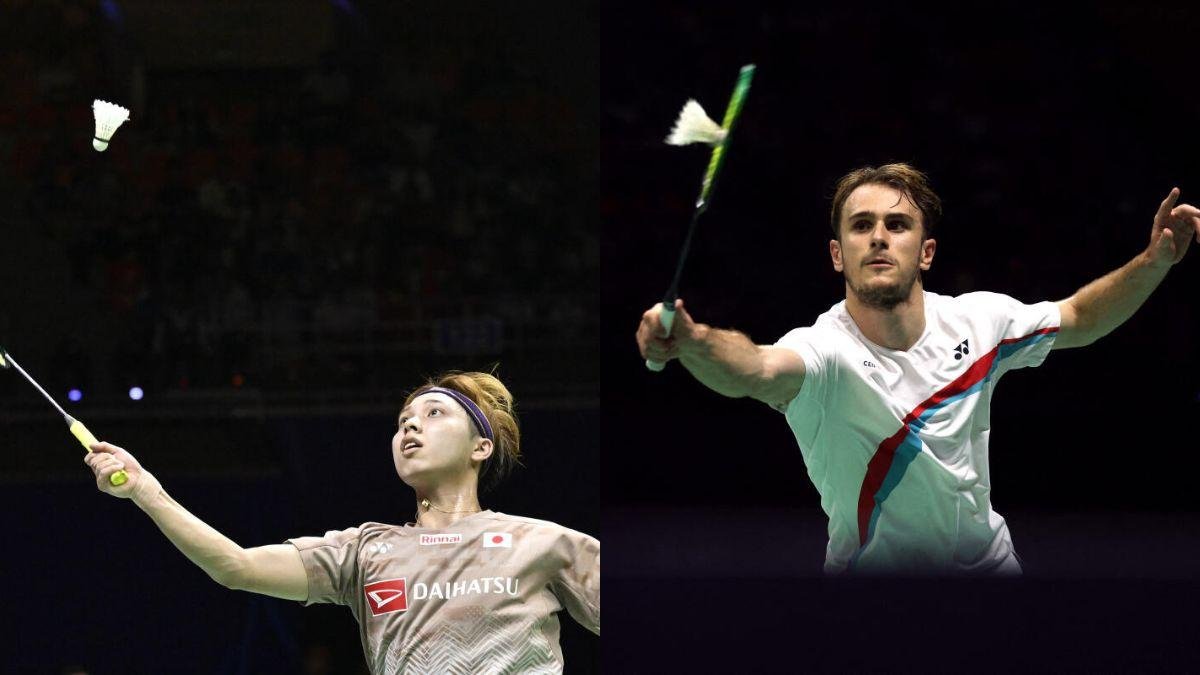
Alex Lanier fought back from a game down to become France’s first men’s singles finalist at the World Championships, while Kodai Naraoka overturned Chou Tien Chen’s early advantage to end the veteran’s bid for another record after he became the oldest world championship medal holder in men’s singles. Two contrasting semifinal wins have set up a final between two first-time medallists.
Lanier had little interest in pausing to take in the magnitude of what he had done. The Frenchman had just spent 78 minutes fighting back from a game down against Canada’s Victor Lai, and by the time he walked off court, exhaustion was competing with the emotions.
“I don’t feel that emotional at the moment. I think I’m a little bit too tired,” Lanier said. “But I’m also proud of the way I managed that match.”
That match followed a pattern that has defined Lanier’s run in New Delhi: get into trouble, resist the temptation to panic and find a way back. Against Lai, the 21-year-old lost the opening game 16-21. He then changed the pace of the contest, took the second 21-13 and pulled away in the decider, winning 21-14.
It was another match in which Lanier had to manage moments when the game threatened to slip away. He had faced a similar situation in the quarterfinal against 2023 world champion Kunlavut Vitidsarn, when he fell 3-11 behind in the second game after losing the first.
“It’s game management,” he said, almost deadpan. His coach chuckled at the answer, telling him not to “act too cool.” Lanier then admitted there had been a lot more emotion underneath. “I mean, definitely I got stressed at that moment. I think that was the moment where I got too emotional.”
Also read | Pullela Gopichand on Gayatri’s Worlds medal: No extra emotion for daughter, all players are same
He said the support from the chair helped him settle. “And at some point, I should trust myself that I’m able to do the thing,” he said.
Accept it. Move on. Trust himself. Those have become important parts of Lanier’s tournament.
His preparation for these championships was built around the expectation that the tournament would be physically demanding. His team worked on that aspect before arriving in Japan and then “we went to Denmark to get the intensity, to get some very good practice,” he said.
The work, however, only gets a player so far. “At some point you need to trust how good you are, and you just need to play and enjoy being on court and play the shots that I have learned.”
Now the biggest stage is one match away. Waiting there will be Naraoka, who took a very different route through his semifinal.
For a while, Chou looked set to keep his extraordinary tournament going.
The 36-year-old from Chinese Taipei had already become the oldest men’s singles medallist in World Championships history after beating Indonesia’s 21-year-old Alwi Farhan in the quarterfinals. A victory over Naraoka would have sent him into the final with another record within reach: becoming the oldest men’s singles world champion, surpassing legendary Lin Dan, who was 30 when he won the title in 2013.
The opening game was a battle of small margins. The scores moved from 13-13 to 14-13, 16-15, 16-16 and 18-17 before Chou created the first meaningful separation. He moved 19-17 ahead after Naraoka was called for a fault at the net and held on to take the game 21-19.
His variety was a problem for Naraoka. Chou repeatedly used deception, changing the direction of the shuttle at the last possible moment. One of his distinctive movements saw him turn his body almost face-to-face with his racket, change his grip in the movement and then toss the shuttle deep into the backcourt.
In the second game, he tried the same route again. At 10-16, with Naraoka beginning to establish control, Chou produced three deceptive shots in succession. This time around, the Japanese was ready.
Naraoka had begun to settle into the rallies, taking away the uncertainty that had made Chou so dangerous in the opening game. He moved from 1-4 to 4-7 and then 7-11. Chou briefly reduced the gap to 8-11, but Naraoka kept dragging the rallies into the territory he preferred. The second game ended 21-10.
The third was more one-sided still. Naraoka opened 4-0 and led 11-4 at the interval. Chou refused to disappear, fighting from 17-8 to 17-10, but the Japanese quickly restored his advantage. Naraoka closed out a 19-21, 21-10, 21-10 victory and moved into his first World Championships final.
For a player who has built much of his game around long rallies, the 25-year-old was not pretending that endurance was some special pleasure.
“No, it is not like that. I’m just trying to do my best.”
That will be tested immediately in the final by Lanier, who is four years younger and whose physical intensity has been one of the defining features of his run.
Lai, after his semifinal loss to Lanier, pointed to the work behind that physicality. “I think France is one of the countries who takes advantage of that [sports science] and they have great strength trainers; great physios and they’re doing a great job. Alex physically is a beast so they’re doing something right.”
On Sunday, one of them will add a world title to a medal they had never won before this week. And the new order in men’s singles will have its first name.
Published on Aug 23, 2026