

[ad_1]
Football teams are often a reflection of their coaches.
It is expected for a Jose Mourinho side to be attritional, a Pep Guardiola side to be obsessive with possession, or a Zinedine Zidane side to be flamboyant.
For over a decade, France’s senior men’s team has shrouded itself in the garb of pragmatism, invoking the image of its suave head coach, Didier Deschamps.
On Saturday, France lined up for the final time under Deschamps, against England in the third-place match of the FIFA World Cup 2026.
In what could be rightfully construed as an anti-climactic end, England trounced France 6-4 in a remarkably open encounter that bore no resemblance to an archetypal Deschamps game – low in drama and high in control. The sort of game we have gotten accustomed to since he took on the French job in 2012.
From turmoil to tournament regulars
It was under Deschamps’ prudent stewardship that France recovered from its acrimonious existence in the early 2010s. Once the framework was consolidated, he smoothed and polished the side to reflect another shining aspect of his self – relentless winning.
As a player, he had an enviable trophy cabinet that included the Champions League, the Euros and the World Cup.
With Deschamps at the helm, success latched onto France easily. First came a final appearance in the 2016 Euros, followed by the triumphant march at the 2018 World Cup. The Nations League title came in 2021, before an epic final defeat to Argentina in the 2022 World Cup. It was a run of consistency no other national team could boast.
Deschamps achieved all this while letting France play largely within itself. With the attacking riches France had, it would have been easy for him to succumb to the temptation of being aesthetic for the sake of being it.
READ: Deschamps takes responsibility for unacceptable first half in last game in charge of France
But Deschamps abided by his belief that winning ugly is better than not winning at all. Until the 2026 World Cup, he regularly fielded an extra defensive player in the midfield instead of squeezing in another creative player, the sort of profile which he always had in surplus.
After all, as a player, he was a defensive midfielder, tasked with doing the ‘dirty work’ of retrieving possession and delivering the ball to much more technically refined players to create goals. In fairness, he was arguably the best in his position in the 1990s. It was under his captaincy that France triumphed in the 1998 World Cup, with his positional play in central midfield allowing the likes of Zidane, Emmanuel Petit and Youri Djorkaeff to thrive upfront.
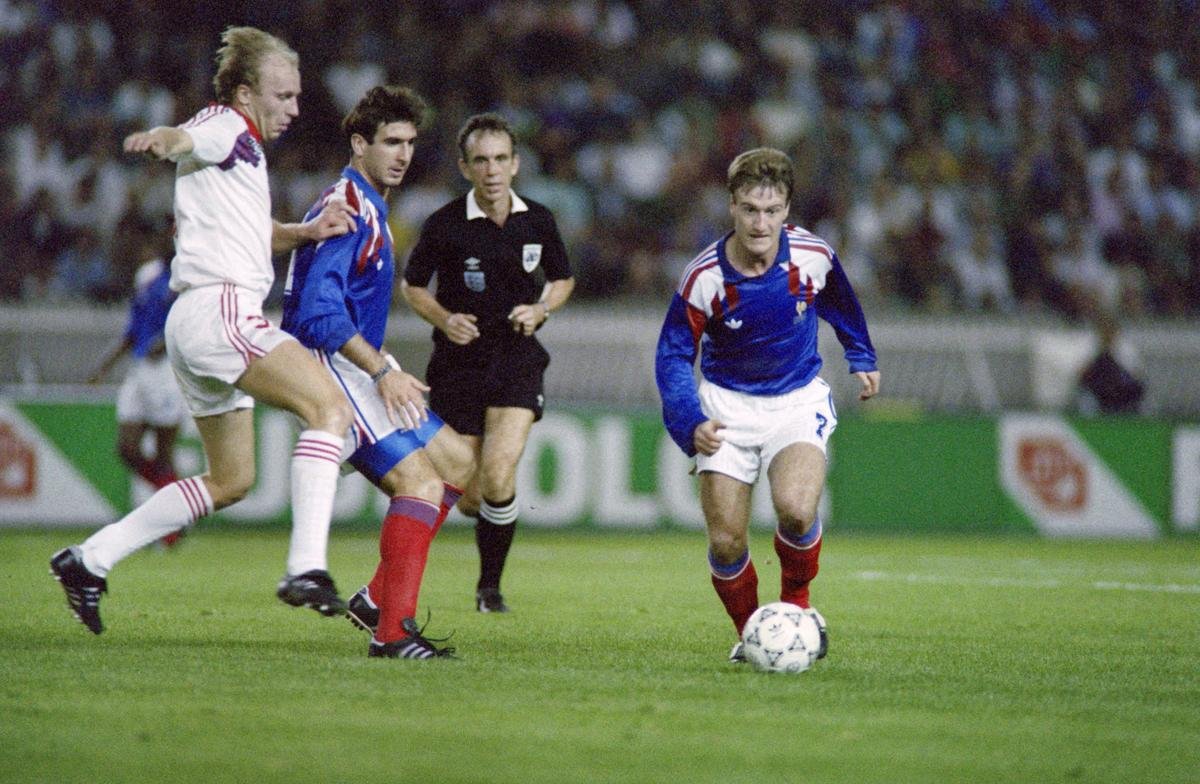
Didier Deschamps (R) and Eric Cantona (2nd L) during a 1990 European Nations’ Cup qualifying match against Czechoslovakia.
| Photo Credit:
AFP

Didier Deschamps (R) and Eric Cantona (2nd L) during a 1990 European Nations’ Cup qualifying match against Czechoslovakia.
| Photo Credit:
AFP
His limited ability with the ball had always made him an easy target for his critics. The sharpest of those affronts came from Eric Cantona, the man who Deschamps replaced as French captain.
“Deschamps gets by because he gives 100 per cent, but he’ll never be anything more than a water carrier,” Cantona said in an interview in 1996.
ALSO READ: Beyond the box: The tactical shift behind World Cup’s long-range goals
The ‘water carrier’ label is something that Deschamps has carried ever since. But it is also an identity he has long embraced.

Didier Deschamps (L) challenges South African player David Nyathi during a 1998 World Cup game at the Velodrome Stadium in Marseille.
| Photo Credit:
AFP
Didier Deschamps (L) challenges South African player David Nyathi during a 1998 World Cup game at the Velodrome Stadium in Marseille.
| Photo Credit:
AFP
“Look, I was a water carrier. I don’t reject my image. I didn’t have the pretension to think that I could change a match by myself. Players like me, we did something of a thankless job. You don’t show a hard tackle on the big screen. But if you add it all up, I was always the one that the coaches wrote down automatically on the lineup card,” Deschamps told The Guardian.
Why transitions became his footballing religion
As a defensive midfielder, much of Deschamps’ job rested on the in-between phases of play – the immediate moments after his team won the ball or lost it. Either he would have to initiate a counter-attack or snuff one out.
Years of existing and thriving in the transitional phase naturally shaped Deschamps’ footballing perspective, as we can elicit from his interview with the FIFA Training Centre in 2023.
“The pivotal moment in football is the transition from defence to attack, when the opposition doesn’t have time. Between regaining possession and initiating the attack, obviously there’s more space. And that ability to transition as soon as you win the ball back [is important]. The same applies on a defensive level,” said Deschamps.
It helped Deschamps that France doesn’t carry the burden of a national football identity. There exists no cultural demand for a certain style of football – the sort of affliction that continues to haunt teams like the Netherlands and Brazil.
This granted him the liberty to play the footballing style of his choice, ceding possession when deemed fit and relying heavily on transitions. Deschamps is well aware of the risks that come along with such a structure. It is just that he is armed to deal with its consequences.
“I am not affected by stress or pressure. It’s adrenaline for me. Stress and pressure are negative. I need the adrenaline. I can’t get enough of it,” he said.
Adaptation over ideology
Ultimately, Deschamps’ success was rooted in his ability to adapt. Over the course of his 12 years with France, he had overseen multiple squad overhauls, all the while retaining the thread of his own thought, the theory of winning efficiently.
“I have a magic word: adaptation. It’s not because we did this and it worked well that we shouldn’t change. It’s not about changing for the sake of changing either,” he told The Guardian ahead of FIFA World Cup 2026.
The only time he pivoted away from his pragmatic principles was in the 2026 World Cup, when he finally let himself be swayed by the possibilities of chasing something better than just winning – winning by entertaining.
ALSO READ: How can Lionel Messi win FIFA World Cup 2026 Golden Boot ahead of Kylian Mbappe?
The 57-year-old might have been untethered by the knowledge that this was his farewell tournament, allowing him to plan and play without fretting about the consequences.
Right through the World Cup he lined up a four-man attack, enveloping his talisman, Kylian Mbappe, with the explosiveness and creativity of Ousmane Dembele, Michael Olise and Desire Doue/Bradley Barcola.
The shift worked like a treat in the early stages of the tournament, as the French attack went ballistic, scything through opposition defences.
But the Les Blues storm died off in the semifinal against Spain. Ironically, the Spanish side dominated the midfield battle, with France’s numerical disadvantage in the centre leading to its downfall – a tactical misstep Deschamps might not have committed in the past. And then came the mind-bending chaos of the third-place match, a 10-goal madness that almost made Deschamps lose his composure.
A legacy beyond aesthetics
Despite the farewell hiccups, Deschamps has certainly left the French team on a much higher pedestal than when he found it. He is most likely to be replaced by Zidane, a trusted ally from his playing times and a more-than-capable coach in his own right, as seen from his exploits with Real Madrid.
Deschamps also walks away as the most successful coach in the FIFA World Cup, having won more games than anyone in the tournament’s history. Not bad for a ‘water carrier’, who loved to ‘play it safe.’
Published on Jul 19, 2026
[ad_2]
Source link