


[ad_1]
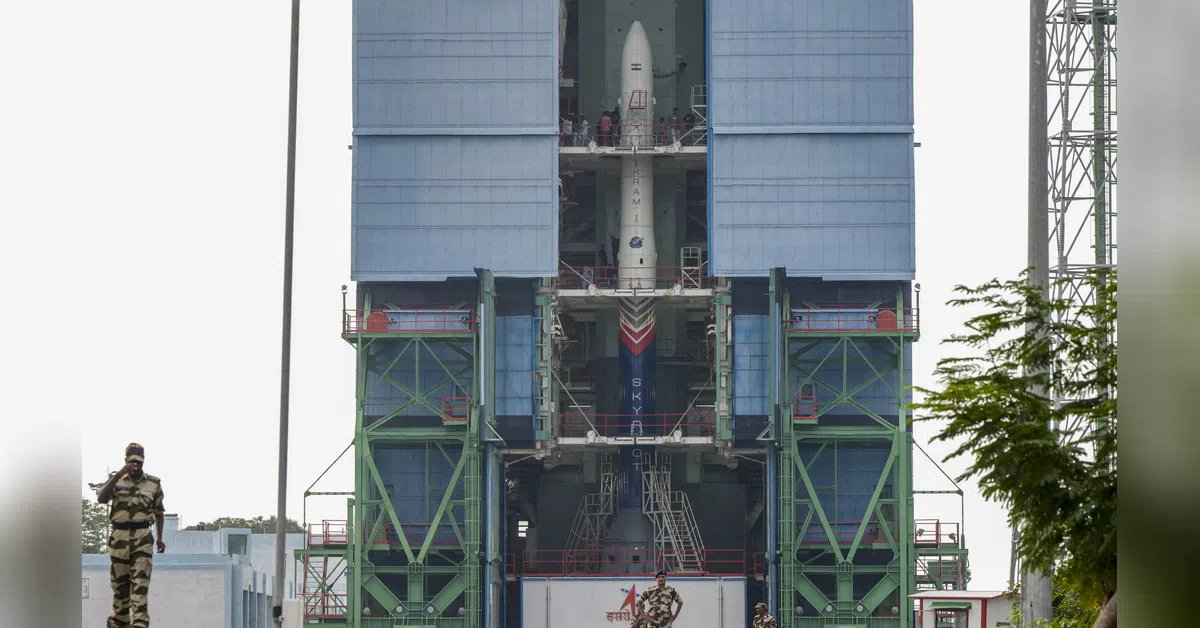
The historic feat by Skyroot Aerospace on Saturday, becoming the first private company to fly an Indian-built rocket to orbit on its maiden attempt, may well be the unlocking moment for upstream space services in the country, say experts.
According to the Indian Space Association (ISPA), out of the around $9 billion Indian space economy, the downstream segment contributes around 80 per cent, or $7.8 billion. Skyroot’s success, also dubbed India’s SpaceX moment, is key to the future growth of the upstream segment, valued at $1.2 billion, as rocket technology is key to the entire space ecosystem, said Lt Gen A K Bhatt (retd), director general of ISPA.
“Launch vehicles are the key that opens all these opportunities. Indigenous private space capability in this domain opens doors for all sectors,” he added.
The upstream segment refers to all activities, products, and infrastructure ensuring the development, testing, launching, operations, and monitoring, including space situational awareness, of space assets. On the other hand, the downstream segment refers to all applications, services, and devices relying on satellites to create business value. In the upstream sector, the major private startups in India include Skyroot Aerospace, Agnikul Cosmos, and Pixxel, focusing on rocket development, satellite launches, and space technology.
On Saturday, Mission Aagaman, meaning “arrival”, lifted off from the First Launch Pad at the Satish Dhawan Space Centre, Sriharikota, and Vikram-1 flew a nominal profile to reach its target low-earth orbit of approximately 450 km at a 60-degree inclination, where it successfully deployed its payloads. In doing so, Skyroot joined the exclusive group of companies able to reach orbit.
“Beyond the engineering marvel of an all-carbon composite rocket, this launch is a masterclass in public-private co-existence. Furthermore, with Skyroot’s validation as India’s first space-tech unicorn, this success is a resounding signal to global sovereign and institutional funds. The Indian private space sector is no longer a high-risk bet; it is a highly bankable, globally competitive asset class capable of breaking the global small satellite launch bottleneck,” Bhatt said.
Vikram-1 is a seven-storey-tall, multi-stage orbital launch vehicle built around an all-carbon composite structure and powered by in-house-developed propulsion, including 3D-printed engines and high-thrust solid-fuel motors, and is designed to carry small satellites of up to 350 kg into low-earth orbit. Its ultra-low-shock, ground-testable separation systems are engineered to protect the delicate satellites it carries.
On this flight, Vikram-1 carried technology-demonstration payloads from Grahaa Space, Cosmoserve, and DCubed, alongside Skyroot’s own SCOPE satellite, together with Cosmos Diamonds’ artwork “Cosmic Bloom” and a micro-art piece — a small, human reminder of what access to space can carry.
“Lower-cost and more responsive launch services will enable more Indian satellite operators to deploy and replenish constellations, significantly improving the availability, revisit frequency, and timeliness of Earth observation data. Equally important, it lowers the barrier for emerging downstream and application-focused space startups to own and operate dedicated satellite assets tailored to specific industry needs,” said Krishanu Acharya, chief executive officer and co-founder, Suhora Technologies.
“This milestone beautifully demonstrates how India’s space economy is thriving through a truly collaborative ecosystem where government, brilliant startups, academia, investors, and global industry players are helping build the NewSpace future together,” said Gautam Sharma, managing director, Viasat India.
The success of Vikram-1 establishes the foundation for Skyroot’s commercial launch programme and reinforces India’s emergence as a major force in the global space economy. The company’s roadmap includes Vikram-2, capable of carrying up to 1,000 kg to low-earth orbit, with its maiden flight targeted for 2027, and a fully reusable launch vehicle, with both booster and upper stage engineered for recovery and reuse, designed to lower the cost of reaching orbit still further.
[ad_2]
Source link