

[ad_1]
A few months back, Harjit Singh Deol, a sergeant in the Indian Air Force, was chatting with some of his colleagues when the topic reached the question of finances. “Some of them were talking about investments. Others were talking about a plot of land they had put a down payment for. When it came to me though, I had to confess that although I’d been working for six years, I didn’t have a single rupee in my account!” he says.
Everything he earned, Harjit told his incredulous colleagues, was exhausted in nutrition, supplements, running spikes and travel to competition.
“They asked me why am I even trying to be a sprinter,” he says.
Harjit knows the answer. “I can only say that this is my junoon (passion). Money isn’t everything. Everyone can make money. Only one man can be the fastest Indian. Only one man can be the first Indian to run the 100m in under 10 seconds,” he says.
It’s a dream that more than a few have dismissed as foolhardy but on Sunday, Harjit took a bold step towards that goal when he became the third fastest Indian over the 100m. Although a tailwind (2.1m/s) made it just barely impermissible for a national record (only tailwinds less than 2.0 m/s are considered eligible for records), Harjit’s time of 10.17 at the Indian Athletics Series 8 at the Army Institute of Physical training in Pune was still remarkable.
Had it come just a couple of weeks back, it would have been faster than the then Indian national record (Animesh Kujur’s 10.18 seconds). But that mark had been lowered to 10.09 seconds by Gurindervir Singh at the Federation Cup late last month.
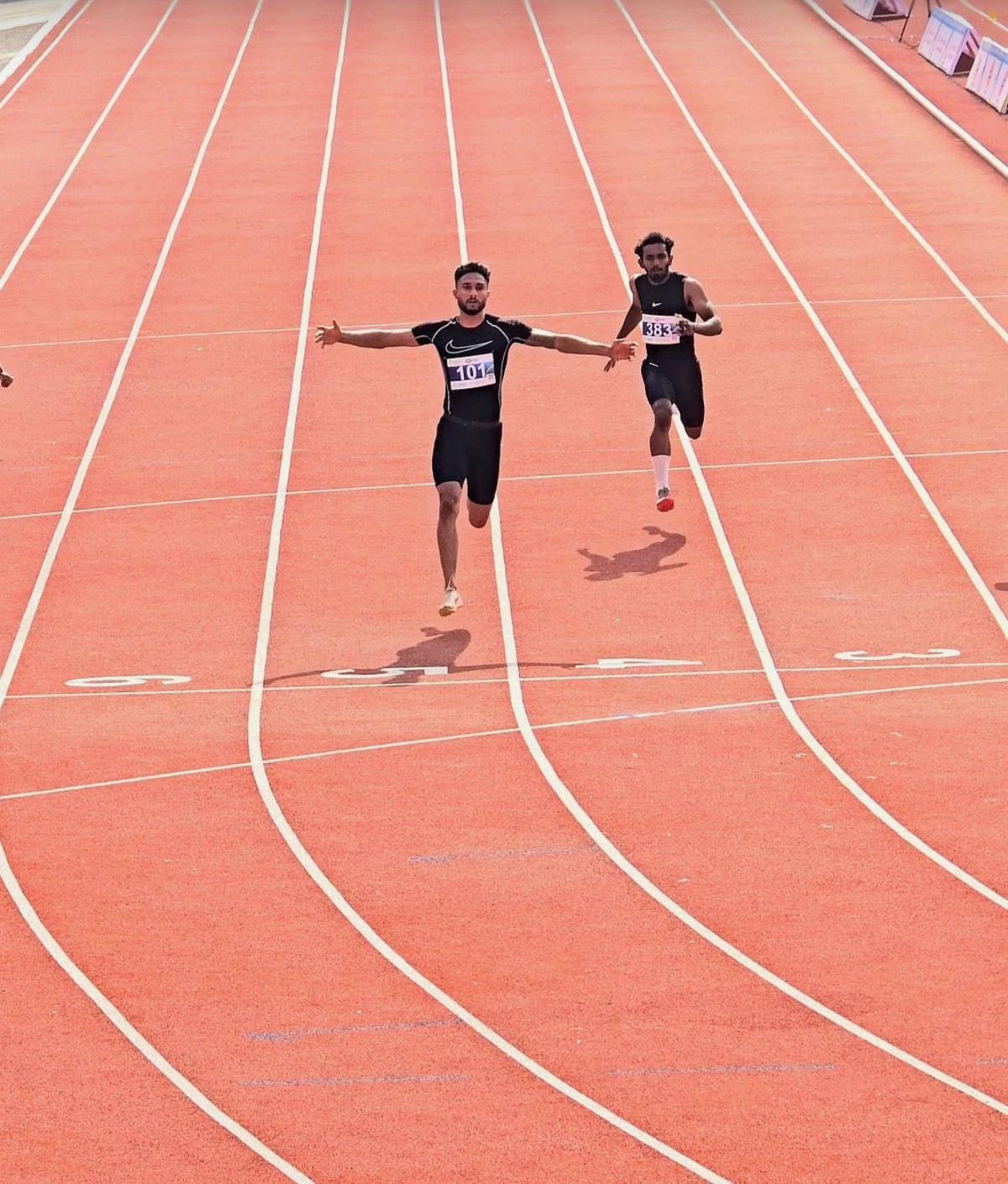
But even Gurindervir’s blistering national record was in danger in Pune a couple of days back. Harjit was clear of the field by the 60m mark and had stretched his arms out for the cameras as he coasted the final 10m. That premature celebration, likely cost a few fractions of a second.
Harjit Singh threatened to break Gurindervir Singh’s 100m national record.
| Photo Credit:
Special Arrangement

Harjit Singh threatened to break Gurindervir Singh’s 100m national record.
| Photo Credit:
Special Arrangement
“When I saw my timing, I was thinking I should probably have pushed all the way to the end. I knew I had run a fast race, but I thought it would be in the 10.20 second range. I didn’t realise I had run inside the 10.10 second range,” he tells Sportstar.
While he might have missed out this time, Harjit is confident he will get another crack at the national mark. He wasn’t anywhere near peak shape at Pune. Just a couple of days before, he had run at the Punjab Open State Championships in Ludhiana where he had clocked what was a then personal best of 10.21 seconds. He hadn’t expected to improve on that personal best so soon.
“My body was feeling a bit tired after that race. When I came to Pune, my coach advised me not to put too much effort and just take the race normally,” he says.
To add to this, the 100m race in Pune had two false starts which saw one of the runners — 2025 Federation Cup winner Pranay Gurav — removed from the line up. “I almost got a foul in the second false start. I was really worried about getting disqualified, so I had a very slow reaction time. I might have been the slowest off the blocks,” Harjit says.
Harjit admits he wasn’t expecting to run as fast as he did in Pune. He’s probably not the only one to be taken by surprise. Sprinting is a young man’s sport and at 28-years-old, Harjit’s isn’t what might be considered at the prime age for finding his peak.
He has always been in the mix at the national level. Harjit’s been competing nationally since 2017 and won his first senior national medal in 2019 and earned gold for India in the 4x100m relay at the SAF Games the same year. However, it’s this season that he has really made people take notice.
He has taken part in three races so far this season and run personal bests in each of them. He started the season with a 10.32 at the Indian Athletics Series 5 in Sangrur in May. That mark improved on a personal best of 10.34 that he had run in 2021. He subsequently improved to 10.21 at the Punjab Open State meet before his latest effort in Pune.
Behind his late spark, Harjit says was the motivation to prove a point. “People look at my age. They see that I had stagnated for three-four years. They see that I don’t have the resources that other sprinters who have big name sponsors have. They think I’m done. But I want to prove that I can still achieve something,” he says.
‘Late start

Harjit Singh started his athletics career relatively late.
| Photo Credit:
Special Arrangement
Harjit Singh started his athletics career relatively late.
| Photo Credit:
Special Arrangement
Harjit points out that while he’s 28, he actually got his start in athletics relatively late. Growing up in the village of Raipur Majri in Punjab’s Fatehgarh Sahib district. He was a kabaddi player for most of his childhood before switching to running when he entered the 12th grade.
He didn’t even start with the sprints. “At first, I was a little scared of the 100m because I saw how fast people were running and how much strain their bodies were under. In my first district level race, I pulled a muscle and that made me think I need to do something else. I actually started doing the long jump. But as I developed the physical strength, my coach pushed me towards sprinting once again. But I only started training the 100m when I was 18,” he says.
He soon grew to enjoy the thrill of speed and It wasn’t hard to figure out that he was naturally quick. “I very quickly became a fan of Usain Bolt and Yohan Blake and all those guys. In one of my first state level competitions, I ran a 10.60 100m. I knew I could be good at this,” he recalls.
At first his progress was rapid. Two years into his sprint career he won silver at the Federation Cup and then bronze at the Open National Championships. He became an international athlete, winning silver in the 4x100m relay at the South Asian Games in Nepal. Two years later, at a time the national record stood at 10.26 seconds, he clocked 10.34 seconds at the Open National championships.
‘Too old’
Harjit felt ready to step up to bigger things. But when he looked for sponsors, he was turned down. “I remember at that time there were only a few organisations that were working with athletes. I remember I reached out to a few of these guys after I ran my 10.34 race. I remember them saying they’d get back to me, but they never did,” he recalls.
Harjit wasn’t told why he was turned down but he reckons he knows why.
“I was already 23 when I first approached them. I’ve approached them once or twice after that also but I never got a good response. I think they must have felt that I didn’t have age on my side,” he says.
Harjit admits the going has been hard. Currently training in Jalandhar with coach Sarabjit Singh Happy, incidentally also the first coach of Gurindervir Singh, Harjit says that hard work and resourcefulness have to do double duty.
“I don’t have a physio or massager or dietitian. If we don’t have a certain exercise equipment, our coach modifies our workout to try and get the same result from what we already have,” he says.
As his colleagues in the Air Force would be told, Harjit says whatever he makes goes right back into his training. “When you include, you include registration, travel and accommodation. every tournament takes out 20000 from my pocket. If I compete just twice a month, I’m spending 40-50000 rupees. This is before I include my nutrition, supplementation and kit. I’m not even making that much in terms of salary! There are some athletes who will be going overseas for training and competition and on the other hand, I have to skip lot of competitions inside India because I can’t afford it,” he says.
He admits it is easy to get frustrated especially when he compares himself with former compatriots who have benefited from better resources. “I’m managing but I know that if I had the right resources at the right time, I would have been running the time I’m running today, 3-4 years back. I don’t think that running a 10.10 second race would have been a big deal for me,” he says.
Harjit says it would have been impossible for him to continue on his path if he didn’t have people who backed him. “I have a friend Narinder Singh who works with Punjab Police. I usually stay with him when I’m in Jalandhar. I’m also lucky that that my father supports me completely. Although I’m 28, he still sends me money so that I can continue. He tells me not to worry about expenses and to focus on my sport and never lose sight of my goal,” he says.
The goal is a sub 10 second 100m.

Harjit Singh’s dream is to have a 9 at the start of his 100m timing.
| Photo Credit:
Special Arrangement
Harjit Singh’s dream is to have a 9 at the start of his 100m timing.
| Photo Credit:
Special Arrangement
“It’s my dream to have a 9 at the start of my 100m timing. I’m not thinking of the rest of the numbers. I just want to be the first Indian to have a personal best that starts with a 9. I’ve had this dream for a long time. Even when I started athletics and go to know about the 100m properly, I used to watch videos of runners like Yohan Blake and Usain Bolt. I’d see all these athletes and I’d think that I should be near that level,” he says.
Harjit’s chase for a sub 10second 100m borders on obsession. This is all the more likely when you consider that with his build – he’s five foot 11 and weighs 72kg – he’s perhaps more suited for the 200m. “I know that I’m tall for the 100m. It takes time for me to reach top acceleration (shorter limbs hit peak frequency faster than longer ones). But I don’t want to be a 200m runner. I only want a sub 10 second 100m,” he says.
There were years in which he felt that dream was slipping away from his grasp. This was especially so between 2022 and 2025 where he was unable to improve on his personal best. At the end of a middling last season, Harjit felt it was time to shape up.
Renewed focus
“I don’t think I was always the most focused athlete. I’d train in Jalandhar, but I’d go back home every few weeks. My results were not going anywhere. I had started to hear people talking about me behind my back, saying I was finished; that I was now past my prime or that I didn’t have a sponsor and that meant I wasn’t good enough. When I heard that, I got a new motivation. I decided I’ll show everyone what I’m capable of. I want people to realise that I was good enough to run a sub 10 second race without training at any big academy,” he says.
The job’s not done yet.
While the sub 10 second 100m remains the ultimate target, Harjit has other objectives for the season. Having been part of the Indian team that failed to qualify for the Asian Games in 2023, he wants to make it to Tokyo this time around. He’ll be running at the Athletics Series 9 in Ludhiana on June 13 and then at the Inter State Athletics Championships in Bhubaneswar where he hopes to meet the Athletics Federation of India’s qualification standard of 10.16.
He’d like to run even faster if he can though.
Having missed out on making a serious attempt at the national record. Harjit wants to give former training partner Gurindervir Singh a real fight when they compete. Both are chasing the same goal, and Gurindervir is currently sponsored by the Reliance Foundation, benefiting from the resources Harjit lacks.
Despite this, the rivalry is a friendly one. “Both of us trained together in Jalandhar. We were on the same relay team at the SAF Games. We always used to hang out together,” says Harjit. He even got a call from the Indian National record holder not long after his run in Pune. “Guri called me and said ‘it’s a good thing that there are two of us Punjabis at the top of the 100m. Earlier it was just me. I felt lonely. Now that you are here with us, it will be even better’. For me the fight isn’t with Guri. It’s to prove myself,” Harjit says.
Published on Jun 10, 2026
[ad_2]
Source link