

[ad_1]
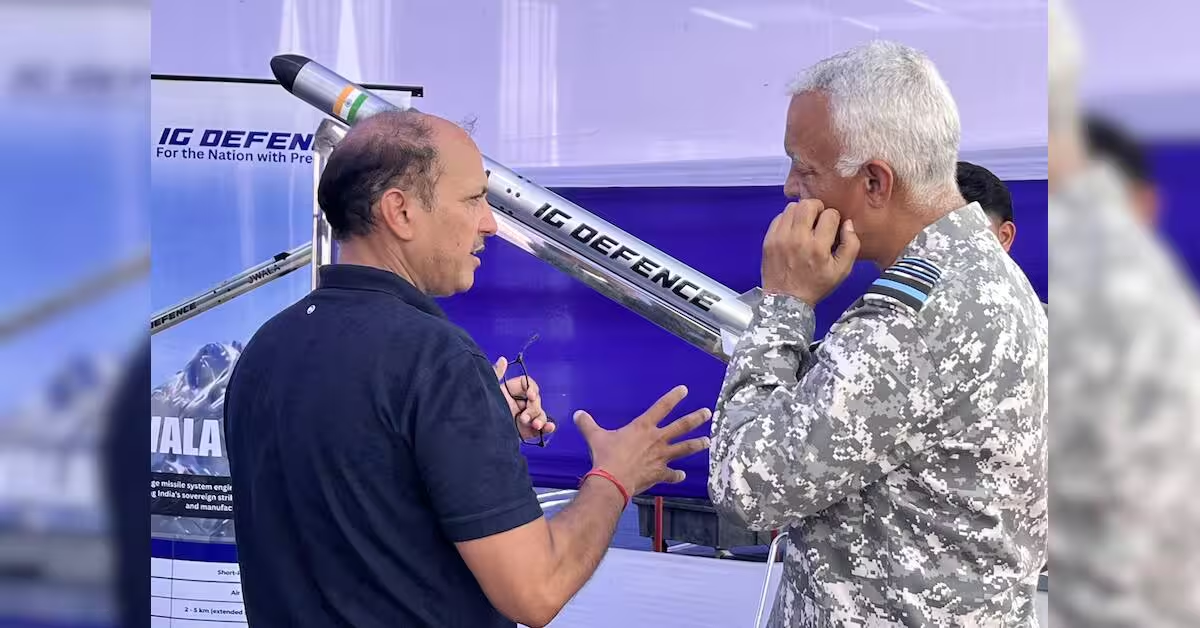
Defence technology company IG Defence is gearing up for the first experimental trial of India’s first indigenous private-sector micro-missile programme, with its JWALA interceptor set to move into system-level testing in the coming months following the successful test-firing of two solid rocket motors.
On Saturday, the company successfully test-fired two solid rocket motors, marking a key milestone in the development of the short-range surface-to-air missile (SAM) JWALA. The system is being developed as a scalable, affordable and robust hard-kill Counter-UAS (C-UAS) capability to neutralise hostile drones.
The company said it has already developed most of the missile’s major components, including seeker/target-acquisition elements, avionics, warhead and other electronics subsystems.
“The successful test-firing of two solid rocket motors is a significant milestone ahead of integrating these components into the complete missile system and preparing it for the first experimental flight trial in the coming months,” the company said on Sunday.
JWALA has been designed as a dedicated, relatively low-cost kinetic interceptor for neutralising hostile drones. It will have a strike range of 2 km to 5 km and an engagement envelope extending from 50 metres to 5,000 metres, covering cruise as well as higher-altitude aerial targets. The company has set a design objective of a circular error probable (CEP) of less than 2 metres at maximum range.
The missile’s propulsion is based on a dual-pulse solid rocket motor with fin control, and the latest successful motor firing provided an important validation milestone for this part of the system.
According to the company, JWALA will carry a 0.5-1.5 kg pre-fragmented high-explosive warhead equipped with a proximity fuze, allowing it to be used as a hard-kill interceptor against drone targets.
The proposed system is also being configured around a truck-mounted multi-canister launcher, intended to provide mobility as well as the ability to carry multiple interceptors for sustained Counter-UAS operations.
“The missile system will have a reaction time of less than seven seconds from target detection to missile launch. This will allow the system to respond rapidly to aerial threats once they are detected and classified. The short reaction time is considered to be significant in counter-drone operations involving low-flying and fast-moving targets,” it said.
The missile is also being developed as part of IG Defence’s wider GRID Defend ecosystem, an AI-enabled battle-management network designed to link sensors, command systems and effectors. GRID will bring target detection, identification, tracking, threat assessment and engagement management into a common operational architecture.
As part of the wider network, JWALA would constitute the hard-kill effector, while GRID would provide the mission-management layer. The system has been designed to process inputs from multiple sensors, develop a common operational picture, identify and track aerial threats, assess the threat situation and coordinate an appropriate authorised response.
“We are not building JWALA as a standalone missile. We are building it as part of an intelligent defence architecture. GRID is designed to bring sensors, AI, command and effectors together so that the system can autonomously execute authorised Counter-UAS missions from detection to engagement. JWALA becomes the hard-kill effect, while GRID provides the brain that coordinates the mission,” said Bodhisattwa Sanghapriya, founder and CEO of IG Defence.
Since the growing use of drones has altered the economics of air defence, small unmanned systems can be produced and deployed at a substantially lower cost than many conventional air-defence interceptors, creating a requirement for defensive systems capable of maintaining sufficient interceptor stocks, or magazine depth, during sustained operations.
IG Defence has already demonstrated another counter-UAS system — T-SHUL BEAM — at the Indian Air Force’s Dronathon 2026 exercise in Pokhran recently. That system uses electronic countermeasures as a soft-kill option and also operates through the GRID architecture.
“The drone threat is evolving rapidly, and Counter-UAS systems must evolve with it. There is a growing need for affordable interceptors that can be produced and deployed in meaningful numbers. JWALA is being developed with exactly this requirement in mind. This successful propulsion test is an important milestone towards building an indigenous hard-kill capability for the evolving drone threat,” said Wing Commander Anoop Sharma (Retd), AVP, IG Defence.
Once proven, the system could provide an additional low-cost hard-kill layer for counter-drone operations, combining a compact interceptor, mobile multi-canister launcher and AI-enabled battle-management architecture.
[ad_2]
Source link