


[ad_1]
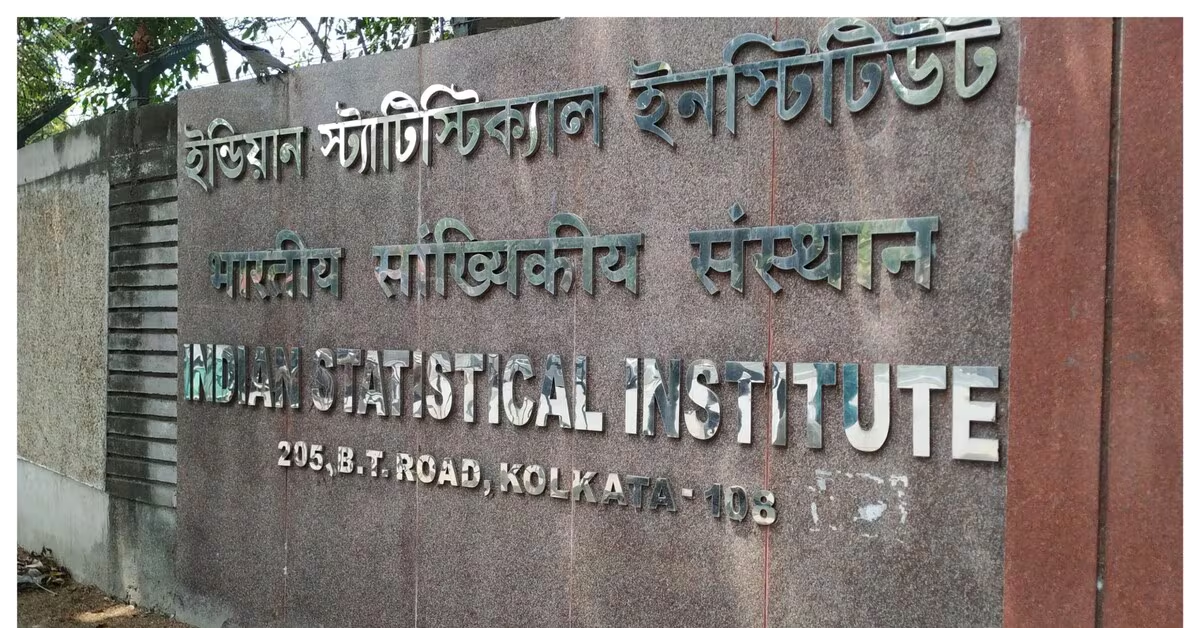
The Indian Statistical Institute (ISI) Bill, 2026, introduced in the Lok Sabha on August 3, has reignited a debate over the autonomy of one of India’s premier research institutions.
The legislation comes nearly a year after its draft version was released for public consultation. Following its introduction in Parliament, senior ISI faculty members and Opposition leaders have urged lawmakers to reject the Bill or refer it to a Parliamentary Standing Committee, arguing that it was drafted without adequate consultation with the institute and the wider academic community.
What is the Indian Statistical Institute?
The Indian Statistical Institute (ISI), headquartered in Kolkata, was founded in 1931 by eminent statistician PC Mahalanobis. It has centres in Delhi, Bengaluru, Chennai and Tezpur, and offers undergraduate, postgraduate and doctoral programmes in statistics, mathematics and allied disciplines, while also carrying out research across multiple fields.
Parliament declared ISI an Institution of National Importance in 1959, enabling it to award degrees and receive central funding. However, the institute continued to function as a registered society under its existing governance framework.
At present, ISI is governed by a 33-member Council comprising an elected chairman, government representatives, scientists and institute members. Representatives from the Ministry of Statistics and Programme Implementation (MoSPI), the Ministry of Finance and the Reserve Bank of India (RBI) are part of the Council, which also appoints the Director, the institute’s chief academic and administrative officer.
What changes does the Bill propose?
The Bill, which seeks to replace the ISI Act, 1959, proposes converting ISI from a registered society into a statutory body corporate established through an Act of Parliament. It also proposes replacing the existing 33-member governing body, the ISI Council, with an 11-member Board of Governance.
According to MoSPI, the current Council has become too large, with excessive internal representation and too many elected members, making decision-making cumbersome. The ministry says the proposed changes will modernise ISI’s governance and improve administrative efficiency.
Instead of the existing Council, the institute would be governed by a Board of Governance. Under the proposed framework, the President of India will serve as the Visitor of the institute, while the Board will comprise a chairperson nominated by the Visitor on the recommendation of the Central government, government representatives, eminent persons nominated by the Centre, the Director, and other institute representatives.
The Board will be empowered to take administrative decisions, appoint faculty and staff, frame regulations, make rules, and confer degrees. The Bill also proposes an Academic Council, headed by the Director and comprising heads of divisions and centres, to advise the Board on academic matters.
The Director will be appointed by the Board chairperson from a panel prepared by a search-cum-selection committee constituted by the Union government. The Visitor will also be empowered to remove the Director and order inquiries or reviews into the institute’s functioning.
Besides governance reforms, the Bill broadens the scope of statistical sciences to include data science, computer science, cryptology, biostatistics and other allied disciplines, enabling ISI to award degrees in emerging fields such as cryptology.
Why are faculty members opposing the Bill?
The strongest criticism of the Bill relates to institutional autonomy. Addressing a press conference on Wednesday, senior ISI faculty members said the proposed legislation replaces the institute’s existing society-based governance framework with a centrally controlled Board of Governance, reducing the role of elected faculty, staff representatives and the existing ISI Council. They argued that the changes would weaken institutional autonomy and internal accountability.
They contend that, unlike the present Council, which has broader representation from the scientific community and elected members, the proposed Board would largely comprise government nominees and individuals appointed by the Centre.
Another major concern relates to the appointment of the Director. Under the proposed law, the Director would be selected from a panel recommended by a committee constituted by the Centre, while the Visitor would also have the power to remove the Director. Faculty members argue that these provisions would make the Director more accountable to the government than to the institute.
They have also objected to the reduced role of the Academic Council, arguing that important academic decisions, including those relating to courses, fees and academic policies, would effectively rest with the Board of Governance rather than the academic community.
Unlike the current system, where several external members are nominated by independent institutions such as the Indian National Science Academy (INSA), the University Grants Commission (UGC) and the Indian Council of Social Science Research (ICSSR), the Bill allows the Board chairperson to nominate them, which faculty members say centralises authority.
Faculty members have also rejected MoSPI’s contention that ISI failed to implement recommendations made by the Fourth ISI Review Committee headed by RA Mashelkar, saying that most of the recommendations had already been implemented, while the remaining ones had been adequately justified.
Apart from the governance changes, faculty members and researchers say the legislation was drafted without institutional consultation.
How has the government defended the legislation?
The Centre has rejected allegations that the Bill seeks to undermine ISI’s autonomy.
According to a Business Standard report, a senior government official said the legislation was intended to strengthen, not weaken, the Indian Statistical Institute. The official argued that the Bill gives greater autonomy to the Board of Governance and ISI’s centres, while ending the influence of the institute’s roughly 1,800-member society, where, by the government’s account, only 150 to 200 members typically participate in decisions on the institute’s direction. The official also maintained that the legislation does not erode ISI’s autonomy.
Defending the provision allowing the Board of Governance to overrule the Academic Council where necessary, the official said such checks were reasonable. The official also dismissed concerns that the institute’s headquarters could be shifted out of Kolkata. He said the Bill explicitly provides for Kolkata as ISI’s headquarters and protects its status through a saving clause. Responding to criticism that the Bill was drafted without adequate consultation, the official said the government had engaged with stakeholders for over a year.
MoSPI has also said that more than half of the roughly 600 comments received on the draft Bill came from ISI faculty members and that several suggestions were incorporated. Faculty members, however, argue that written submissions cannot substitute for formal consultations with the institute’s governing bodies and stakeholders before introducing such far-reaching reforms.
[ad_2]
Source link