

[ad_1]
Some lines outlive the moment that created them. After the attack on the American naval base at Pearl Harbor, President Franklin D. Roosevelt came to embody a refusal to accept impossibility, a sentiment often distilled into a simple idea: Do not tell me it cannot be done.
Sport is not war, but in Atlanta, Argentina found its own, far smaller version of that defiance.
Egypt had given Lionel Messi and his teammates every reason to accept the night as one of those brutal endings sport reserves even for its greatest figures. The defending champion was two goals down, the clock was racing on cruelly, and Messi’s evening had already carried the kind of images that can harden into memory. A missed penalty. A free-kick against the post. A team in blue and white looking not beaten in one moment, but slowly drained across many.
Then Argentina did what it has so often done in the Messi years. It stopped treating time as a limit and began treating it as a dare.
The 3-2 win over Egypt in the round of 16 was not a clean performance. It was not the champion moving smoothly through the gears. It was frantic, flawed and at times desperate. But that was also what made it feel so true to this Argentina. There are teams that win because they impose order. Argentina, on nights like these, wins because it finds emotion at the edge of disorder.
The comeback began with Cristian Romero, which felt right. Cuti has never worn the national shirt lightly. Even when rhythm at club level has not always been kind, Argentina has often drawn something more primal from him. He plays for the Albiceleste as though defending is not a job but a declaration. When his goal arrived, it did more than reduce the deficit. It changed the air inside the stadium.
Egypt, until then, had been brave, sharp and close to a famous night of its own. It had made Argentina chase shadows and then chase the game. It had carried the threat of Mohamed Salah, the energy of men sensing history, and the stubbornness of a side unwilling to be dazzled by reputation. For long stretches, Egypt did not look like a team waiting for Argentina to fall. It looked like one pushing it there.
But Romero’s intervention gave Argentina the chance to believe again.
Belief, in this team, almost always travels through Messi.
RELATED | Argentina stitches together another escape, beats Egypt 3-2 to reach last-eight
The second goal belonged to the part of him that has never needed explanation. The ball was high, awkward and unkind, dropping from a height that would have had most players control first and think later. Messi did neither. Instinct took over. The left foot, that old instrument of punishment, met the ball as if it had been waiting for that exact inconvenience.
For more than two decades, that foot has tormented defenders, turned goalkeepers into spectators and bent logic. In Atlanta, it did not miss the moment. The strike climbed fiercely and crashed into the roof of the net. Under the closed roof, the sound seemed to multiply. The stadium did not merely celebrate; it erupted with the shock of a crowd that had just watched the tide change.
Messi’s face told its own story. This was not the grin of a man adding another goal to a long collection. It was release. Redemption, perhaps. A reminder that even at 39, after everything, he could still drag a match out of the hands of those who thought they had taken it from him.
Yet Argentina’s night was not saved by Messi alone, and that is the point of this team.
For years, the country waited for a generation that would not merely play with Messi, but play for him without becoming smaller in his presence. That generation now surrounds him. It tackles for him, runs for him, fights for him, and when needed, writes its own lines into his story.
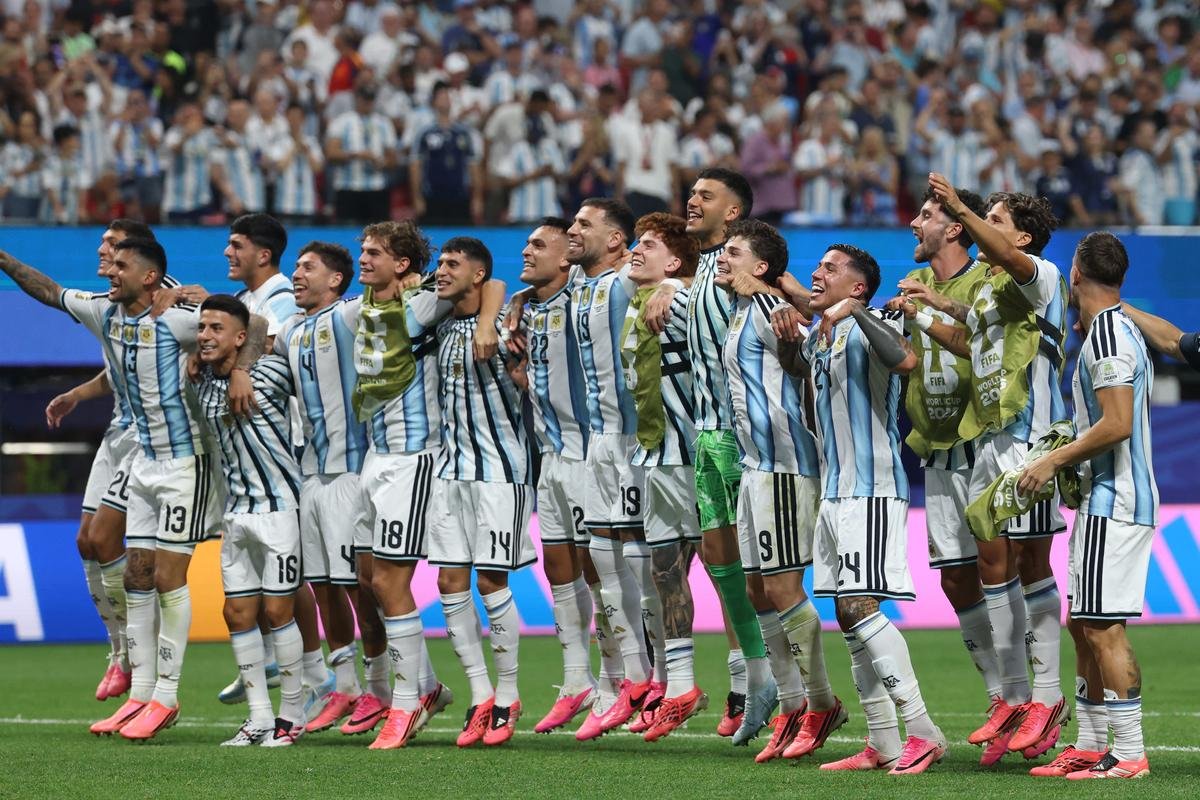
Generation next: Argentina’s players celebrate together, a team no longer content with merely playing alongside Lionel Messi, but one determined to protect and extend his World Cup story.
| Photo Credit:
AFP

Generation next: Argentina’s players celebrate together, a team no longer content with merely playing alongside Lionel Messi, but one determined to protect and extend his World Cup story.
| Photo Credit:
AFP
Lautaro Martinez came on and gave Argentina the reference it had been missing up front. Fresh from another demanding season with Inter Milan, he brought the kind of movement that unsettles tired defenders and the presence that forces a back line to think about more than Messi. His value was not only in touches, but in occupation. He pulled Egypt into uncomfortable places and helped turn Argentina’s late pressure from hope into threat.
Leandro Paredes had his moment too, the sort that rarely survives in the headline version of a comeback. Near the 90-minute mark, with Egypt breaking and Emiliano Martinez exposed behind him, Paredes stood as Argentina’s last outfield barrier. He held his ground, stretched at the right instant and cleared the danger.
Then came Enzo Fernandez.
There was poetry in that. As a teenager, Enzo had once written to Messi when his idol stepped away from the national team, asking him to return. He was not a teammate then, not a World Cup winner, not a midfielder carrying the expectations of a country. He was a boy watching the player he loved walk towards the exit and begging him not to go.

Final word: Enzo Fernandez scoring the winner against Egypt.
| Photo Credit:
AP
Final word: Enzo Fernandez scoring the winner against Egypt.
| Photo Credit:
AP
On Tuesday, Enzo wrote another love letter.
This one came at the back post, in stoppage time, with Argentina’s tournament still trembling. His header carried more than technique. It carried the devotion of a generation that grew up with Messi, won with him, and now seems determined to keep him on this stage for as long as it can.
That is why the celebrations mattered. Argentina plays for the shirt; no one can doubt that. It is there in Romero’s roar, in Lisandro’s tackle, in Lautaro’s running, in the substitutes sprinting on as if the match belonged to every man in the squad. But it also plays for Messi. Not in a way that weakens the team, but in a way that binds it.
When his teammates threw him into the air, it was not just a celebration of victory. It was an act of protection. They had ensured that Messi would walk out of Atlanta Stadium with his head held high, not as the great man whose missed penalty marked the end, but as the captain whose left foot had once again clawed the impossible into reach.
Egypt deserved tenderness in defeat. It had come close enough to a famous result for the loss to feel almost unfair. It had made the world champion suffer, made Messi miss, made Argentina confront its own vulnerability. For much of the night, it was the better story.
But Argentina still had the final laugh.
That is what champions do, sometimes. Not always with control. Not always with beauty. Sometimes they survive because one leader refuses the obvious, and because the men around him decide that refusal is enough to follow.
Do not tell Messi it cannot be done.
Do not tell Argentina either.
Published on Jul 08, 2026
[ad_2]
Source link