

[ad_1]
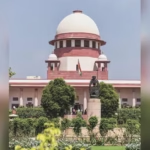
The Supreme Court on Tuesday indicated that it may constitute a Special Investigation Team (SIT) to conduct a fair, transparent and evidence-based probe into allegations of police excesses and violence during recent protests over irregularities in the National Eligibility-cum-Entrance Test (Neet).
Hearing a batch of petitions, a Bench headed by Chief Justice of India (CJI) Surya Kant said a prima facie case had been made out for an independent investigation into the incidents. The Bench, also comprising Justices Joymalya Bagchi and V Mohan, observed that the inquiry should cover allegations of police action against students as well as attacks on police personnel.
“We will have a thorough scientific probe based on evidentiary value,” the CJI said, adding that the composition of the proposed SIT would be decided later.
The court said an investigation was also required to ascertain whether the injuries suffered by around 250 police personnel were caused by student protesters or by “miscreants”.
“Whosoever committed excesses, took law into their hands should be taken to task,” the Bench observed, adding that once there was a violation of the “defined protocol”, the law must take its course.
The CJI also remarked that the time had come to collate the judicial principles evolved over the years to deal with allegations of police excesses.
Senior advocate Vrinda Grover, appearing for some petitioners, referred to pellet injuries sustained by some protesters and urged the court to issue appropriate directions.
Appearing for the Centre, Solicitor General Tushar Mehta submitted that students would ordinarily not indulge in violence against police personnel and alleged that “miscreants” had infiltrated the protests. He said individuals facing charges in cases involving murder, rape and offences under the Narcotic Drugs and Psychotropic Substances (NDPS) Act had entered the demonstrations and attacked police personnel.
Mehta told the court that the government was prepared to act in whatever manner the court considered appropriate.
As an interim measure, the Supreme Court directed authorities to preserve all CCTV footage, drone recordings, body camera footage and wireless communication related to the protests. It also ordered police authorities to preserve the digital data of protesters and restrained the authorities from placing any personal data of students in the public domain until further orders.
The court further directed that no coercive action be taken against students who participated in the protests. It also ordered all states to release those below 18 years of age who were arrested during the protests, provided they had no criminal antecedents.
[ad_2]
Source link