

[ad_1]
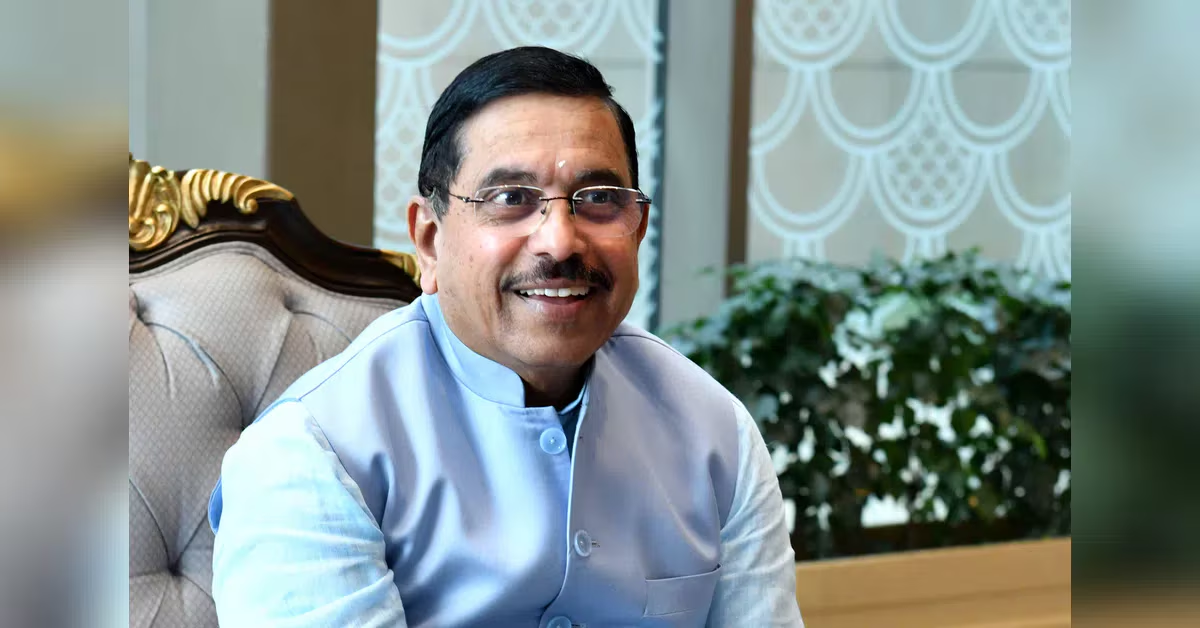
For Pralhad Joshi, Union minister and Lok Sabha member from Karnataka’s Dharwad, who was appointed education minister on Saturday following the exit of cabinet colleague Dharmendra Pradhan, the challenge is clear: rebuild trust in India’s education system while tackling long-standing structural issues including the poor employability of college graduates.
A long-time BJP organisation man, Joshi began his political career through RSS-linked activism and organisational work in the party’s local unit in Dharwad. He has been representing Dharwad in Lok Sabha for five consecutive terms since 2004.
He served as Karnataka BJP president from 2013 to 2016 and held several Union portfolios, including Parliamentary Affairs and Coal and Mines between 2019 and 2024. He continues to handle the portfolios of Consumer Affairs, Food and Public Distribution and New and Renewable Energy, which were assigned to him in 2024.
Joshi is widely seen as an RSS loyalist and is considered to enjoy the confidence of Prime Minister Narendra Modi.
As part of his renewable energy portfolio, Joshi’s performance is crucial for its contribution to two larger national ambitions, achieving the 500 Gigawatt target of non-fossil fuel-based power capacity by 2030 and the Net Zero target of 2070, essential for sustainable economic development and energy security.
Joshi’s tenure as renewable energy minister is widely praised for the exponential growth achieved in renewable energy capacity addition, with more than half of the country’s electricity power coming from non-fossil sources in June 2025, five years ahead of the 2030 target set under the Paris Agreement.
However, the past few months have also witnessed the domestic industry raising concerns over the lack of matching growth in transmission capacity that often leads to grid curtailments.
Fixing the education sector
Joshi’s appointment to the education ministry comes at a challenging juncture, with his predecessor Dharmendra Pradhan resigning from the portfolio after several weeks of student protests over alleged examination paper leaks across the country.
The protests, which raised questions about the functioning of the National Testing Agency (NTA), examination security and accountability in the testing system, have placed the ministry under heightened scrutiny.
Restoring confidence in competitive examinations, strengthening oversight mechanisms and addressing concerns around testing agencies are likely to be among Joshi’s immediate challenges.
Education experts said Joshi’s challenge extends beyond the immediate crisis in examinations, with the sector facing structural issues across school and higher education.
Syed Sultan Ahmed, Chairperson of The Association of International Schools of India (TAISI), said school and higher education often get clubbed together despite having different challenges and requiring separate approaches.
“The challenge is structural in nature where some states do well while some do not; so working smoothly with states going forward will be important,” Ahmed said, emphasising the need to preserve the federal character of education.
“The more you centralise, the more problems will prop up due to high variation among our states. We cannot set central benchmarks for states with wide variations. When we do, we put up a lot of states to fail, making them incompetent by comparing with national averages,”
He said implementing the National Education Policy (NEP) remained a key challenge, with public spending on education still below the policy’s recommended target of 6 per cent of GDP. At around 3.5-4 per cent of GDP currently, around 80 per cent of the spending is absorbed by teacher salaries, leaving limited resources for infrastructure development and upgradation, he added.
Ahmed also called for a rethink of India’s examination system, arguing that a student’s future should not be determined by a single three-hour test. “Most countries are moving away from marks to portfolio evaluation,” he said, adding that Class XII board examinations had lost relevance.
He also flagged the influence of coaching centres on competitive examinations such as NEET and JEE, calling for a law against such institutions.
“We need to stop coaching classes and bring a law against it. If we do that, the coaching centres industry will fall like a pack of cards,” he added.
In higher education, Ahmed said high costs and high cut-offs in quality public institutions were pushing many students towards expensive private universities.
Bornali Bhandari, Professor at the National Council of Applied Economic Research (NCAER), said the focus of reforms should extend beyond enrolment numbers to actual learning outcomes.
Flagging India’s high secondary education drop-out rate, she called for ensuring that students complete at least Class X and for greater attention to educational attainment rather than only gross enrolment ratios.
Bhandari said reforms were needed across five areas — books, teachers, examinations, curriculum and pedagogy — with greater emphasis on improving teaching methods. She also advocated introducing pre-vocational exposure in Classes IX and X, followed by vocational training in Classes XI and XII, alongside regular education.
“We can integrate AI and tech into education but that is just a means and not an end. Ultimately, we need to control what happens in a classroom and we need to let teachers innovate their teaching style to suit the needs of Gen Z and beyond,” she said.
She also pointed to the growing gap between education and workplace requirements, with employers reporting skill gaps among fresh graduates.
“There is a basic disconnect between what firms want and what the education system is giving,” Bhandari said, adding that students need a combination of socio-emotional, cognitive and technical skills to improve employability. (ends)
[ad_2]
Source link