
[ad_1]
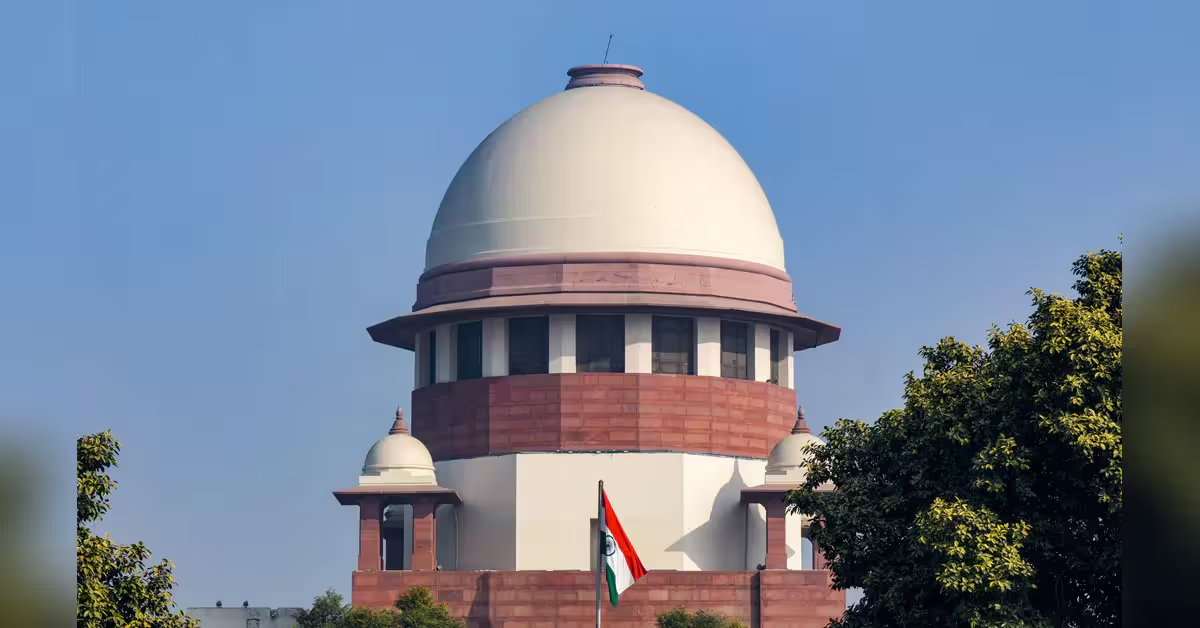
The Supreme Court on Friday put on hold a Punjab and Haryana High Court ruling that had declared Section 147A of the Income-tax Act, 1961, unconstitutional, in a dispute concerning the authority empowered to issue notices for reopening tax assessments.
A Bench of Justices J B Pardiwala and K Vinod Chandran passed the interim order while hearing the Centre’s challenge to the High Court judgment in Union of India and Others v Bharat Industrial Enterprises Private Limited.
The Bench directed that the High Court judgment would remain stayed. It also ordered that assessment and reassessment proceedings covered by the dispute should not be taken forward until the Supreme Court decides the matter finally.
The underlying dispute concerns the manner in which notices under Section 148 of the Income-tax Act can be issued. In particular, the question is whether such notices can be issued by the taxpayer’s jurisdictional assessing officer (JAO) or have to be issued through the faceless assessment mechanism.
The controversy stems from Section 151A of the Act and the e-Assessment of Income Escaping Assessment Scheme notified on March 29, 2022. The scheme envisaged the use of automated allocation and a faceless mechanism for issuing notices seeking to reopen assessments.
A number of taxpayers subsequently questioned reassessment notices issued directly by their respective jurisdictional assessing officers.
Against this backdrop, Parliament introduced Section 147A through the Finance Act, 2026, with retrospective effect from April 1, 2021. The provision contained an overriding clause and specified that, for reassessment proceedings covered by it, the assessing officer would mean an officer other than the National Faceless Assessment Centre (NFAC) or its assessment units.
The Punjab and Haryana High Court, on September 10, however, invalidated Section 147A. It held that Parliament could alter the legal position arising from a judicial ruling only by addressing the legal basis underlying that decision, and not merely by declaring through legislation that the judicial position would not apply.
The High Court also held that Section 151A and the 2022 scheme continued to mandate automated allocation and faceless issuance of reassessment notices. In its view, the subsequent insertion of Section 147A, despite its overriding language, did not remove the legal basis of the earlier judicial interpretation or resolve the inconsistency.
The Centre subsequently approached the Supreme Court against the judgment.
The apex court has now stayed the High Court ruling and fixed the matter for final hearing on December 3.
[ad_2]
Source link